

Commentary
Despite a new textbook, an influx of Russian teachers and managers, and an end to the teaching of Ukrainian, the Kremlin is unlikely to have “reprogrammed” locals.
Konstantin Skorkin
{
  "authors": [
    "Sharanya Rajiv",
    "R. Shashank Reddy"
  ],
  "type": "legacyinthemedia",
  "centerAffiliationAll": "dc",
  "centers": [
    "Carnegie Endowment for International Peace",
    "Carnegie India"
  ],
  "collections": [],
  "englishNewsletterAll": "ctw",
  "nonEnglishNewsletterAll": "",
  "primaryCenter": "Carnegie India",
  "programAffiliation": "SAP",
  "programs": [
    "South Asia"
  ],
  "projects": [],
  "regions": [
    "South Asia",
    "India",
    "Russia"
  ],
  "topics": [
    "Foreign Policy"
  ]
}
Source: Getty
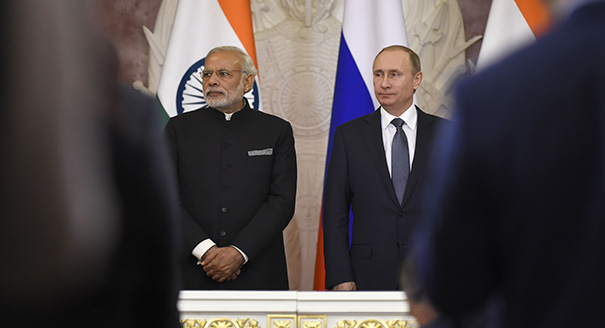
The Indo-Russian relationship is one of the few long-standing successes of Indian diplomacy. Both nations must pay greater attention to emerging technologies that can push the relationship forward.
Source: Live Mint
Despite a deep political and diplomatic partnership for decades, the Indo-Russian relationship is beginning to show early signs of rigor mortis. Ties between the two countries are overwhelmingly dependent on the sale and, in recent years, joint production of weapons systems. The only other area of cooperation that has reflected the “special and privileged” nature of the relationship is nuclear energy. Beyond this, the trade and investment relationship is virtually non-existent. Even in natural gas and oil, where flourishing trade should have existed given Russia’s abundant supply and India’s growing demand, very little exists beyond a few notable Indian investments in Russian oil and gas companies and fields. The deals signed last year, if they come to fruition, could however boost mutual investments in this sector.
One way to shake up this fast atrophying relationship is for India and Russia to direct their attention towards collaboration in new and emerging technologies. Both India and Russia have made significant advancements in sunrise sectors, and offer unique advantages for each other. There are four broad areas where the two countries can join forces.
First is the field of quantum computing. Quantum computing, which uses subatomic particles for computing instead of standard binary bits, is poised to be the next great technological leap. The possibilities of this technology for everything from space travel to medical research are staggering, and have created an inevitable race to develop the first industrial quantum computer, in which China seems to have stolen a march on the rest of the world.
If India desires to be a leading technological power, it is imperative that it invest in necessary research and development. While some recent breakthroughs by Indian physicists have shown that indigenous expertise does exist, a credible support structure is lacking. Russia has been making a concerted effort to pioneer quantum computing, primarily through the Russian Quantum Centre. Significant collaboration in this sector will allow India access to the cutting-edge infrastructure necessary to indigenously develop this technology while providing Russia with ready market access for any quantum technologies it may develop in the future.
Second, Artificial Intelligence (AI) and robotics present a unique opportunity for joint action. While AI is the buzzword of our times, Indian investments, whether public or private, in this sector have been negligible. Despite a large talent pool, neither the Indian state nor the private sector has made a concerted effort to take advantage of this sector’s possibilities. Russia, on the other hand, has made great strides in the militarization of AI and robotics and in allied fields like drone warfare, which could be immensely beneficial for India. While high-tech defence collaboration between India and Russia has focused thus far on conventional weapons like fighter planes and missiles, a greater emphasis on AI and robotics will help extend the military relationship into the future.
The third avenue wherein both nations can work together is cybersecurity. While this may be a controversial suggestion in the light of recent events, from a purely strategic point of view, India has much to learn from the Russian experience. The two countries have recently signed an agreement which establishes a high-level dialogue on cyber issues and provides for cooperation, coordination and exchange of information on counter-terrorism. However, a case can still be made to widen the scope of this engagement to include the training of Indian cyber response teams and officials. Russia, home to leading cybersecurity companies like Kaspersky, has also built considerable state capabilities towards establishing an effective and robust cyber force. With India currently establishing a unified cyber agency, closer collaboration with Russia would immensely benefit Indian cyber preparedness.
The final arena of partnership is traditional information technology (IT) and software, including and especially Big Data. With the US, UK, Singapore and Australia now closing their doors to Indian IT workers, it becomes imperative for India to find alternative avenues that can absorb its technology workforce. Russia’s highly developed IT infrastructure is facing an increasing shortage of skilled labour. Indian IT talent is well placed to take advantage of this shortfall. Russia could also be an outlet for Indian IT investment, given that its location provides ready access to the untapped markets of Central Asia and Eastern Europe.
Each of the four areas listed above require only the most basic government intervention. If a credible bilateral trade framework for these sectors can be put in place, there is enough momentum for market forces to drive collaboration. Indeed, greater emphasis must be placed on private sector initiatives, as previous government-led initiatives have not amounted to much.
The Indo-Russian relationship is one of the few long-standing successes of Indian diplomacy. Given the increasingly volatile nature of global politics, it becomes imperative that this relationship does not become moribund. With limited economic interdependency and recent efforts to work jointly in areas that have traditionally formed the bedrock of bilateral relations, both nations must pay greater attention to those emerging technologies that have the potential to push the relationship firmly into the future.
Sharanya Rajiv
R. Shashank Reddy
Former Research Analyst
R. Shashank Reddy was a research analyst at Carnegie India. His research focuses on the implications of emerging technologies and their governance for international and Indian security.
Carnegie does not take institutional positions on public policy issues; the views represented herein are those of the author(s) and do not necessarily reflect the views of Carnegie, its staff, or its trustees.

Despite a new textbook, an influx of Russian teachers and managers, and an end to the teaching of Ukrainian, the Kremlin is unlikely to have “reprogrammed” locals.

Konstantin Skorkin

For every ruble allocated to social policy, health, and education in 2027, double that amount is earmarked for the army, the police, and the security services.

Alexandra Prokopenko

Cargo traffic through Russia’s Northern Sea Route has increased because of the disruption caused by the conflict in the Middle East, the Ukraine war, and U.S.-China tensions.

Mikhail Korostikov
An analysis of traffic accident data suggests that Ukrainian drone attacks caused a material but not disastrous fall in Russian gasoline consumption over the summer.

Sergey Vakulenko

Sergei Kiriyenko used Russia’s parliamentary vote to further hone his strategy of corporate mobilization that is designed to maximize votes for United Russia.

Andrey Pertsev