

Paper
James M. Acton, Ankit Panda
{
  "authors": [
    "James M. Acton"
  ],
  "type": "other",
  "centerAffiliationAll": "dc",
  "centers": [
    "Carnegie Endowment for International Peace",
    "Carnegie China"
  ],
  "collections": [
    "Korean Peninsula"
  ],
  "englishNewsletterAll": "ctw",
  "nonEnglishNewsletterAll": "",
  "primaryCenter": "Carnegie Endowment for International Peace",
  "programAffiliation": "NPP",
  "programs": [
    "Nuclear Policy"
  ],
  "projects": [],
  "regions": [
    "East Asia",
    "North Korea",
    "North America",
    "United States",
    "South Korea",
    "China",
    "Japan"
  ],
  "topics": [
    "Nuclear Policy",
    "Arms Control"
  ]
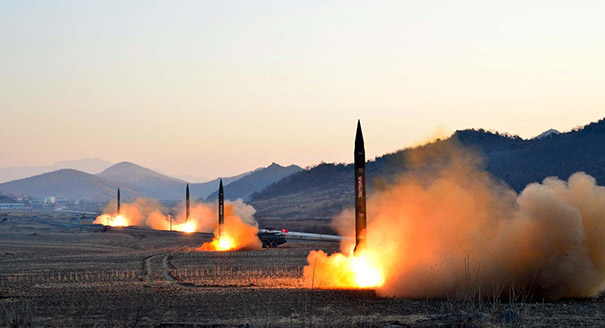
}
Source: Getty
The North Korean nuclear crisis is far from over, and foreclosing escalation pathways is in the best interests of the United States, its allies, and Pyongyang.
Source: Foreign Policy
The time for denial is over. North Korea has — or will very shortly have — the capability to launch a nuclear weapon against the United States. In the coming decades, historians can assign blame. For now, it is the task of policymakers to ensure that historians will still be around in the future to dissect this failure.
While denuclearization should remain the international community’s formal goal, it is no longer a practical policy. A freeze on missile and nuclear testing, which I advocated only seven months ago, has lost value as North Korea’s capabilities have rapidly advanced. Analysts can happily theorize about a disarming preventative strike, but the risks — to both the United States and its allies — are so serious that no sane politician would authorize one. Instead, Washington should try to establish some basic rules of the road with a newly nuclear Pyongyang.
This article was originally published in Foreign Policy

Jessica T. Mathews Chair, Co-director, Nuclear Policy Program
Acton holds the Jessica T. Mathews Chair and is co-director of the Nuclear Policy Program at the Carnegie Endowment for International Peace.
Recent Work

James M. Acton, Ankit Panda
James M. Acton
Carnegie does not take institutional positions on public policy issues; the views represented herein are those of the author(s) and do not necessarily reflect the views of Carnegie, its staff, or its trustees.

Trump has promised Belarus a massive potash deal. But Minsk is seeking something greater: restored Western transit and greater room for maneuver from Russia.

Balázs Jarábik

Minsk clearly expected the dialogue with Washington to yield more results, in particular the lifting of EU sanctions and permission to export potash.

Artyom Shraibman

With the growth in points of friction between the great powers, organizations like the SCO will continue to play a role in the strategic adaptation of the smaller powers caught between them.

Temur Umarov

Ongoing uncertainty in the Middle East allows Moscow to both increase its influence in Tehran and continue to enjoy the financial windfall of higher oil prices.

Nikita Smagin
With no key agreement signed on the Power of Siberia 2 gas pipeline, there is a risk that the window of opportunity for Russia will close if Chinese power generation becomes so green that new gas sources are no longer of any interest to Beijing.

Alexander Gabuev