

Commentary
The truth of the strategic situation is that Europe and Russia are extremely unlikely to be able to “turn the page” on their confrontation within the next two decades.
Arkady Moshes
{
  "authors": [
    "Moisés Naím",
    "Andrew S. Weiss"
  ],
  "type": "legacyinthemedia",
  "centerAffiliationAll": "dc",
  "centers": [
    "Carnegie Endowment for International Peace",
    "Carnegie China"
  ],
  "collections": [],
  "englishNewsletterAll": "ctw",
  "nonEnglishNewsletterAll": "",
  "primaryCenter": "Carnegie Endowment for International Peace",
  "programAffiliation": "russia",
  "programs": [
    "Russia and Eurasia"
  ],
  "projects": [
    "The Return of Global Russia: A Reassessment of the Kremlin’s International Agenda"
  ],
  "regions": [
    "North America",
    "South America",
    "Russia"
  ],
  "topics": [
    "Democracy",
    "Foreign Policy"
  ]
}
Source: Getty
For all its bellicose talk and new sanctions against Nicolás Maduro’s government, the Trump administration has been oddly silent about Russia’s role, perhaps preferring not to draw attention to the fact that Moscow is now the bankrupt nation’s lender of last resort.
Source: Washington Post
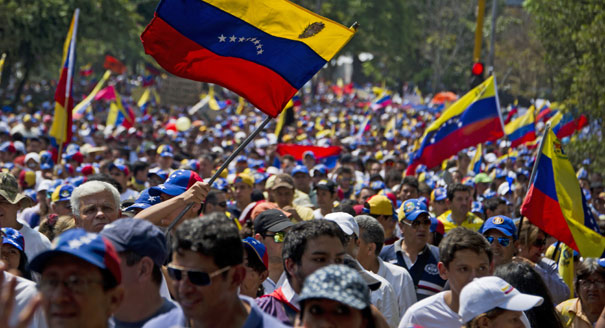
A violent crackdown on civilian protesters rallying against an autocratic president leaves scores dead. The repression pushes even more people into the streets, triggering a spiral of violence and an urgent humanitarian crisis. A U.S. president unequivocally states that the brutal dictator needs to go. The European Union agrees, but no major power has any stomach for direct military intervention. Suddenly, almost out of nowhere, Vladimir Putin decisively inserts Russia into the crisis, ensuring that the repressive dictator stays in power. The U.S. president is ridiculed for his fecklessness.
Unfortunately for President Trump, the above scenario is playing out again, this time not in Syria but in Venezuela.
For all its bellicose talk and new sanctions against Nicolás Maduro’s government, the Trump administration has been oddly silent about Russia’s role, perhaps preferring not to draw attention to the fact that Moscow is now the bankrupt nation’s lender of last resort.
On the surface it may seem odd that that Russia would intervene in a country so far from its borders that appears to be hurtling toward collapse? Yet friendly ties between the Russian government and Venezuela run deep, stretching back to former leader Hugo Chávez’s first trip to Moscow in May 2001. He returned 10 times before his death from cancer in 2013. Over that period Venezuela became one of the world’s top clients of the Russian arms industry. Between 2001 and 2011 it purchased $11 billion worth of Russian weapons.
As its economic situation worsened, the volume of Venezuela’s arms purchases dwindled and its main relationship with Russia shifted from weapons to energy. At first, most of the deals were loans guaranteed by Venezuela’s oil sales. Soon, these largely commercial deals became more complex as the Russians demanded more real assets as guarantees. Caracas obliged, and the Russian companies that were the vehicles for these deals got shares of oil companies and even the right to operate entire Venezuelan oil fields.
While the essence of the relationship between Russia and Venezuela has largely been economic, international and domestic politics are never far away. The Venezuelan government’s move to neuter the elected National Assembly, which triggered an escalation of street protests by the opposition in the past few months, was motivated by, of all things, the need to secure a Russian loan.
The National Assembly is the only lever of power that Maduro does not control. By law, all international credits and sales of the nation’s assets have to be approved by this body. The opposition leaders who run it are strongly opposed to the deals the government was offering to foreigners – mostly to Rosneft, the Russian state-owned energy behemoth. The government, in dire need of cash, decided to bypass this step by having the Supreme Court, which it controls, issue a decision grabbing the National Assembly’s authority — including the power to approve the new asset transfers to Russian entities.
Today the Maduro government is scrambling to service roughly $5 billion in foreign debt due over the next 12 months. In the wake of newly announced U.S. financial sanctions on Venezuela, the national oil company PDVSA, the chief generator of hard currency, has effectively lost the ability to borrow from U.S. or European banks to pay off or refinance most of these debts.
That highlights the importance of the fact that Rosneft loaned PDVSA more than $1 billion in April, bringing the total amount of Russian loans and credits to upward of $5 billion total in the past few years.
Moscow has also offered political support. Russia was among just a handful of foreign governments that endorsed the recent dissolution of the National Assembly, and top Russian diplomats like Foreign Minister Sergei Lavrov routinely complain about the hidden hand of the United States in fostering Venezuela’s domestic crisis. But the Kremlin’s help doesn’t come cheap. PDVSA reportedly is in talks to sell to Rosneft stakes in other lucrative oil and gas projects at a deep discount. Rosneft has also taken over from PDVSA the profitable job of marketing Venezuelan crude to customers in the United States, Asia, and beyond.
In the wake of Putin’s successful streak of geopolitical adventurism, the big question is whether he sees another opening in Venezuela. An inveterate opportunist, he surely knows that Donald Trump’s recent bombshell statement about possible military options for the Venezuela crisis was an empty threat. On the restive streets of Caracas, it is also increasingly clear that the regime has the upper hand and is unlikely to collapse any time soon.
What we don’t know is whether the financial and political costs of keeping Maduro in power will turn out to be affordable for the Kremlin. But it would surprise us if Putin passes up a chance to throw his weight around in America’s backyard — and build some healthy income streams on the side. In Syria, Putin flipped a messy civil war on its head and prevented a U.S. policy goal of regime change from becoming reality.
Exposing the hollowness of the Trump administration’s bombastic brand of foreign policy in Venezuela could be a reward in and of itself.
This article was originally published in the Washington Post.

Distinguished Fellow
Moisés Naím is a distinguished fellow at the Carnegie Endowment for International Peace, a best-selling author, and an internationally syndicated columnist.
James Family Chair, Vice President for Studies
Andrew S. Weiss is the James Family Chair and vice president for studies at the Carnegie Endowment for International Peace, where he oversees research on Russia, Ukraine, and Eurasia. His graphic novel biography of Vladimir Putin, Accidental Czar: the Life and Lies of Vladimir Putin, was published by First Second/Macmillan in 2022.
Carnegie does not take institutional positions on public policy issues; the views represented herein are those of the author(s) and do not necessarily reflect the views of Carnegie, its staff, or its trustees.

The truth of the strategic situation is that Europe and Russia are extremely unlikely to be able to “turn the page” on their confrontation within the next two decades.

Arkady Moshes

Russia spent years building a “sovereign internet,” concentrating web infrastructure exclusively within Russian territory. Ukrainian drone attacks have shown how vulnerable that approach has left the Russian internet.

Maria Kolomychenko

Putin’s conservative staffing policies and search for ever greater control have cemented parliament’s transformation into a bureaucratic appendage of the executive branch.

Andrey Pertsev

Russia’s AI-driven propaganda campaigns operate in a fragmented, chaotic, and often illogical manner. That’s not necessarily a problem for the Kremlin, though: It’s much easier to mimic genuine public debate that way.

Ilya Klishin

Without a ceasefire with Ukraine on attacking each other’s energy infrastructure—to which the Kremlin is unlikely to agree—the diesel agreement between Putin and Trump is largely for show, rather than representing a genuine increase in the volumes of Russian diesel on the global market.

Sergey Vakulenko