

Commentary
A much-discussed disagreement over internet restrictions in Russia was never an existential threat for Putin: It was about elite groups protecting their interests.
Alexandra Prokopenko
{
  "authors": [
    "James D.J. Brown",
    "Andrei Kozinets"
  ],
  "type": "commentary",
  "centerAffiliationAll": "",
  "centers": [
    "Carnegie Endowment for International Peace",
    "Carnegie Russia Eurasia Center"
  ],
  "collections": [
    "Inside Russia"
  ],
  "englishNewsletterAll": "",
  "nonEnglishNewsletterAll": "",
  "primaryCenter": "Carnegie Russia Eurasia Center",
  "programAffiliation": "",
  "programs": [],
  "projects": [],
  "regions": [],
  "topics": [
    "Economy"
  ]
}
Source: Getty
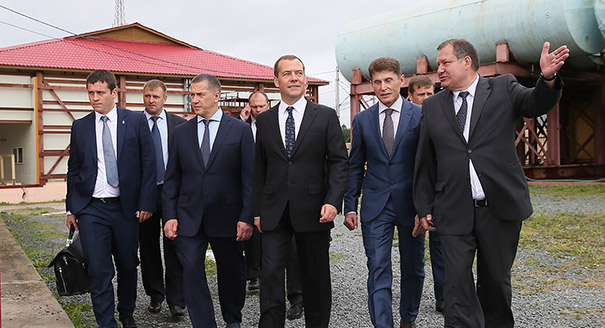
In theory, the seizure of a greater share of Sakhalin’s resource wealth by the federal authorities could lead to a fairer distribution of wealth throughout the Russian Far East. The fear, however, is that further centralization of budgetary revenues will merely encourage the pursuit of vanity projects that will not come to fruition for over a decade, if ever.
Thousands gathered in several Russian cities on October 7 to demand that opposition leader Alexei Navalny be permitted to stand in next year’s presidential election. The protests coincided with President Vladimir Putin’s sixty-fifth birthday, and attracted significant international attention, but they were not the only demonstrations of public anger to bubble to the surface in Russia this fall.
On October 2, activists established pickets at several sites across Yuzhno-Sakhalinsk and in other towns of the Far Eastern Sakhalin region. The purpose was to protest the introduction into the State Duma of draft legislation that would see a major redistribution of oil and gas revenues from Sakhalin’s budget to the federal government. Under a production sharing agreement signed in 1994, royalties and tax revenues from the lucrative Sakhalin-2 oil and gas project are divided between the Sakhalin regional authorities and the central government, with 75 percent going to the former and 25 percent to the latter. The new law would invert that ratio, entitling the federal budget to three-quarters of the revenues.
The official justification for this change is to provide funds to support economic development across all nine federal subjects of the Russian Far East. Unlike the island of Sakhalin, these regions are net recipients from the federal budget. Although a more equal distribution of spending within the Russian Far East may seem fair to some, many Sakhalin residents regard the measure as an unwarranted intervention that will leave the region with a catastrophic budgetary shortfall. Indeed, it is estimated that Sakhalin will lose 68.4 billion rubles ($1.2 billion) in just the first three years.
This is expected to lead to the cancelation of new school construction, as well as the postponement of development plans for several cities and towns. It is likely that some support programs for low-income households will also have to be suspended. Overall, even if a significant proportion of the funds is returned to the region in the form of federal spending, it is probable that living standards on Sakhalin will fall.
Responding to the outburst of public frustration, parliamentarians of the Sakhalin regional assembly voted on October 5 overwhelmingly in favor of issuing an official appeal to Vyacheslav Volodin, speaker of the State Duma. Urging reconsideration of the new law, Andrei Khapochkin, chair of the regional assembly, stressed Sakhalin’s need to retain the lion’s share of the oil and gas revenues. Khapochkin highlighted that 9 percent of Sakhalin residential buildings are classified as low-quality, dangerous housing, compared with a nationwide average of 3 percent. Remarkably for such a resource-rich area, the rate of household gasification in Sakhalin is also only 13 percent, versus 67 percent nationally. In addition, 60 percent of power lines are in need of repair, and only 40 percent of roads in the Sakhalin region are paved.
As well as representing a particular blow to Sakhalin, the planned reallocation of funds is worthy of broader attention as indicative of Moscow’s highly centralized approach to the Far East’s development. The development of this super-region has become a leading priority for the Russian leadership in recent years. Efforts to promote this goal have included the establishment of the Ministry for the Development of the Russian Far East, as well as the Agency for the Development of Human Capital in the Far East.
Vladivostok was also selected to host the Asia-Pacific Economic Cooperation forum in 2012, and, in preparation for this, several infrastructure projects were completed in the city, including two large bridges. A new campus for the recently formed Far Eastern Federal University was also constructed, and this now serves as the venue for the annual Eastern Economic Forum. Other initiatives have seen the creation of special economic zones, as well as a free port with a special customs and taxation system in Vladivostok. A Russian version of the Homestead Act has also been introduced to give away land in the Far East to citizens committed to putting it to productive use.
The success of these assorted efforts has varied significantly, but what they have in common is that they are all top-down initiatives rather than projects decided upon and overseen by local authorities. The reallocation of the majority of Sakhalin’s oil and gas revenues is just another example of this tendency toward overcentralization.
The federal bureaucracy undoubtedly has greater expertise than its regional counterparts. The problem with such a centralized approach, however, is that the priorities of decisionmakers in Moscow are not always closely aligned with those of local residents. In particular, inhabitants of the Russian Far East are likely to place greater emphasis on pragmatic initiatives that promote meaningful improvements in living standards, such as better schools, hospitals, housing, and roads. By contrast, the federal authorities tend to favor grand projects that magnify national prestige, yet may actually contribute little to the lives of local residents.
A clear example of the national leadership’s preference for grandiose schemes was revealed at the Eastern Economic Forum in September 2017. For the second year running, Japanese Prime Minister Shinzo Abe was a guest of honor. Since returning to power in December 2012, he has made relations with Russia a priority, believing that closer economic ties could provide the foundation for a breakthrough in the countries’ longstanding territorial dispute over the Kuril islands. To this end, the Japanese side has put forward an eight-point economic cooperation plan, which, in the prime minister’s own words, focuses attention on “fields directly connected with the daily lives of individual citizens living in Russia.”
Based on this approach, during his speech in Vladivostok on September 7, Abe concentrated on the prospects for highly practical cooperation, encouraging joint efforts to tackle tuberculosis in Russia, as well as plans to improve Russia’s postal service, traffic management, and sewage systems. However, while these proposals were designed to address pressing social needs in Russia, they failed to capture the imagination of the Russian leadership.
Instead, Energy Minister Alexander Novak focused attention on an ambitious scheme to construct an “energy bridge” to export electricity from Sakhalin to the Japanese island of Hokkaido. First Deputy Prime Minister Igor Shuvalov went one step further, inviting the Japanese to consider the construction of a mixed road and railway route from Hokkaido to the southern part of Sakhalin. Combined with another bridge from Sakhalin to the Russian mainland, the link would connect Japan directly with the Trans-Siberian Railway, thereby transforming the Japanese archipelago into a continental state.
There is no question that dreams of mega-projects are more exciting than discussions about waste management or traffic light sequencing. But when it comes to the living standards of residents of the Russian Far East, dull, locally focused projects will have a greater impact than idealistic schemes that will not come to fruition for over a decade, if ever.
In theory, the seizure of a greater share of Sakhalin’s resource wealth by the federal authorities could lead to a fairer distribution of wealth throughout the Russian Far East. The fear, however, is that further centralization of budgetary revenues will merely encourage the pursuit of vanity projects. These may have political rationale for the Moscow-based elite, but they will make little real contribution to Far Eastern development. If this occurs, the protests seen on Sakhalin at the beginning of October could prove to be just the start of wider expressions of public dissatisfaction within the region as more and more residents take up the call for better living conditions.

Professor of Political Science at Temple University
Andrei Kozinets
Carnegie does not take institutional positions on public policy issues; the views represented herein are those of the author(s) and do not necessarily reflect the views of Carnegie, its staff, or its trustees.
A much-discussed disagreement over internet restrictions in Russia was never an existential threat for Putin: It was about elite groups protecting their interests.

Alexandra Prokopenko

The demands of the Kremlin’s war in Ukraine, demographic problems, and public hostility toward Central Asians mean Russia does not have enough workers.
Salavat Abylkalikov
Minsk’s faith in the future of its larger neighbor’s economy is fading as Belarusian firms in Russia see record losses.

Olga Loiko

The cost of air defense has become an unregistered tax on revenue for businesses. While military rents are consolidated in the federal budget, the costs of defense are being spread across the balance sheets of companies and regional governments.
Alexandra Prokopenko

Powerful lobbyists and inertia led to Russia’s coal-mining sector missing an excellent opportunity to solve its structural problems.
Alexey Gusev