

Report
- +8
Salman Ahmed, Wendy Cutler, Rozlyn C. Engel, …
{
  "authors": [
    "Christopher Smart"
  ],
  "type": "other",
  "centerAffiliationAll": "dc",
  "centers": [
    "Carnegie Endowment for International Peace"
  ],
  "collections": [],
  "englishNewsletterAll": "americanStatecraft",
  "nonEnglishNewsletterAll": "",
  "primaryCenter": "Carnegie Endowment for International Peace",
  "programAffiliation": "ASP",
  "programs": [
    "American Statecraft"
  ],
  "projects": [],
  "regions": [
    "Russia"
  ],
  "topics": [
    "Economy",
    "Foreign Policy"
  ]
}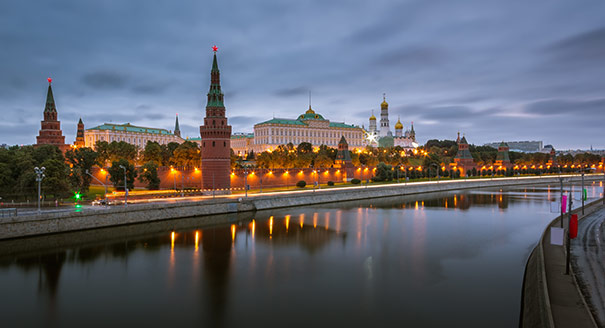
Source: Getty
U.S.-Russian rivalry will likely endure, but limited cooperation may be possible when Moscow realizes it cannot grow without the West.
Source: Council on Foreign Relations
The recent collapse in the U.S.-Russia relationship has roots that stretch back to fundamental misunderstandings at the end of the Cold War. Western democracies have watched with dismay as tightening political controls in Russia have throttled domestic pluralism, while Moscow’s roughshod foreign policy and military tactics have driven its neighbors into submission or open hostility. Russia has bemoaned what it sees as Western arrogance and a stubborn refusal to recognize its security concerns and great-power status. Today, Russia’s annexation of Crimea, support of Syrian repression, and, above all, meddling in the U.S. presidential election have shattered any desire in Washington—at least outside the Oval Office—to search for common ground. Indeed, amid congressional logjams on nearly every issue, overwhelming bipartisan majorities passed a stiffer sanctions regime. The narrative in Moscow, meanwhile, paints a consistent picture of Washington actively rallying Europeans to expand footholds around Russia’s borders with an ultimate goal of regime change in the Kremlin itself. In spite of President Donald J. Trump’s apparent eagerness to improve relations, deepening resistance across the political spectrum makes any progress fanciful at this stage.Whether either side understands how to get relations back on track remains uncertain. What is clear is that neither side wants to. Deep-seated U.S. mistrust and an unyielding Russian government seem likely to confine the bilateral relationship to a series of sour exchanges and blustery confrontations for now.
Yet one persistent weakness will ultimately limit Russia’s foreign agenda: an economy that is likely to fall increasingly behind those of its major neighbors and partners. For now, Russia has largely learned to tolerate Western economic sanctions, and its companies have found ways to live with restricted access to finance. Without reform and economic integration with the West, however, Russian influence will drift toward the margins of global diplomacy. Russia’s economy will atrophy from a combination of hyperconcentrated decision-making, continuing dependence on hydrocarbons, and persistent financial isolation. Core goals of Russia’s foreign policy will steadily recede from view, including important elements of the economic agenda with its immediate neighbors, the European Union and China. Though a snapback of oil prices would undoubtedly delay any day of reckoning, even large new inflows of petro-profits will not fundamentally close the widening gap with major partners.
For policymakers in the United States, the quandary is how to resist Russia’s obstreperous behavior abroad while remaining alert to the potential for change. Mounting economic challenges to Russia’s foreign policy goals will likely not force a new course anytime soon. Russians have an impressive historical record of withstanding extended economic hardship far worse than what they face today. Even more challenging is that Russian President Vladimir Putin has proved adept at foreign policy on the cheap, through a mix of tactics he has deployed in spite of a shrinking budget. These include sophisticated public diplomacy, including cyber interference in elections; targeted financial support to troublesome regimes; and carefully limited military interventions. These specific involvements range from Ukraine to Syria to Venezuela, but the broader theme has been to rally global resistance to the U.S.-led liberal international order. For the foreseeable future, this leaves the United States to respond with vigorous diplomatic resistance, extended economic sanctions, and fresh displays of military readiness. Over the next decade, however, as Russia’s economic lag widens and core foreign policy goals fade further from view, a potential future generation of Russia’s leaders could begin to realize that their focus on what they term economic sovereignty is self-defeating. Such a change is hardly inevitable, but if anything is likely to alter the current calculus in Moscow, it is the realization that any prospect of a global role for Russia is slipping away. The challenge for Washington will be to watch for signs that Moscow is ready to make changes and judge whether those changes could warrant relaxing sanctions, or even introducing incentives. History suggests that the two worldviews may never fully reconcile and that some rivalry is inevitable. Still, the United States should prepare for the possibility that economic constraints could trigger meaningful changes in Russia that could then lead to limited cooperation on major U.S. priorities—whether in Eastern Europe or the Middle East, cyberspace or outer space.
This paper was originally published by the Council on Foreign Relations.
Former Nonresident Fellow, Geoeconomics and Strategy Program
Christopher Smart was a nonresident fellow at the Carnegie Endowment for International Peace, where he focuses on the interaction of global financial markets and international economic policy.
Recent Work

Salman Ahmed, Wendy Cutler, Rozlyn C. Engel, …
Salman Ahmed, Allison Gelman, Tarik Abdel-Monem, …
Carnegie does not take institutional positions on public policy issues; the views represented herein are those of the author(s) and do not necessarily reflect the views of Carnegie, its staff, or its trustees.

For every ruble allocated to social policy, health, and education in 2027, double that amount is earmarked for the army, the police, and the security services.

Alexandra Prokopenko

Cargo traffic through Russia’s Northern Sea Route has increased because of the disruption caused by the conflict in the Middle East, the Ukraine war, and U.S.-China tensions.

Mikhail Korostikov
An analysis of traffic accident data suggests that Ukrainian drone attacks caused a material but not disastrous fall in Russian gasoline consumption over the summer.

Sergey Vakulenko

Sergei Kiriyenko used Russia’s parliamentary vote to further hone his strategy of corporate mobilization that is designed to maximize votes for United Russia.

Andrey Pertsev

The European far right might fail to steer EU policy in the direction Russia wants, but they will create enough chaos inside Europe to benefit the Kremlin.

Dimitar Bechev