

Article
Tristan Volpe
{
  "authors": [
    "Tristan Volpe"
  ],
  "type": "other",
  "centerAffiliationAll": "dc",
  "centers": [
    "Carnegie Endowment for International Peace"
  ],
  "collections": [],
  "englishNewsletterAll": "ctw",
  "nonEnglishNewsletterAll": "",
  "primaryCenter": "Carnegie Endowment for International Peace",
  "programAffiliation": "NPP",
  "programs": [
    "Nuclear Policy"
  ],
  "projects": [],
  "regions": [],
  "topics": [
    "Nuclear Policy",
    "Arms Control"
  ]
}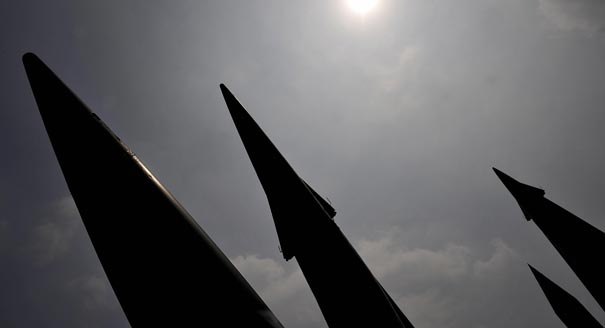
Source: Getty
In this article, Tristan Volpe reviews Rachel Whitlark’s article, “Nuclear Beliefs: A Leader-Focused Theory of Counter-Proliferation.”
Source: H-Diplo ISSF
In “Nuclear Beliefs: A Leader-Focused Theory of Counter-Proliferation,” Rachel Whitlark advances a new framework to explain why military force is rarely employed to prevent the spread of nuclear weapons. According to power transition theory, a nuclear weapons program should spark an intense security dilemma with a high risk of war as other nations consider using force to forestall an adverse shift in the balance of power. Contrary to this conventional wisdom, Whitlark demonstrates that even a looming proliferation threat does not pressure all leaders to “think and act similarly” by mulling over preventive war (550). Instead, the article shows that presidents and prime ministers come into political office with prior beliefs about the consequences of proliferation and stability of nuclear deterrence. For some leaders, a sanguine judgement about the ability to manage nuclear-armed adversaries becomes an anchor against even deliberating coercive counter-proliferation strategies. Whitlark marshals archival evidence to show how President John F. Kennedy’s entrenched pessimism about proliferation led him to consider a range of military options against China’s emerging nuclear program. In stark contrast, President Lyndon B. Johnson’s optimism seemed to result in these same options being taken off the table on the eve of the first Chinese nuclear weapons test.
The article makes a major contribution to the study of nuclear proliferation and preventive war by identifying the conditions under which military options are unlikely to be considered by executive decision-makers. The leader-focused theory draws upon the groundbreaking work of Elizabeth Saunders on the role that individual leaders play in the formulation and execution of national security strategy. Whitlark deftly imports Saunders’ framework into the nuclear proliferation arena, and backs this modified theory with a rigorous research design. Although a few historical anomalies stand out in the case study of President Johnson, the article crafts a compelling empirical narrative from a trove of archival sources. By bringing leaders’ beliefs into focus, Whitlark unpacks a critical variable in the causal chain of counter-proliferation policy. Moreover, the article cues up several avenues for further research, and sheds light on how President Donald Trump might be thinking through preventive war options on the Korean peninsula.
How often do leaders come into political office with beliefs that prime them to look past coercive counter-proliferation? Whitlark provides a powerful but partial answer to this question. At the outset, the article usefully breaks down the counter-proliferation process into two sequential stages: (1) consideration and (2) use of force. To be sure, Whitlark advances a complete logic to explain how beliefs “act as the lens through which a leader determines the inputs into his or her cost benefit calculation” at each stage (552). But the main emphasis of the article is on the initial consideration of military force, defined as an observable decision by the executive leader to “engage some portion of the national security apparatus as well as request feasibility studies to assess the practicality of conducting the campaign” (548). In Table 1, the article codes a handful of U.S. presidents (Harry Truman, Johnson, Jimmy Carter, George H. W. Bush, and George W. Bush) as having not considered military options against clear proliferation threats (Soviet Union, China, Pakistan, North Korea, and Syria, respectively). As Whitlark notes, this pattern of behavior cuts against the grain of power transition logic, which stipulates that these leaders should have at least considered coercive means to inhibit the spread of nuclear weapons. The article aptly narrows the analytic aperture to focus on explaining this trend.

Nonresident Fellow, Nuclear Policy Program
Tristan Volpe is a nonresident fellow at the Carnegie Endowment for International Peace and assistant professor of defense analysis at the Naval Postgraduate School.
Recent Work

Joseph Bahout, Perry Cammack, David Livingston, …
Carnegie does not take institutional positions on public policy issues; the views represented herein are those of the author(s) and do not necessarily reflect the views of Carnegie, its staff, or its trustees.
Troubled by the growing salience of nuclear debates in East Asia, Moscow has responded in its usual way: with condemnation and threats. But by exacerbating insecurity, Russia is forcing South Korea and Japan to consider radical security options.

James D.J. Brown
The Russian leadership wants to avoid a dangerous precedent in which it is squeezed out of Iran by the United States and Israel—and left powerless to respond in any meaningful way.

Nikita Smagin
For Putin, upgrading Russia’s nuclear forces was a secondary goal. The main aim was to gain an advantage over the West, including by strengthening the nuclear threat on all fronts. That made growth in missile arsenals and a new arms race inevitable.

Maxim Starchak
The Kremlin will only be prepared to negotiate strategic arms limitations if it is confident it can secure significant concessions from the United States. Otherwise, meaningful dialogue is unlikely, and the international system of strategic stability will continue to teeter on the brink of total collapse.
Maxim Starchak

Tehran’s most urgent task is to reduce the risk of further Israeli and U.S. airstrikes. Russia’s role as a deterrent in this respect is more multifaceted than simply supplying weapons, whose real impact will only become apparent many years from now.
Nikita Smagin