

Paper
Christopher S. Chivvis, Rohan Mukherjee, Milan Vaishnav
{
  "authors": [
    "Milan Vaishnav"
  ],
  "type": "legacyinthemedia",
  "centerAffiliationAll": "dc",
  "centers": [
    "Carnegie Endowment for International Peace"
  ],
  "collections": [],
  "englishNewsletterAll": "ctw",
  "nonEnglishNewsletterAll": "",
  "primaryCenter": "Carnegie Endowment for International Peace",
  "programAffiliation": "SAP",
  "programs": [
    "South Asia"
  ],
  "projects": [
    "India Elects 2019"
  ],
  "regions": [
    "South Asia",
    "India"
  ],
  "topics": [
    "Political Reform",
    "Democracy"
  ]
}
Source: Getty
Billed as a victory for transparency in political funding, electoral bonds are guaranteed to garner positive headlines. Upon closer inspection, however, the bonds appear to legitimize opacity in political finance rather than combat it.
Source: Indian Express
It is an open secret that political finance in India is, to put it mildly, a sordid affair. When it comes to political contributions, opacity reigns. The situation is not much better when it comes to expenditure, as candidates regularly declare laughably small amounts of campaign spending in order to give the appearance of complying with unrealistic expenditure ceilings that are equally laughable.
Unwilling to succumb to external scrutiny of their accounts, India’s major parties have instead thumbed their nose at the Central Information Commission’s ruling that parties, as public entities, are subject to the Right to Information Act. In a polarised political era, joining hands to protect their murky operations is one thing parties of all stripes can agree upon.
It was into this swamp that the Union Finance Minister Arun Jaitley waded when he made election finance reforms a hallmark of last year’s Budget presentation. In the Budget speech, Jaitley pledged the introduction of a new mechanism for funding elections in India intriguingly called “electoral bonds.” Last week the Modi government made good on its promise, unveiling the details of the new scheme.
Billed as a victory for transparency in political funding, the bonds, in fact, are anything but. Far from reducing opacity in how politics is financed, this new vehicle merely legitimizes it.
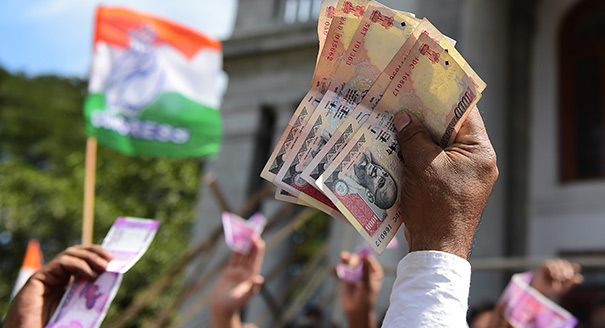
The new scheme will work as follows. Donors can buy bonds — essentially non-interest bearing promissory notes — issued by the State Bank of India (SBI) in specified amounts (Rs 1,000, Rs 10,000, Rs 1 lakh, Rs 10 lakh and Rs 1 crore), on certain days throughout the year. The bonds, which will be valid for only 15 days, can then be deposited in official bank accounts of those registered political parties which have earned at least one percent of votes polled in the previous general (or state) election.
Once deposited, the bonds essentially are converted into donations. The twist is that the donor neither needs to disclose it has purchased the bonds nor must it identify the recipient party. The political party in question will need to report it has received bonds, but it too does not have to disclose the donor’s identity. According to the government notification, individuals, Hindu undivided families, firms, and associations are all eligible to take part in the scheme as donors.
The upshot, according to the government, is that the new scheme will curb the use of black money in elections. Because all transactions related to the purchase and deposit of electoral bonds will happen through the banking system, there will be a digital paper trail that will encourage the use of white money in contrast to the under-the-table cash transactions that prevail under the status quo. Furthermore, donors will be subject to standard Know Your Customer (KYC) norms that will mitigate concerns about money laundering.
What does this all mean for the future of political funding in India?
First, to declare electoral bonds a major victory in the effort to improve transparency in political funding is farcical. There is, by design, nothing transparent about the scheme. In fact, the stated goal is to protect the anonymity of donors by giving them an avenue to contribute without revealing their identity (which corporates, fearful of retaliation by parties to whom they have not given, especially prize).
Thanks to two other changes buried in last year’s Finance Act as part of the Modi government’s “reforms” — the elimination of the cap on corporate giving (which previously stood at 7.5% of a corporation’s average net profits over the previous three years) and the abolition of the provision that firms must declare their political contributions on their profit and loss statements — the floodgates are now open for limitless, anonymous political giving.
This giving is not limited to firms, but extends to individuals, NGOs, and others — as the fine print of the government notification makes plain. As an article in Scroll has pointed out, individuals, NGOs and charitable trusts must file returns with the government but face no obligation to place their annual accounts in the public domain.
Second, given that the bonds are instruments to be issued by SBI there is one entity which will have full view of the transactions taking place: the government itself. Whether potential donors will take advantage of the electoral bond route knowing that the ruling party might be able to access transaction details is ultimately an empirical question. But when something is transparent to government, but kept off-limits to voters, the media, civil society or anyone else, it is hardly a meaningful sort of transparency.
Finally, we should acknowledge that electoral bonds do not strike a blow against opacity. Rather, they represent another salvo in the war on cash. In keeping with the Modi government’s post-demonetisation ethos, the new funding modality encourages digital payments and fund flows through the official banking system. While one can hardly be opposed to curbing the extent of black money in politics, we also have to be aware of the loopholes left in the system.
Another change made in last year’s Finance Act was to reduce the limit for cash donations to political parties from Rs. 20,000 to Rs. 2,000. If the government was serious about curbing cash funding of elections, why not prohibit cash donations altogether? After all, surely political parties are better suited than most to process digital transactions. Even more curious is that while the cash threshold was reduced to Rs. 2,000 in last year’s legislation, no changes were made to the disclosure threshold (which remains at Rs. 20,000).
Electoral bonds are a bright shiny object guaranteed to garner positive headlines, but one whose glimmer quickly fades upon closer inspection. In announcing the recent changes, the Finance Minister stated: “The political funding mechanism developed over the last 70 years has faced wide criticism as people don’t get clear details about how much money comes, from where it comes and where it is spent.”
Jaitley is spot-on in his assessment of the past. Sadly, he is also talking about the future.
This article was originally published in the Indian Express.

Director and Senior Fellow, South Asia Program
Milan Vaishnav is a senior fellow and director of the South Asia Program and the host of the Grand Tamasha podcast at the Carnegie Endowment for International Peace. His primary research focus is the political economy of India, and he examines issues such as corruption and governance, state capacity, federalism, and electoral behavior. He also conducts research on the Indian diaspora.
Recent Work


Christopher S. Chivvis, Rohan Mukherjee, Milan Vaishnav



Sophia Besch, Eric Ciaramella, Steve Feldstein, …
Carnegie does not take institutional positions on public policy issues; the views represented herein are those of the author(s) and do not necessarily reflect the views of Carnegie, its staff, or its trustees.

Putin’s conservative staffing policies and search for ever greater control have cemented parliament’s transformation into a bureaucratic appendage of the executive branch.

Andrey Pertsev

Ex-president Gurbanguly Berdimuhamedov remains interested in politics, but his son Serdar, Turkmenistan’s current president, is becoming increasingly independent and willing to break with his father’s legacy. If their covert rivalry goes too far, both risk losing power.

Galiya Ibragimova

Sergei Kiriyenko used Russia’s parliamentary vote to further hone his strategy of corporate mobilization that is designed to maximize votes for United Russia.
Andrey Pertsev

The European far right might fail to steer EU policy in the direction Russia wants, but they will create enough chaos inside Europe to benefit the Kremlin.

Dimitar Bechev

If the Russian-speaking community in Latvia cannot articulate their interests without being seen as disloyal, they could end up embracing a pro-Kremlin agenda.

Sergejs Potapkins