

Commentary
Judy Dempsey
{
  "authors": [
    "Judy Dempsey"
  ],
  "type": "legacyinthemedia",
  "centerAffiliationAll": "dc",
  "centers": [
    "Carnegie Endowment for International Peace",
    "Carnegie Europe"
  ],
  "collections": [],
  "englishNewsletterAll": "ctw",
  "nonEnglishNewsletterAll": "",
  "primaryCenter": "Carnegie Europe",
  "programAffiliation": "EP",
  "programs": [
    "Europe"
  ],
  "projects": [],
  "regions": [
    "Europe",
    "Western Europe",
    "Germany",
    "Iran"
  ],
  "topics": [
    "EU"
  ]
}
Source: Getty
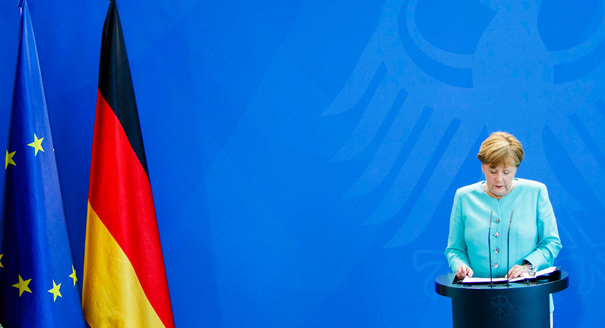
Berlin isn’t in delivery mode. German hesitancy is becoming one of Europe’s biggest liabilities and could derail Macron’s bold plans for a stronger Europe.
Source: Washington Post
France has had its shot. Now it’s Germany’s turn.
As it happens, though, Chancellor Angela Merkel’s trip to Washington this week will be a much lower-key affair than Emmanuel Macron’s grand state visit. Like her French counterpart, Merkel will be doing her best to persuade President Trump that the Iran deal is worth preserving, even if in revised form. And like Macron, she will also be trying to deliver the message that Europe and multilateralism deserve to be taken seriously.But that will only happen if she and the French president, who has ambitious plans for European Union reform, can show that they’re operating in sync. Macron wants to move Europe forward by creating a special finance minister for the euro-zone countries, by setting up a mechanism to support ailing national economies, and by boosting European defense and security policy.
Berlin, however, isn’t in delivery mode. Indeed, German reluctance is becoming one of Europe’s biggest liabilities. Merkel’s hesitancy could derail Macron’s bold plans for a stronger Europe, whose urgency is underlined by the need to deal with the Trump administration. Meanwhile, Russia and China can only revel in Macron’s frustration.
German passivity is deeply ingrained. Berlin’s political class lacks strategic thinking, hates risk and has little spunk. It hides behind its ignominious past to justify pacifism when it comes to hard questions about defense and security issues. It hides behind the dreadful inflation years of the late 1920s and 1930 to justify stringent saving measures that other countries should emulate.
Take the issue of refugees — or the recent missile strikes by the United States, France and Britain on Syria’s chemical weapons sites. Both are linked. Merkel refused to participate in the attacks even though she was quite happy to support the operation with rhetoric. Nothing like passing the buck.
Yet in doing so, Merkel betrayed Germany’s long-trumpeted principles. Where was the country that has been so vocal in supporting disarmament, the nonproliferation of nuclear weapons and upholding treaties to ban chemical weapons?
Had Berlin decided to act, it would have been highly embarrassed by its lack of readiness. Its armed forces are in a shambles. The Tornado fighter jets are so old that experts aren’t sure if they can still communicate with other NATO aircraft. In 2017, not a single German submarine was in working order, according to the yearly report issued by the Parliamentary Commissioner for the Armed Forces, Hans-Peter Bartels. German Army soldiers are short of gloves, protective vests and winter hats. They suffer from miserable conditions in the barracks — to the extent that soldiers have to buy their own cleaning supplies for the toilets.
Then there’s the migrant issue. By generously giving safe haven to almost 1 million refugees fleeing the Syrian war, Germany de facto created an interest in Syria’s future. The longer the war continues, the greater the possibility of more refugees trying to reach Europe.
Had German leaders thought it about logically, they would have pursued a far more hard-nosed strategy on Syria, probably adopting a much tougher policy toward Russia and Iran, which have kept the Bashar al-Assad regime in power. But Berlin held back.
Closer to home, Germany is doing far too little to defend the E.U.’s commitment to values and the rule of law, as well as its strategic planning.
Merkel and her German colleague Manfred Weber, leader of the conservative European People’s Party group in the European Parliament, have refused to consider suspending or expelling Hungary’s governing Fidesz party.
Merkel knows full well that Hungary is casting E.U. values aside by pushing authoritarianism. But she is reluctant to take concrete measures to constrain Prime Minister Viktor Orban. Nor has she criticized him for indirectly financing his pet projects with E.U. subsidies or passing along E.U.-funded contracts to his cronies.
Worst of all, the German government has not publicly condemned Orban’s vitriolic and anti-Semitic campaign against George Soros, the Hungarian-born philanthropist. Soros has now decided to close his Open Society Foundation Office in Budapest because of the intimidation of his staff and blatant anti-Semitic attacks.
The same applies to Poland. Merkel has been notably reluctant to criticize the governing Law and Justice Party for chiseling away at women’s rights, media independence and judicial integrity. (She is presumably nervous about jeopardizing hard-won progress in German-Polish reconciliation despite a dark historical legacy.)
Then there is the German government’s support for the Nord Stream 2 pipeline. This is another example of strategic blindness. The Russians will use the project to ship natural gas to Germany via two pipelines laid under the Baltic Sea. Ukraine, currently one of the major transit routes for Russian gas to Europe, will lose out.
Rather than diversifying energy supplies, German energy companies are snuggling up to Russian monopolist Gazprom. Merkel, who admits there are consequences for Ukraine, has repeatedly described Nord Stream 2 as a purely commercial project. This naive spin is belied by the project’s geo-strategic implications.
The bottom line is that unless Merkel can throw caution to the wind in her fourth term and run with the French president’s bold plans for the E.U., Germany’s strategic and political timidity will undermine both Macron and Europe.
This article was originally published by the Washington Post.

Nonresident Senior Fellow, Carnegie Europe
Judy Dempsey is a nonresident senior fellow at Carnegie Europe
Recent Work
Judy Dempsey
Judy Dempsey
Carnegie does not take institutional positions on public policy issues; the views represented herein are those of the author(s) and do not necessarily reflect the views of Carnegie, its staff, or its trustees.

The European far right might fail to steer EU policy in the direction Russia wants, but they will create enough chaos inside Europe to benefit the Kremlin.

Dimitar Bechev

If the Russian-speaking community in Latvia cannot articulate their interests without being seen as disloyal, they could end up embracing a pro-Kremlin agenda.

Sergejs Potapkins

Andrey Melnichenko’s essay offers no answer to the fundamental question of how, under any kind of negotiated settlement, Europe can protect itself from the Russian ressentiment that is inevitable in all scenarios except for an outright victory for Putin.

Leonid Bershidsky
Whether PAS can refocus on the unfinished business of state-building may ultimately prove more consequential for Moldova’s European future than the pace of its accession negotiations.

Balázs Jarábik

Ongoing uncertainty in the Middle East allows Moscow to both increase its influence in Tehran and continue to enjoy the financial windfall of higher oil prices.

Nikita Smagin