

Article
C. Raja Mohan, Darshana M. Baruah
{
  "authors": [
    "C. Raja Mohan"
  ],
  "type": "legacyinthemedia",
  "centerAffiliationAll": "dc",
  "centers": [
    "Carnegie Endowment for International Peace",
    "Carnegie India",
    "Malcolm H. Kerr Carnegie Middle East Center"
  ],
  "collections": [
    "Iranian Proliferation"
  ],
  "englishNewsletterAll": "ctw",
  "nonEnglishNewsletterAll": "",
  "primaryCenter": "Carnegie India",
  "programAffiliation": "SAP",
  "programs": [
    "South Asia"
  ],
  "projects": [],
  "regions": [
    "United States",
    "Asia",
    "North America",
    "Middle East",
    "Iran"
  ],
  "topics": [
    "Foreign Policy",
    "Political Reform",
    "Nuclear Policy"
  ]
}
Source: Getty
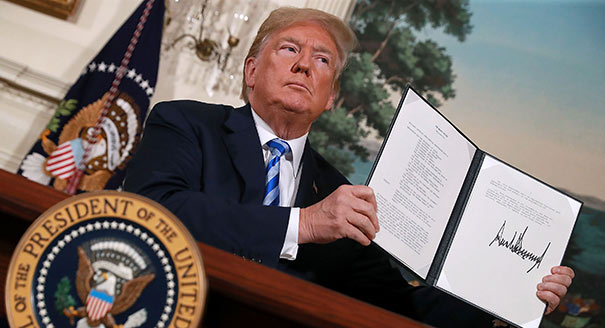
U.S. President Donald Trump’s decision to pull out of the Iran nuclear deal appears to have put regime change at the very center of the new American power play against Tehran.
Source: Indian Express
Washington finds it hard to resist the temptation to promote regime change in the Middle East. After the disastrous experience in Libya (2011) and Iraq (2003), with ousting Mohammed Gaddafi and Saddam Hussein, one would have thought that regime change had gone out of fashion. But President Donald Trump’s decision to pull out of the Iran nuclear deal appears to have put regime change at the very centre of the new American power play against Tehran.
At first cut, that is quite a surprise. Few mainstream politicians in the US have been as critical of US record of interventions in the Middle East as Trump. During the 2016 presidential campaign and since he occupied the White House January 2017, Trump has repeatedly criticised his predecessors for squandering American blood and treasure in pursuit of unrealistic goals in the region.
Yet, most analysts of Trump’s decision to unilaterally withdraw from the nuclear deal negotiated with Iran in 2015 suggest this might be less about atomic weapons and more about overthrowing the Islamic Republic. If the question was how to make the nuclear agreement tighter, critics say, Trump could have gone along with America’s European allies — France, Britain and Germany — who were promising precisely that.
The other case for abandoning the deal was that the agreement has emboldened the Iranian regime to project its power way beyond its borders much to the discomfort of many Arab governments. As Trump put it in his remarks last week announcing the withdrawal from the nuclear deal, “The Iranian regime is the leading state sponsor of terror. It exports dangerous missiles, fuels conflicts across the Middle East, and supports terrorist proxies and militias such as Hezbollah, Hamas, the Taliban and Al Qaeda.”
One way of addressing this might have been to focus on the larger questions of regional balance of power in a new set of negotiations with Tehran. Instead, Trump has chosen to confront Iran. Two key members of Trump’s foreign policy team — Secretary of State Michael Pompeo and National Security Adviser John Bolton — are known to have long favoured regime change in Iran.
The theme of regime change was implicit in Trump’s remarks on the nuclear deal last week. The President accused Iran of funding “its long reign of chaos and terror by plundering the wealth of its own people.” He warned Tehran that if it persists with its nuclear ambitions, “It will have bigger problems than it has ever had before.”
Trump also sought to differentiate between the Iranian government and the people by directly appealing to the latter: “The people of America stand with you. It has now been almost 40 years since this dictatorship seized power and took a proud nation hostage. Most of Iran’s 80 million citizens have sadly never known an Iran that prospered in peace with its neighbours and commanded the admiration of the world.”
The contrast between Trump and his predecessor Barack Obama stands out sharply. Obama avoided being drawn into questions about the nature of the Islamic Republic and focused on the challenge of Iran’s nuclear weapons programme. Trump seems to believe that the problem lies in the very character of the Islamic Republic.
The emphasis on regime change does not mean, Trump will follow George W Bush in embarking on direct military intervention and occupation of Afghanistan. Trump has often called the Bush policy on Iraq “stupid.” He repeatedly affirmed that he has no interest in promoting democracy abroad or building other nations with American resources.
Trump’s strategy appears to be different. It might be called “regime change on the cheap”. One element of the strategy is to mount massive economic sanctions, unilateral if necessary, against Iran. Some in Washington are betting that given the mounting economic crisis in Iran, the sanctions could recall bite and push the Islamic Republic to its knees.
Another element is to strengthen Iranian opposition groups working to oust the Iranian theocracy. A third element is to reinforce the regional efforts by Iran’s local rivals — Israel, Saudi Arabia and the United Arab Emirates — to push back against Tehran’s expansionism. All three countries have welcomed Trump’s decision to pull out of the nuclear deal with Iran.
None of these instruments are new to the US in the Middle East. Their efficacy, however, has always been doubtful. Nor is there any guarantee that external pressure will produce desired consequences within Iran. The unintended consequences of Western intervention in developing societies have in the past belied the fond hopes of grand strategists and political engineers.
Sceptics say US pressure will play into the hands of Iranian hardliners. They insist that America’s decision to walk out of the deal will help the regime rally the people round the flag. The proponents, however, are hopeful that Iran might be ripe for change. They calculate that external pressure will intensify the real and deep internal resentments against Tehran and compel the Islamic Republic to either sue for peace or collapse.
Iran’s Islamic revolution in 1979 dramatically altered the geopolitical landscape of the Middle East. Four decades later, Trump’s effort to roll back the revolution is bound to unleash much turbulence. Meanwhile, the contours of a regional realignment are marked by the current convergence of interests between the Sunni Arab states, Israel and the US.
This article was originally published in the Indian Express.
Former Nonresident Senior Fellow, Carnegie India
A leading analyst of India’s foreign policy, Mohan is also an expert on South Asian security, great-power relations in Asia, and arms control.
Recent Work

C. Raja Mohan, Darshana M. Baruah


Alexander Gabuev, Paul Haenle, C. Raja Mohan, …
Carnegie does not take institutional positions on public policy issues; the views represented herein are those of the author(s) and do not necessarily reflect the views of Carnegie, its staff, or its trustees.

Putin’s conservative staffing policies and search for ever greater control have cemented parliament’s transformation into a bureaucratic appendage of the executive branch.

Andrey Pertsev

Without a ceasefire with Ukraine on attacking each other’s energy infrastructure—to which the Kremlin is unlikely to agree—the diesel agreement between Putin and Trump is largely for show, rather than representing a genuine increase in the volumes of Russian diesel on the global market.

Sergey Vakulenko

Ex-president Gurbanguly Berdimuhamedov remains interested in politics, but his son Serdar, Turkmenistan’s current president, is becoming increasingly independent and willing to break with his father’s legacy. If their covert rivalry goes too far, both risk losing power.

Galiya Ibragimova

Despite a new textbook, an influx of Russian teachers and managers, and an end to the teaching of Ukrainian, the Kremlin is unlikely to have “reprogrammed” locals.

Konstantin Skorkin

Cargo traffic through Russia’s Northern Sea Route has increased because of the disruption caused by the conflict in the Middle East, the Ukraine war, and U.S.-China tensions.

Mikhail Korostikov