

Commentary
- +8
Sophia Besch, Eric Ciaramella, Steve Feldstein, …
{
  "authors": [
    "Steve Feldstein"
  ],
  "type": "legacyinthemedia",
  "centerAffiliationAll": "dc",
  "centers": [
    "Carnegie Endowment for International Peace"
  ],
  "collections": [],
  "englishNewsletterAll": "democracy",
  "nonEnglishNewsletterAll": "",
  "primaryCenter": "Carnegie Endowment for International Peace",
  "programAffiliation": "DCG",
  "programs": [
    "Democracy, Conflict, and Governance"
  ],
  "projects": [],
  "regions": [
    "North America",
    "United States",
    "Southern, Eastern, and Western Africa",
    "East Asia",
    "Japan",
    "Eastern Europe",
    "Western Europe",
    "United Kingdom",
    "France",
    "Germany"
  ],
  "topics": [
    "Democracy",
    "Foreign Policy",
    "Global Governance"
  ]
}
Source: Getty
Trump’s behavior has not wholly damaged U.S. credibility — yet. But over time, his unilateral volatility threatens to become the dominant narrative about the U.S., eclipsing past values and leadership.
Source: The Hill
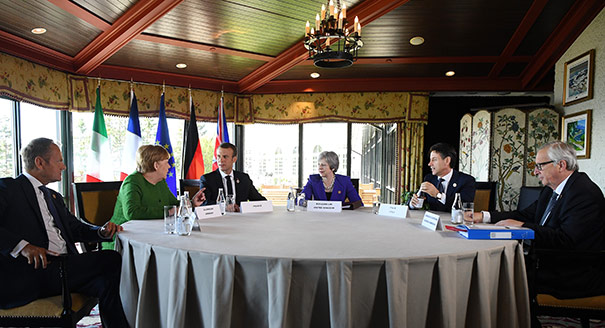
The disastrous Group of Seven (G-7) meeting in Quebec, where President Trump lashed out as his fellow leaders and singled out Canadian Prime Minister Justin Trudeau as “dishonest and weak,” raises an important question: Just how much is Trump’s erratic behavior damaging U.S. standing and credibility in the world?
Nearly 17 months into Trump’s presidency, he is upending the western alliance and fundamentally calling into question the reliability of the U.S. as an economic, political and security partner. He has inflamed tensions by slapping punitive steel and aluminum tariffs on America’s closest allies.
He has repeatedly ignored the entreaties of France, the U.K. and Germany to reconsider leaving the Paris climate change agreement or to stay in the Iran nuclear deal. Even while Trump lacks basic rapport with his fellow western democratic leaders, he has taken undeniable delight in sharing company with autocrats and strongmen.
Consequently, many are asking whether Trump’s latest behavior is finally leading to a “major reorientation of allies and partnerships worldwide.” How much is Trump damaging U.S. credibility and reputation?
I believe that in the short-term, the U.S. can weather the Trump storm for two reasons. First, the U.S. has built up a sufficient reservoir of international good will so that other countries will continue to give us a pass, notwithstanding the latest histrionics from Trump.
Second, the U.S. retains a disproportionate level of influence — economically and militarily — that compels other countries to deal with us. But over time, Trump’s leadership will steadily erode U.S. credibility. The longer Trump stays in power, the higher the likelihood that U.S. leadership and authority will dramatically diminish.
Why does credibility matter? A country with a high amount of credibility is able to build important alliances because potential allies are not worried about betrayal or potential abandonment. Credibility allows a country to deter adversaries and prevent costly wars through strength of reputation rather than through fighting.
Conventional wisdom says that a country is only as trustworthy as its last words or actions, and that credibility can dissipate swiftly (Will Rogers’ quip comes to mind: “It takes a lifetime to build a good reputation, but you can lose it in a minute”).
But that conventional view of credibility is not accurate.
A country’s reputation does not ebb and flow based on the week-to-week actions of its leader. While current leadership is a critical aspect of credibility, it is just one of many ingredients that countries use to evaluate reputation. In other words, a number of factors come into play when it comes to shaping a country’s reputation.
For example, what actions has the country undertaken in the past? What present interests does the country have? What capabilities and resolve does the country possess in order to defend those interests?
The good news is that most of these elements remain positive for the U.S. Despite the recent rashness of the Trump administration, the U.S. enjoys a solid reputation for steadfastness and resolve going back decades.
It retains enormous capabilities to defend its interests. As ongoing wars against the Islamic State and the Taliban demonstrate, the U.S. also maintains sufficient resolve to deploy and wield force when necessary.
At the same time, past actions and capabilities are not permanent conditions. The longer Trump lurches the U.S. along an unpredictable path, the more the world will begin to forget the United States' extended history as a guarantor of the international system.
The more Trump pursues a narrow definition of U.S. interests that calls treaty commitments and longstanding partnerships into question, the greater the risk to U.S. credibility, particularly when the next major crisis erupts.
Trump’s behavior has not wholly damaged U.S. credibility — yet. But over time, his unilateral volatility threatens to become the dominant narrative about the U.S., eclipsing past values and leadership.
Trump’s performance at the G-7 summit was embarrassing and cringe worthy; but it was not fatally damaging to U.S. credibility. However, if the Trump administration announces more unilateral tariffs and additional departures from international treaties, it will be harder and harder for the U.S. to maintain its good reputation.
Such an outcome would put the U.S. into uncharted territory — mercurial leadership that is increasingly isolated and decreasingly trusted around the world.

Director and Senior Fellow, Democracy, Conflict, and Governance Program
Steve Feldstein is a senior fellow and director of the Democracy, Conflict, and Governance Program at the Carnegie Endowment for International Peace. His research focuses on technology, national security, the global context for democracy, and U.S. foreign policy.
Recent Work


Sophia Besch, Eric Ciaramella, Steve Feldstein, …
Steve Feldstein
Carnegie does not take institutional positions on public policy issues; the views represented herein are those of the author(s) and do not necessarily reflect the views of Carnegie, its staff, or its trustees.

If the Russian-speaking community in Latvia cannot articulate their interests without being seen as disloyal, they could end up embracing a pro-Kremlin agenda.

Sergejs Potapkins

With the growth in points of friction between the great powers, organizations like the SCO will continue to play a role in the strategic adaptation of the smaller powers caught between them.

Temur Umarov

When faced with fuel shortages in the past, Central Asian governments could always count on additional supplies from Moscow. That safety net no longer exists.

Galiya Ibragimova
Ultimately, Zelensky sided neither with the reform camp nor with the military establishment as such, but with political control.

Balázs Jarábik

Andrey Melnichenko’s essay offers no answer to the fundamental question of how, under any kind of negotiated settlement, Europe can protect itself from the Russian ressentiment that is inevitable in all scenarios except for an outright victory for Putin.

Leonid Bershidsky