

Commentary
In the discussions made possible by the State Duma election campaign, one question is being asked more and more loudly. “What next?”
Andrey Pertsev
{
  "authors": [
    "Richard Sokolsky",
    "Aaron David Miller"
  ],
  "type": "legacyinthemedia",
  "centerAffiliationAll": "dc",
  "centers": [
    "Carnegie Endowment for International Peace"
  ],
  "collections": [],
  "englishNewsletterAll": "ctw",
  "nonEnglishNewsletterAll": "",
  "primaryCenter": "Carnegie Endowment for International Peace",
  "programAffiliation": "russia",
  "programs": [
    "Russia and Eurasia"
  ],
  "projects": [],
  "regions": [
    "North America",
    "United States",
    "Russia"
  ],
  "topics": [
    "Foreign Policy",
    "Technology"
  ]
}
Source: Getty
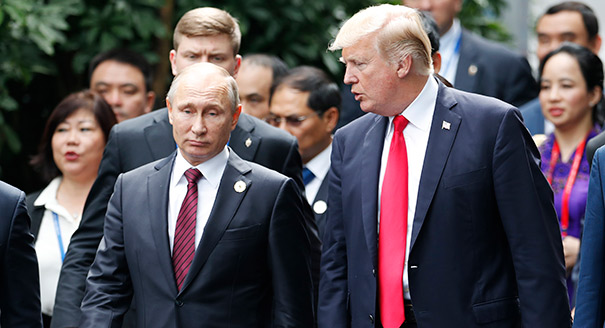
Relations between the United States and Russia are at their lowest since the end of the Cold War. President Trump just demonstrated at the recent NATO summit, he is more focused on the “me”, and this meeting in Helsinki might more narrowly benefit him and align his preferences.
Source: USA Today
Relations between the U.S. and Russia — the world’s two most formidable nuclear powers — are perhaps at their lowest ebb since the end of the Cold War. We ought to be engaging with Moscow at all levels on a regular basis to discuss what divides us and were we can coordinate on shared interests.
But President Donald Trump is going to Helsinki for all the wrong reasons and is more than likely to deliver all the wrong messages to Russian President Vladimir Putin. Call this a summit of the vanities. Trump is not thinking about the “we” and how a meeting might benefit American national interests. As he just demonstrated by disrupting the NATO summit in Brussels, he is more focused on the “me” and how this meeting might more narrowly benefit him and align with his likes and preferences.
Why can’t we all get along? Trump is addicted to doing the opposite of what all his predecessors have done, figuring perhaps, like George Costanza in the classic TV sitcom "Seinfeld", that if everything they did has turned America into a mess, then doing the opposite will Make America Great Again. But when it comes to U.S.-Russian relations, he is attempting exactly what all of his predecessors tried and failed to do: develop and sustain a cooperative bilateral relationship.
Trump is right to want a summit with Putin. Russia is a great power with whom the U.S. has serious differences over Ukraine, Syria, Russian interference in our elections, the future of the international order and human rights, to name a few. It is one of the only countries that could wipe the U.S. off the face of the earth. It ranks among the world’s great producers of oil and natural gas.
The U.S. and Russia, however, share common interests — for example, combating global jihadism, proliferation of weapons of mass destruction and nuclear terrorism and avoiding a military confrontation. Shunning Russia is not going to alter its behavior, and Russia is too powerful to isolate diplomatically. Consequently, presidential talk therapy with Russia is a good thing, provided that Trump doesn’t let Putin take him to the cleaners.
At Helsinki, the focus is on Trump. It should be abundantly clear by now that Trump is driven by the need for attention and acclamation. This has given rise to a pattern. He dislikes large, multilateral gatherings and prefers high-wire visibility where he can dominate and is unlikely to encounter criticism and pushback. When Trump says his meeting with Putin will be “easy,” that’s what he means.
It’s no coincidence that all of his multilateral meetings with the Europeans — G7 or NATO — have been preceded or followed by visits or summits where he’s either been feted or flattered (his first foreign trip to Saudi Arabia and Israel) or where he’s doing high-profile meet-and-greets (Singapore summit with North Korea’s Kim Jong Un) after the G7 in Canada. And this week’s sequence fits the pattern. He will go from NATO — where other leaders disputed his accounts of what went on — to a high-profile summit with Putin where he’ll thrive and where he can calibrate and control the messaging.
And he prefers authoritarians over allies. It should also be obvious by now that Trump loves to hammer America’s democratic allies while he accords a good deal more respect and leeway to strongmen and authoritarians. From Egypt’s Abdel-Fattach el-Sissito Turkey’s Recep Tayyip Erdogan and Saudi Arabia’s King Salman bin Abdul-Aziz Al Saud Salman, he gives them a free pass, while he has recently blasted Canadian Prime Minister Trudeau and Germany’s Angela Merkel.
In light of Putin’s behavior in Ukraine and Syria and his interference in U.S. elections, why Trump accords Russia so much safe space is a mystery. And it’s likely that any tough talking points Trump will use with Putin will be what we in the trade call throwaways (and we should know, because we drafted many of these ourselves during our time at the State Department.) The odds are high that he will praise rather than criticize Putin publicly. Indeed there’s some concern that Trump will somehow look for a way to endorse Russia’s annexation of Crimea or downplay its activities in eastern Ukraine.
Can Helsinki produce anything? Trump somehow seems to believe that he can do deals with Putin. But it’s not at all clear there are any deals to be done on Ukraine, sanctions or arms control. Stabilizing Syria stands out as a possible exception; Trump seems to believe that Putin might reduce Iran’s influence there and allow Trump to withdraw U.S. forces from Syria. But that’s a long shot.
If we’re really lucky, this summit will do no harm and possibly some good by jump starting a dialogue to attack the underlying causes of what ails U.S.-Russian relations. But in the process it will accord Putin greater legitimacy even as he continues his malign activities. And it will leave America’s allies scratching their collective heads about why the meeting took place, what Trump may have conceded to Putin, and whether his Russia-First policy will undermine their interests as well as America's.
Nonresident Senior Fellow, Russia and Eurasia Program
Richard Sokolsky is a nonresident senior fellow in Carnegie’s Russia and Eurasia Program. His work focuses on U.S. policy toward Russia in the wake of the Ukraine crisis.

Senior Fellow, American Statecraft Program
Aaron David Miller is a senior fellow at the Carnegie Endowment for International Peace, focusing on U.S. foreign policy.
Carnegie does not take institutional positions on public policy issues; the views represented herein are those of the author(s) and do not necessarily reflect the views of Carnegie, its staff, or its trustees.

In the discussions made possible by the State Duma election campaign, one question is being asked more and more loudly. “What next?”

Andrey Pertsev
While the Nazis rushed ahead in a revolutionary fervor, Russia’s modern crusaders against enemies of the state work methodically, giving their targets time to adjust to restrictions before closing the loopholes.

Leonid Bershidsky

When faced with fuel shortages in the past, Central Asian governments could always count on additional supplies from Moscow. That safety net no longer exists.

Galiya Ibragimova
Reading the purported correspondence of celebrity Ksenia Sobchak sheds light on her role within the system, and how journalism and politics function in Putin’s Russia.
Vladislav Gorin

When political power is concentrated in the hands of a small circle of people, a country invariably ends up with technological stagnation.
Aleksei Kiselev