

Paper
James M. Acton, Ankit Panda
{
  "authors": [
    "James M. Acton"
  ],
  "type": "legacyinthemedia",
  "centerAffiliationAll": "dc",
  "centers": [
    "Carnegie Endowment for International Peace",
    "Carnegie Russia Eurasia Center"
  ],
  "collections": [
    "U.S. Nuclear Policy",
    "Korean Peninsula"
  ],
  "englishNewsletterAll": "ctw",
  "nonEnglishNewsletterAll": "",
  "primaryCenter": "Carnegie Endowment for International Peace",
  "programAffiliation": "NPP",
  "programs": [
    "Nuclear Policy"
  ],
  "projects": [],
  "regions": [
    "North America",
    "United States",
    "East Asia",
    "North Korea"
  ],
  "topics": [
    "Democracy",
    "Foreign Policy",
    "Nuclear Policy",
    "Global Governance"
  ]
}
Source: Getty
It’s not impossible that the Singapore summit will spark a process that succeeds. But the president’s all-or-nothing approach to denuclearizing North Korea is a misrepresentation to the summit’s outcome.
Source: Huffington Post
Let’s not be too critical of President Donald Trump. As long as he and North Korean leader Kim Jong Un are swapping pleasantries rather than threats, the United States and North Korea are unlikely to start exchanging nuclear weapons. And, it’s not impossible that the Singapore summit will spark a process that succeeds, over the long term, in curbing the threat from North Korea.
Unfortunately, however, that outcome is also pretty unlikely right now. The summit — and particularly its aftermath — was a farce. And, while it doesn’t need to be this way, the president’s bombastic all-or-nothing approach to denuclearizing North Korea means that, by the end of this process, we could easily be closer to a war than when we began.
We’ll start from the end — the news conference that Trump gave immediately after the summit. Let’s ignore his description of the North Koreans being tortured in gulags as “the great winners,” as well as his promotion of North Korea real estate opportunities, and focus solely on how he fared in trying to convince North Korea to abandon its nuclear weapons.
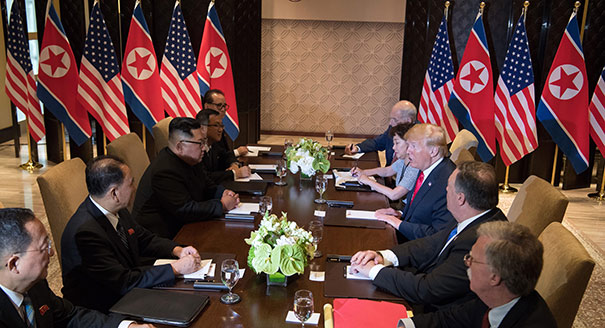
Trump indicated that North Korea had agreed to disarm unilaterally and verifiably and that it would start “right away.” He may honestly believe this description, but it’s a serious misrepresentation of the summit’s outcome.
What came out of the summit was a brief, vague statement in which North Korea recommitted itself to “work toward the complete denuclearization of the Korean peninsula.” The term “complete denuclearization of the Korean Peninsula” isn’t new. North Korea first agreed to it (albeit without the word “complete”) in 1992 and has repeated it on various occasions since then. It has, however, never been defined precisely — and the summit provided no additional clarity. But, for Pyongyang, it requires unspecified but presumably significant concessions from the United States and South Korea: the end of their alliance, perhaps, or the removal of U.S. troops from the peninsula.
In fact, some past joint statements with North Korea were significantly stronger than this one. In particular, in 2005, North Korea “committed to abandoning all nuclear weapons and existing nuclear programs.” Given that Kim did not reiterate this commitment in Singapore, it strongly suggests that he no longer intends to abide by it.
In short, whatever it was that was agreed to in Singapore, it’s not the “complete, verifiable, irreversible denuclearization” the Trump administration has sought.
To be fair, the Singapore summit is only intended to start a process. Secretary of State Mike Pompeo is now supposed to go off and work out an implementation plan with, worryingly, an unspecified North Korean counterpart. Yet, such a process would have a much greater chance of success if it were built on solid foundations. For example, the interim agreement that the P5+1 reached with Iran in 2013 ― the deal before the deal ― was much more detailed than the Trump-Kim joint statement and represented genuine agreement on basic principles, thus paving the way for the 2015 Iran nuclear deal. It’s very difficult to see the Trump administration reaching anything remotely comparable with North Korea.
Diplomacy is nonetheless likely to continue for the time being. However, sooner or later — most likely within the next year or so — it will become clear that Kim is not in the process of “de-nuking the whole place,” as Trump hopes.
At this point, the risks of a war will probably start rising again. At the news conference in Singapore, Trump unveiled (much to the surprise of South Korea) a big and apparently unilateral concession: the suspension of U.S.-South Korean military exercises. Restarting these exercises when North Korea fails to disarm will lead to a serious increase in tensions — more so, in fact, than if they had never been suspended.
Moreover, once diplomacy has been tried and it has “failed,” what else is left?
Trump administration officials have made it clear (wrongly in my opinion) that they think a nuclear-armed North Korea cannot be deterred, so it seems all too possible that they will go back to making military threats. In fact, before he became national security adviser, John Bolton pretty much told us that this was his strategy, supporting a summit on the grounds that it was “a way to foreshorten the amount of time that we’re gonna waste in negotiations.”
If there is a way out of this mess, it must involve the United States adopting realistic goals. The United States should not abandon the long-term goal of North Korean nuclear disarmament. But, for now, in addition to working to reduce the risk of a conflict with North Korea, it should prioritize verifiable and simple-to-negotiate steps to cap the threat posed by North Korea’s nuclear and missile programs (which is the first part of rolling them back). In return for such modest steps, the United States and others should offer North Korea only modest concessions — an approach that I call “less for less.”
North Korea, for example, has already announced a moratorium on nuclear tests and intercontinental ballistic missile flight tests. The United States should now press North Korea to expand this moratorium to include missiles of shorter ranges than ICBMs and also ground tests of missile engines. It should also aim to have North Korea sign and ratify the Comprehensive Nuclear-Test-Ban Treaty, which would make its moratorium on nuclear tests legally binding. Another goal should be for North Korea to agree not to operate any nuclear reactors, which could be used to produce more plutonium and tritium (a material that is useful for miniaturizing nuclear warheads).
North Korea’s reward for taking such steps should primarily be economic, though the United States should also consider further ratcheting down its military posture. For example, Washington could commit to not conducting bomber training missions within a certain distance of North Korea’s borders (such operations are presumably not covered by the suspension of joint military exercises with South Korea).
These modest steps would hardly be a panacea, but they would go a long way to preventing the threat from North Korea’s nuclear and missile programs from getting worse. If implemented successfully, they could pave the way for more challenging measures, such as a cap on North Korea’s enrichment of uranium.
This step-by-step approach is not the yuuuge win Trump is looking for — but it’s a better option than betting everything on immediate and complete denuclearization with the risk of a war if we lose.

Jessica T. Mathews Chair, Co-director, Nuclear Policy Program
Acton holds the Jessica T. Mathews Chair and is co-director of the Nuclear Policy Program at the Carnegie Endowment for International Peace.
Recent Work

James M. Acton, Ankit Panda
James M. Acton
Carnegie does not take institutional positions on public policy issues; the views represented herein are those of the author(s) and do not necessarily reflect the views of Carnegie, its staff, or its trustees.

Japan’s long-term security policy is driven by concerns about China, and there is little appetite for (or interest in) pursuing a confrontation with Moscow.

James D.J. Brown

Russia’s AI-driven propaganda campaigns operate in a fragmented, chaotic, and often illogical manner. That’s not necessarily a problem for the Kremlin, though: It’s much easier to mimic genuine public debate that way.

Ilya Klishin

Without a ceasefire with Ukraine on attacking each other’s energy infrastructure—to which the Kremlin is unlikely to agree—the diesel agreement between Putin and Trump is largely for show, rather than representing a genuine increase in the volumes of Russian diesel on the global market.

Sergey Vakulenko

Despite a new textbook, an influx of Russian teachers and managers, and an end to the teaching of Ukrainian, the Kremlin is unlikely to have “reprogrammed” locals.

Konstantin Skorkin

Cargo traffic through Russia’s Northern Sea Route has increased because of the disruption caused by the conflict in the Middle East, the Ukraine war, and U.S.-China tensions.

Mikhail Korostikov