

Commentary
Andrey Pertsev
{
  "authors": [
    "Andrey Pertsev"
  ],
  "type": "commentary",
  "centerAffiliationAll": "",
  "centers": [
    "Carnegie Endowment for International Peace",
    "Carnegie Russia Eurasia Center"
  ],
  "collections": [
    "Inside Russia"
  ],
  "englishNewsletterAll": "",
  "nonEnglishNewsletterAll": "",
  "primaryCenter": "Carnegie Russia Eurasia Center",
  "programAffiliation": "",
  "programs": [],
  "projects": [],
  "regions": [],
  "topics": [
    "Economy"
  ]
}
Source: Getty
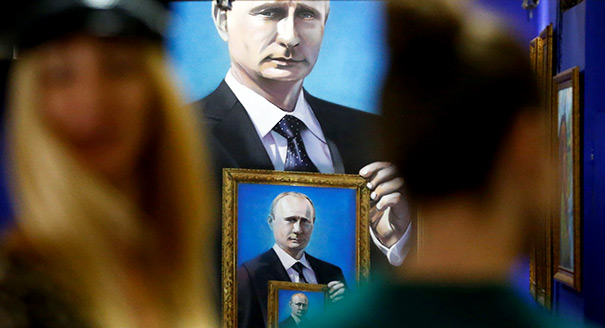
Public discontent over a plan to raise Russia’s pension age has revealed a critical flaw in the country’s political system: there is no political infrastructure that can function in crisis conditions. Only President Vladimir Putin can speak on behalf of the state. Without him, the vertical collapses. Russia desperately needs alternative connections between the state and the people. But virtually any political infrastructure project fundamentally undermines the country’s power vertical.
The first months of Vladimir Putin’s final term have quickly exposed his main problem: the Russian political system lacks virtually any political infrastructure that could stably function in crisis conditions. Its fundamental element is the president, his image, his first and last name. Other institutions—political parties, the parliament, regional and municipal government—ostensibly exist in Russia. But they fail to function as elements of the power mechanism.
Only the president or those who present themselves as his representatives—the United Russia party, individual parliamentarians, governors—address the people on behalf of the state. For now, the president’s name guarantees relatively successful communication. But that setup has one clear flaw: without the popular president, the entire power vertical collapses, and there are neither strong institutions nor horizontal infrastructure to prop it up.
The recent proposal to raise Russia’s pension age vividly demonstrated this problem. The system required political infrastructure to explain this unpopular reform to the people. It engaged the Duma, regional parliaments, United Russia, the governors, and television propaganda. Nonetheless, the approval ratings of the president, cabinet, and United Russia all began to decline, even though the authorities tried to hide the announcement of the reform behind the World Cup.
For a while, the system tried to keep its main and only functioning infrastructural element—Vladimir Putin—out of the spotlight. Eventually, however, it had to engage him as well. The head of state said he “disliked” the reform, but that it cannot be avoided in the near future.
Virtually all political actors began to present the president’s ambiguous position in the light most favorable to themselves. Many media outlets portrayed Putin as an opponent of the reform, stressing the word “dislike.” United Russia focused on the second part of the speech, where Putin stated that the pension reform would continue. As a result, party representatives in the regions avoided public discussions of the matter. Some—especially candidates from single-member districts—say they don’t support it.
Such challenges were not difficult to predict. This winter, large-scale protests erupted in Kemerovo and Volokolamsk over a deadly shopping mall fire and a garbage dump, respectively. Both demonstrations had local roots, but they stood out because of the intensity of people’s discontent. Regional leaders tried to quell the protests, but had little success.
Any government official, parliamentarian, or United Russia functionary can easily wind up in this position. These people are unable to establish communication between the government and the public, let alone make independent decisions. In the best-case scenario, Putin’s envoy can do the job, since he can relay people’s woes and wishes to the president. Vladimir Putin is the only real link between the federal government, regional elites, and ordinary people. Take this link away, and communication breaks down.
Russia desperately needs alternative linkages, and this is turning the country’s politics into a market for political infrastructure proposals. Putin is the buyer, and top officials are attempting to sell him their projects.
Sergei Kiriyenko, deputy chief of staff of the presidential administration, has offered Putin a personnel selection policy entitled “Russia’s Leaders.” Using an approach akin to team-building in large corporations, the program intends to attract young people with promises of mentoring and career advancement. Presidential administration officials are also discussing plans to revamp the pro-regime party structures to create new entities headed by young specialists.
But these projects don’t actually create new political infrastructure. Rather, they imitate it. They are more like a talent show, where Putin still remains at the system’s core and makes the final judgment. And it is unclear whether they work: the winners of “Russia’s Leaders” haven’t yet been appointed to positions higher than deputy minister.
There are other proposals. United Russia head Andrei Turchak has pitched creating party chapters at enterprises, much like during Soviet times (current legislation does not allow for this). If implemented, this proposal will indeed create infrastructure, but it will be the infrastructure of control. Such an approach works well to monitor discipline among a large number of supporters, but it becomes ineffective under crisis conditions. The 1989 election to the USSR Supreme Soviet clearly demonstrated the fragility of this strategy: party officials suddenly started losing to alternative candidates.
Moreover, as the pension reform proposal revealed, the United Russia ranks already lack ironclad discipline. Prominent Crimean parliamentarian Natalia Poklonskaya voted against the reform, and regional legislatures have had different reactions to the issue. Behind the scenes, many parliamentarians complain about being sent to the regions to explain the intricacies of the reform with instructions to tell the people that raising the pension age will make them (especially women) happy. Not all parliamentarians are divorced from reality; many understand that such arguments will only make people angrier.
Duma speaker Vyacheslav Volodin suggests using the legislative branch as an instrument for discussing and testing government initiatives. But the parliament is not really an element of political infrastructure either, since the lower house lacks truly popular and charismatic members. Volodin himself shaped the current makeup of the Duma during his tenure as deputy chief of staff of the presidential administration. At that time, he had a completely different goal: to make the parliamentarians as controllable and dependent on the Kremlin as possible. Such parliamentarians will likely find it difficult, if not impossible, to talk with the people at times of crisis.
Accounts Chamber Chairman Alexei Kudrin proposed running the state like a “digital platform.” Under this plan, most simple decisions would be made with the help of artificial intelligence, while more complex steps would be delegated to a few professionals. It’s easy to recognize that this is also non-political infrastructure. Such a system could appear mechanically effective, but it is unlikely to work well politically.
The Russian political system’s extreme focus on Putin, which must be overcome, dates back to the 2000 presidential election. Even during his campaign, candidate Putin addressed voters as an individual without referring to the political forces and groups that nominated him.
Political strategists didn’t want the image of the new leader to be associated with an ideology or a structure: personality always has a more universal appeal. Other government officials, including the elected ones, quickly lost their influence under this system, becoming mere presidential aides. They were left to monitor the work of regional government officials, report problems to the president, and vote for his initiatives in the parliament.
The architects of the Putin system had no need for alternative structures; to the contrary, they considered them harmful and even hostile. Political management was entirely outsourced to the presidential administration, which acted on the president’s behalf. This significantly complicates the creation of new political infrastructure in the future.
Moreover, it is exceedingly risky to even cautiously suggest a new scheme that looks beyond Putin. The inventor of an autonomous, non-Putin-centric construct can be automatically branded as disloyal. And his competitors will gladly report this disloyalty all the way to the top. That is why all attempts to propose political infrastructure projects appear incomplete: they still hinge on the premise that Putin will remain the only significant figure in Russian politics.
However, current realities are forcing the Kremlin to create political infrastructure independent of the president. The unpopular reforms started earlier than expected, and so did the public discontent with them.
Meanwhile, the revolution in Armenia earlier this year has demonstrated the lightning speed with which a ruling party can disintegrate. But Armenia had a self-sufficient opposition, which was able to organize the protests and even introduce its members into the government. Russia lacks such an opposition: the “in system” parties have been totally weakened, in part through their collusion with the government.
Russia needs a political infrastructure project with strong institutions and internal competition. The problem is that such projects are incompatible with the Russian power vertical. In fact, they would destroy its very essence.

Andrey Pertsev is a journalist with Meduza website.
Recent Work
Andrey Pertsev
Andrey Pertsev
Carnegie does not take institutional positions on public policy issues; the views represented herein are those of the author(s) and do not necessarily reflect the views of Carnegie, its staff, or its trustees.

A much-discussed disagreement over internet restrictions in Russia was never an existential threat for Putin: It was about elite groups protecting their interests.

Alexandra Prokopenko

The demands of the Kremlin’s war in Ukraine, demographic problems, and public hostility toward Central Asians mean Russia does not have enough workers.

Salavat Abylkalikov
Minsk’s faith in the future of its larger neighbor’s economy is fading as Belarusian firms in Russia see record losses.

Olga Loiko
The cost of air defense has become an unregistered tax on revenue for businesses. While military rents are consolidated in the federal budget, the costs of defense are being spread across the balance sheets of companies and regional governments.
Alexandra Prokopenko
Powerful lobbyists and inertia led to Russia’s coal-mining sector missing an excellent opportunity to solve its structural problems.
Alexey Gusev