

Article
Dalia Ghanem
{
  "authors": [
    "Dalia Ghanem"
  ],
  "type": "other",
  "centerAffiliationAll": "dc",
  "centers": [
    "Carnegie Endowment for International Peace",
    "Malcolm H. Kerr Carnegie Middle East Center"
  ],
  "collections": [
    "Civil-Military Relations in Arab States"
  ],
  "englishNewsletterAll": "menaTransitions",
  "nonEnglishNewsletterAll": "",
  "primaryCenter": "Malcolm H. Kerr Carnegie Middle East Center",
  "programAffiliation": "MEP",
  "programs": [
    "Middle East"
  ],
  "projects": [],
  "regions": [
    "Maghreb",
    "North Africa",
    "Algeria"
  ],
  "topics": [
    "Political Reform",
    "Security"
  ]
}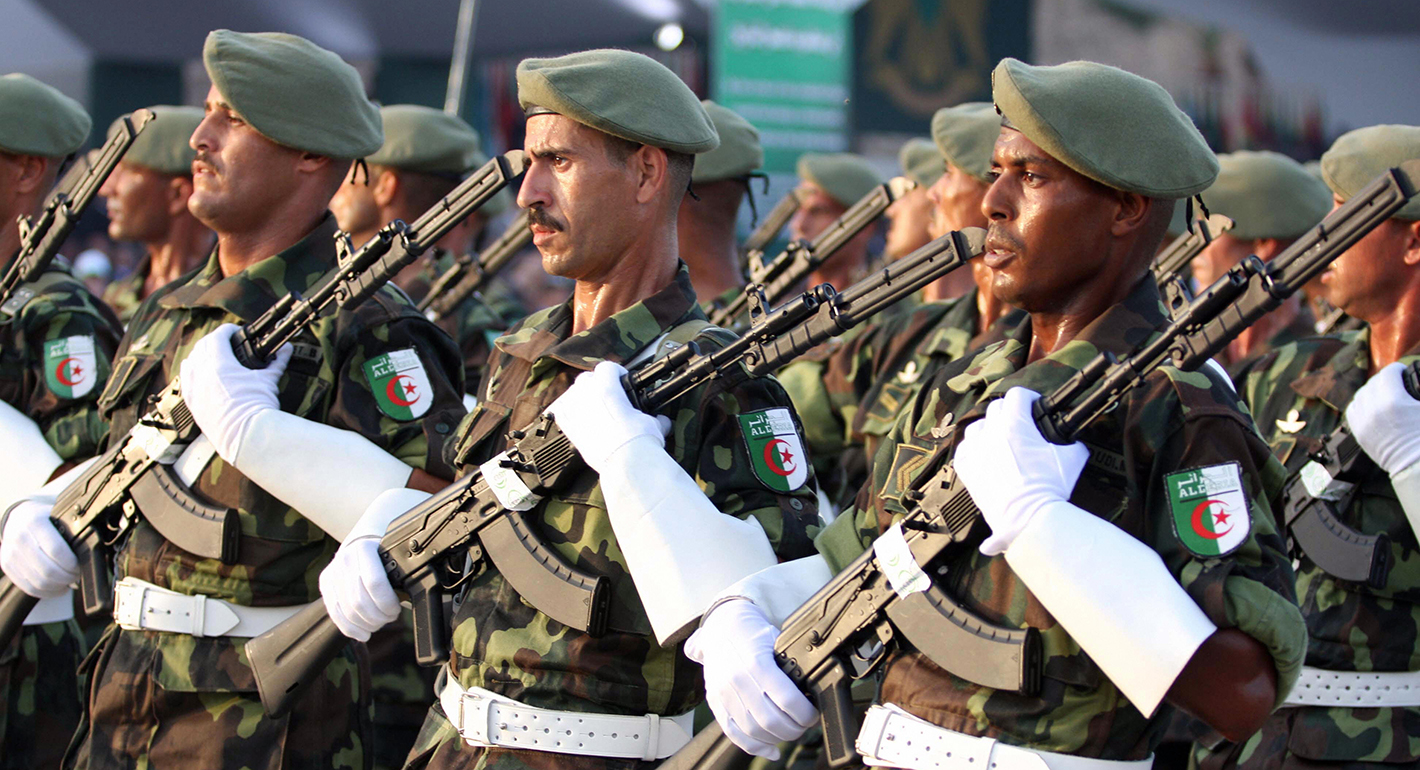
Source: Getty
Algeria’s president, Abdelaziz Bouteflika, has been dismissing high-profile security officials at an unprecedented rate without any public explanation from Bouteflika or his inner circle.
Source: World Politics Review
Since last June, Algeria’s 81-year-old president, Abdelaziz Bouteflika, has been dismissing high-profile security officials at an unprecedented rate. A who’s-who of top brass from the police, the gendarmerie and most importantly the army, which has long been the backbone of the Algerian regime, have all been replaced—and all without any public explanation from Bouteflika or his inner circle.
The shake-ups, which seemed to have concluded in late September, ousted around a dozen senior generals and regional army commanders, including the director of defense personnel, the chief of the army’s powerful Central Security Directorate, the commander of the ground forces and the head of the air force. Five of those generals were then jailed in October, apparently on charges of corruption and other wrongdoing. Last week, Bouteflika reportedly released the five generals, according to Reuters.
The full article originally appeared in World Politics Review.
Former Senior Resident Scholar, Malcolm H. Kerr Carnegie Middle East Center
Dalia Ghanem was a senior resident scholar at the Malcolm H. Kerr Carnegie Middle East Center in Beirut, where her research focuses on Algeria’s political, economic, social, and security developments. Her research also examines political violence, radicalization, civil-military relationships, transborder dynamics, and gender.
Recent Work
Dalia Ghanem


Frances Z. Brown, Judy Dempsey, Dalia Ghanem, …
Carnegie does not take institutional positions on public policy issues; the views represented herein are those of the author(s) and do not necessarily reflect the views of Carnegie, its staff, or its trustees.

Sergei Kiriyenko used Russia’s parliamentary vote to further hone his strategy of corporate mobilization that is designed to maximize votes for United Russia.

Andrey Pertsev

The European far right might fail to steer EU policy in the direction Russia wants, but they will create enough chaos inside Europe to benefit the Kremlin.

Dimitar Bechev

If the Russian-speaking community in Latvia cannot articulate their interests without being seen as disloyal, they could end up embracing a pro-Kremlin agenda.

Sergejs Potapkins

Russia’s ruling party would have benefited from Putin appearing as its distant patron, but as an active frontman imposing his views on the public, he has done nothing but harm both the party’s election campaign and the ruling system overall.
Andrey Pertsev

In the tenth year of his presidency, President Mirziyoyev’s system is becoming even more personalized than that of his predecessor Karimov.

Galiya Ibragimova