

Commentary
Joseph Bahout
{
  "authors": [
    "Joseph Bahout"
  ],
  "type": "commentary",
  "centerAffiliationAll": "dc",
  "centers": [
    "Carnegie Endowment for International Peace",
    "Malcolm H. Kerr Carnegie Middle East Center"
  ],
  "collections": [],
  "englishNewsletterAll": "menaTransitions",
  "nonEnglishNewsletterAll": "",
  "primaryCenter": "Carnegie Endowment for International Peace",
  "programAffiliation": "MEP",
  "programs": [
    "Middle East"
  ],
  "projects": [],
  "regions": [
    "North America",
    "United States",
    "Middle East",
    "Syria",
    "Levant"
  ],
  "topics": [
    "Political Reform",
    "Security",
    "Military",
    "Foreign Policy"
  ]
}
Source: Getty
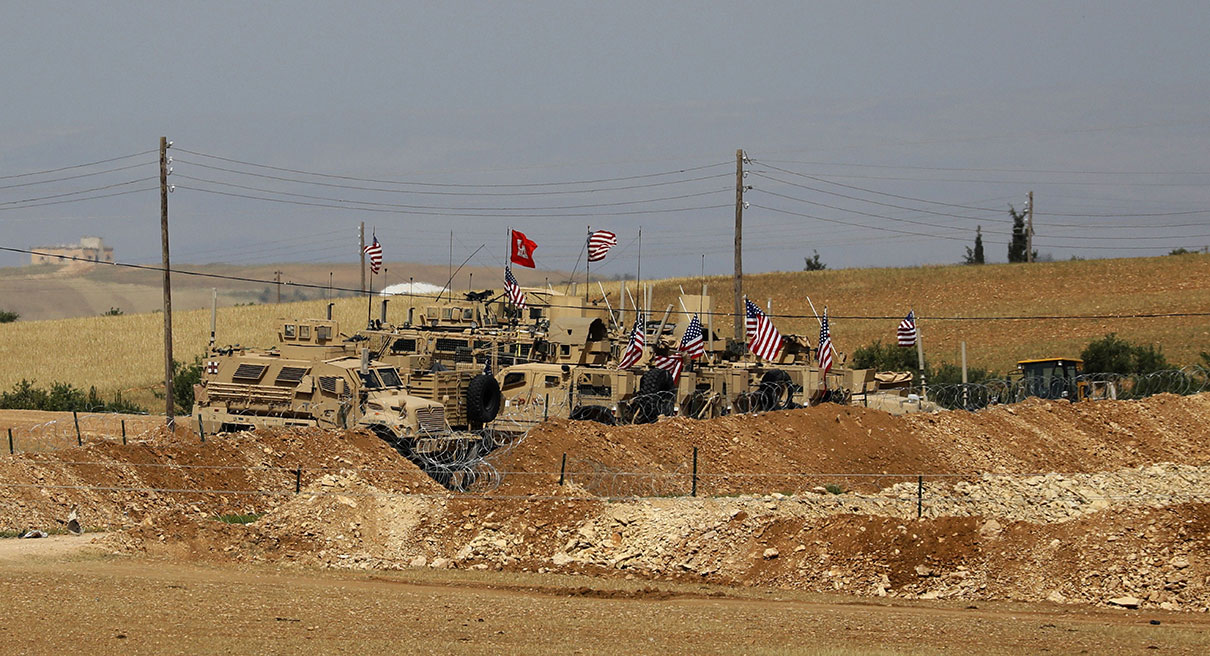
The White House is pulling U.S. forces out of Syria. U.S. President Donald Trump tweeted “We have defeated ISIS in Syria, my only reason for being there during the Trump Presidency.” What comes next?
There’s a grim joke in Washington that the end of the U.S. presence in northeast Syria was only one Trump tweet away. The sudden announcement, long promised by Trump, that the United States would withdraw its two thousand troops from Syria has proved it right.
For Beltway insiders this was predictable. The president has never been convinced that the United States needs a physical presence in a theater where it has had minimal influence and leverage.
But this analysis was not shared by many in the White House. National Security Adviser John Bolton saw the U.S. presence as a potential deterrent to Iran, his longtime obsession. Secretary of Defense James Mattis feared that an early exit would leave a vacuum the Islamic State would fill, forcing Washington to redeploy again in worse conditions.
The withdrawal allows Trump to argue that the “Islamic State has been defeated” and to fulfill a campaign promise to withdraw U.S. troops completely. Most would dispute that assessment, including the president’s own intelligence community and the Pentagon. In reports made public last August, U.S. intelligence estimated that remnants of the Islamic State still had some seventeen thousand men in Iraq and some fourteen thousand five hundred in Syria. These figures point to a risk similar to the one the Obama administration incurred in 2011 when it prematurely left Iraq, leading to increased violence and terrorist attacks. In fact, as a presidential candidate Trump enjoyed depicting that as his predecessor’s greatest sin in the Middle East.
Trump’s abrupt decision on Syria is even riskier. Tumult in Syria’s northeast could trigger a wider and uncontrolled regional confrontation. The vacuum left by the departure of U.S. troops will open a deadly race for control. Washington’s closest allies in the fight against the Islamic State have long been the Kurdish Syrian Democratic Forces. Turkey, another key player in the region, considers the Kurds a threat to its own government and will finally have a golden opportunity to try to crush its Kurdish foes with the departure of their U.S. protectors. This new front in the war will pull forces away from the fight with the Islamic State—creating an opening for the group and increasing violence in the region.
The withdrawal holds wider geopolitical risks as well. Russia will see this as a chance to boost its role as an arbiter of the Syrian conflict. This will further strengthen the regime of Syrian President Bashar al-Assad, Russia’s ally. The U.S. presence was supposed to avoid this exact outcome.
But the risks do not end here. Like all decisions by this administration, this strategy must be seen in the larger context of its obsession with Iran. U.S. military presence close to the Syrian-Iraqi border was meant to curb increasing Iranian influence in the region. Trump told Israeli Prime Minister Benjamin Netanyahu about his decision to withdraw from Syria a few days ago. In a first reaction to the U.S. public announcement, Netanyahu acknowledged the change to Israel’s strategic environment. He said that “we will take care to maintain the security of Israel and to defend ourselves in this area.” Does this mean that the Trump administration has approved Israel expanding its air raids, so far concentrated in the Damascus area, and its military engagement to directly counter Iran?
The result of withdrawing a few thousand troops to fulfill a campaign promise, against the advice of Trump’s own domestic advisers and allies in the region, will have huge consequences for the region. The Syrian conflict has become a proxy for the regional power struggle in the Middle East. The United States’ withdrawal leaves this battle raging with no end in sight and contributes to increased regional instability.
Former Nonresident Fellow, Middle East Program
Joseph Bahout was a nonresident fellow in Carnegie’s Middle East Program. His research focuses on political developments in Lebanon and Syria, regional spillover from the Syrian crisis, and identity politics across the region.
Recent Work
Joseph Bahout
Joseph Bahout
Carnegie does not take institutional positions on public policy issues; the views represented herein are those of the author(s) and do not necessarily reflect the views of Carnegie, its staff, or its trustees.

Putin’s conservative staffing policies and search for ever greater control have cemented parliament’s transformation into a bureaucratic appendage of the executive branch.

Andrey Pertsev

Russia’s AI-driven propaganda campaigns operate in a fragmented, chaotic, and often illogical manner. That’s not necessarily a problem for the Kremlin, though: It’s much easier to mimic genuine public debate that way.

Ilya Klishin

Without a ceasefire with Ukraine on attacking each other’s energy infrastructure—to which the Kremlin is unlikely to agree—the diesel agreement between Putin and Trump is largely for show, rather than representing a genuine increase in the volumes of Russian diesel on the global market.

Sergey Vakulenko

Russian strikes are weakening the economy sustaining Ukraine’s war effort. Closing the growing funding gap will require more European support and politically contentious reforms in Kyiv.

Balázs Jarábik

Ex-president Gurbanguly Berdimuhamedov remains interested in politics, but his son Serdar, Turkmenistan’s current president, is becoming increasingly independent and willing to break with his father’s legacy. If their covert rivalry goes too far, both risk losing power.

Galiya Ibragimova