

Commentary
Andrei Kolesnikov
{
  "authors": [
    "Andrei Kolesnikov"
  ],
  "type": "legacyinthemedia",
  "centerAffiliationAll": "",
  "centers": [
    "Carnegie Endowment for International Peace",
    "Carnegie Russia Eurasia Center"
  ],
  "collections": [],
  "englishNewsletterAll": "",
  "nonEnglishNewsletterAll": "",
  "primaryCenter": "Carnegie Endowment for International Peace",
  "programAffiliation": "",
  "programs": [],
  "projects": [],
  "regions": [
    "Russia",
    "Eastern Europe",
    "Ukraine"
  ],
  "topics": [
    "Political Reform"
  ]
}
Source: Getty
Will Russia equally fall for a political outsider? Only time will tell.
Source: Moscow Times
The presidential elections that took place in Ukraine and Slovakia a day apart served as a lesson both for European countries and for Russia, as a potential indicator of their political future.
Years of disappointment with the establishment has given rise to/had voters seeking fundamental change, and new faces in politics.
In this brave new world, political experience is, in fact, a negative quality for an elected head of state. Coming from outside the system can only be a good thing, along with a completely different way of speaking to voters, especially young people.
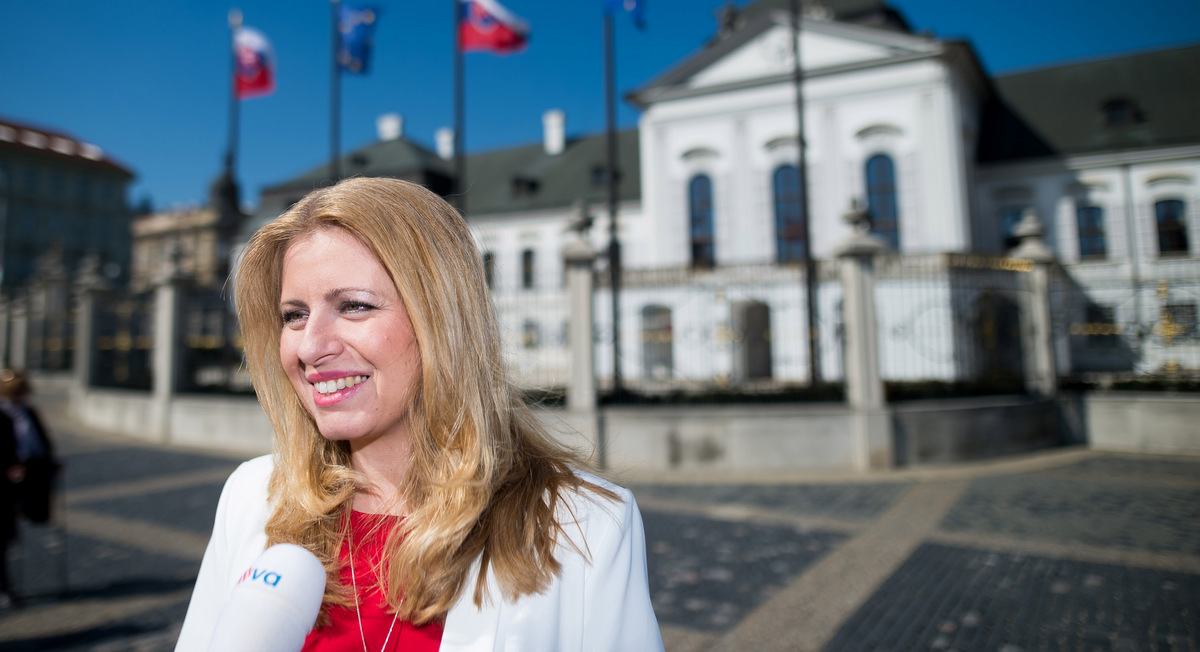
There are many differences between Zuzana Čaputová, who won the Slovakian presidential election on March 30, and Volodymyr Zelensky, who won in the first round of Ukraine’s election on March 31.
Čaputová can boast of a wealth of experience in human rights work along with a history of successfully challenging the state.
Zelensky has nothing but his reputation as a popular showman, whose on-screen role as a an ordinary guy who accidentally ends up becoming president appears to be a case of fiction becoming reality. And yet, there are many more qualities that unite them.
In a world in which election results are often determined by voters aged 65 and over, they are young. Their core audience, as surveys have shown, is made up of 18-30 year-olds.
For this, they have brought young people to the polling stations in places where no one has given a thought to the youth vote for a long time. They speak a different language: not the dialect of those on the left or the right, with empty promises, but a rhetoric that appeals on moral grounds.
Zelensky’s dream of a peaceful country is something that voters in war-torn Ukraine can relate to: a state without the grim vision of incumbent President Petro Poroshenko. Zelensky was also not afraid of offering ambitious plans rather than figures in his manifesto; instead of advertisements offering Ukrainians work in Poland, he dreamed of ads offering Poles work in Ukraine.
Maybe Zelensky’s push to appeal to Polish workers is an utopia, but voters perceive it as a clear goal, and one that’s not connected with the neverending hybrid war with Russia that must be won, through means yet unclear.
Čaputová declared ‘evil’ as her main opponent. When a seasoned politician says, “if we don’t change anything now, it will be too late,” it comes across somewhat vapid, but when it comes from the lips of a human rights defender who shut down a landfill site following a 14-year-old battle, it looks like a very concrete promise.
Zelensky and Čaputová do not look politicians. A charismatic 45-year-old divorcee and mother of two, Čaputová has charmed a Slovakia that has been heading in the same conservative direction as Poland and Hungary has in recent years. And (yet), Čaputová won the election despite the Catholic Church declaring it a sin to vote for her because of her liberal attitude to abortion and same-sex marriage.
Meanwhile, in Ukraine, it turns out that 41-year-old fun-loving Jewish comedian Zelensky is what voters need and want following Sovietized leaders Leonid Kravchuk and Leonid Kuchma, the revolutionaries Viktor Yushchenko and Yulia Tymoshenko, and the militant oligarch Petro Poroshenko, who cites Russian President Vladimir Putin’s name so frequently as if to suggest the country had no other problems.
Their respective parties, Progressive Slovakia and Servant of the People, are new and unrepresented in their countries’ parliaments. It’s hard to define them along the narrow lines of left or right-wing, the nearest approximation perhaps being populist, or liberal-populist.
This being said, it’s hard to call Čaputová a populist: her human rights and anti-corruption agenda is absolutely vital and tangible in a country that appears to have finally snapped out of a stupor, following the shocking murder of the investigative journalist Ján Kuciak and his girlfriend just over a year ago.
Čaputová’s opponent in the election was Maroš Šefčovič, a politician who, five years ago, would have been considered the perfect candidate, thanks to his experience and macho image. Now, this is only important to less than half of voters.
Poroshenko’s final campaign message was “Think” — i.e., don’t trust glib talkers; trust experienced professionals. But if the output of is corruption, monopolization, and the inability to implement reforms over the last few years, then why not entrust the running of the country to someone with relatively no experience?
So it seems that what voters want then is new leaders that operate outside the system, speak a new kind of language and present short but vibrant manifestos. For that, it’s not essential to be far left or far right; it’s important to be different. With this, perhaps extremism is going out of fashion.
And while this might appear far from Russian politics, the muted discontent that has been growing, manifesting itself in protest voting in regional elections or in the resistance to landfill sites, is gradually giving rise to a new kind of politician in Russia too. Russians might not yet be ready to accept this challenge because they don’t believe it’s genuine.
Further down the line? It might be too late then.
Former Senior Fellow, Carnegie Russia Eurasia Center
Kolesnikov was a senior fellow at the Carnegie Russia Eurasia Center.
Recent Work
Andrei Kolesnikov
Andrei Kolesnikov
Carnegie does not take institutional positions on public policy issues; the views represented herein are those of the author(s) and do not necessarily reflect the views of Carnegie, its staff, or its trustees.

Russian strikes are weakening the economy sustaining Ukraine’s war effort. Closing the growing funding gap will require more European support and politically contentious reforms in Kyiv.

Balázs Jarábik

Ex-president Gurbanguly Berdimuhamedov remains interested in politics, but his son Serdar, Turkmenistan’s current president, is becoming increasingly independent and willing to break with his father’s legacy. If their covert rivalry goes too far, both risk losing power.

Galiya Ibragimova

Despite a new textbook, an influx of Russian teachers and managers, and an end to the teaching of Ukrainian, the Kremlin is unlikely to have “reprogrammed” locals.

Konstantin Skorkin

For every ruble allocated to social policy, health, and education in 2027, double that amount is earmarked for the army, the police, and the security services.

Alexandra Prokopenko

Cargo traffic through Russia’s Northern Sea Route has increased because of the disruption caused by the conflict in the Middle East, the Ukraine war, and U.S.-China tensions.

Mikhail Korostikov