

Paper
Ashley J. Tellis
{
  "authors": [
    "Ashley J. Tellis"
  ],
  "type": "legacyinthemedia",
  "centerAffiliationAll": "dc",
  "centers": [
    "Carnegie Endowment for International Peace"
  ],
  "collections": [],
  "englishNewsletterAll": "ctw",
  "nonEnglishNewsletterAll": "",
  "primaryCenter": "Carnegie Endowment for International Peace",
  "programAffiliation": "SAP",
  "programs": [
    "South Asia"
  ],
  "projects": [],
  "regions": [
    "South Asia",
    "India",
    "Pakistan"
  ],
  "topics": [
    "Security",
    "Military",
    "Foreign Policy"
  ]
}
Source: Getty
Real change will come only when the Pakistani polity begins to believe that the costs of the policies pursued by its army far exceed the benefits accruing to Pakistan as a country.
Source: Business Today
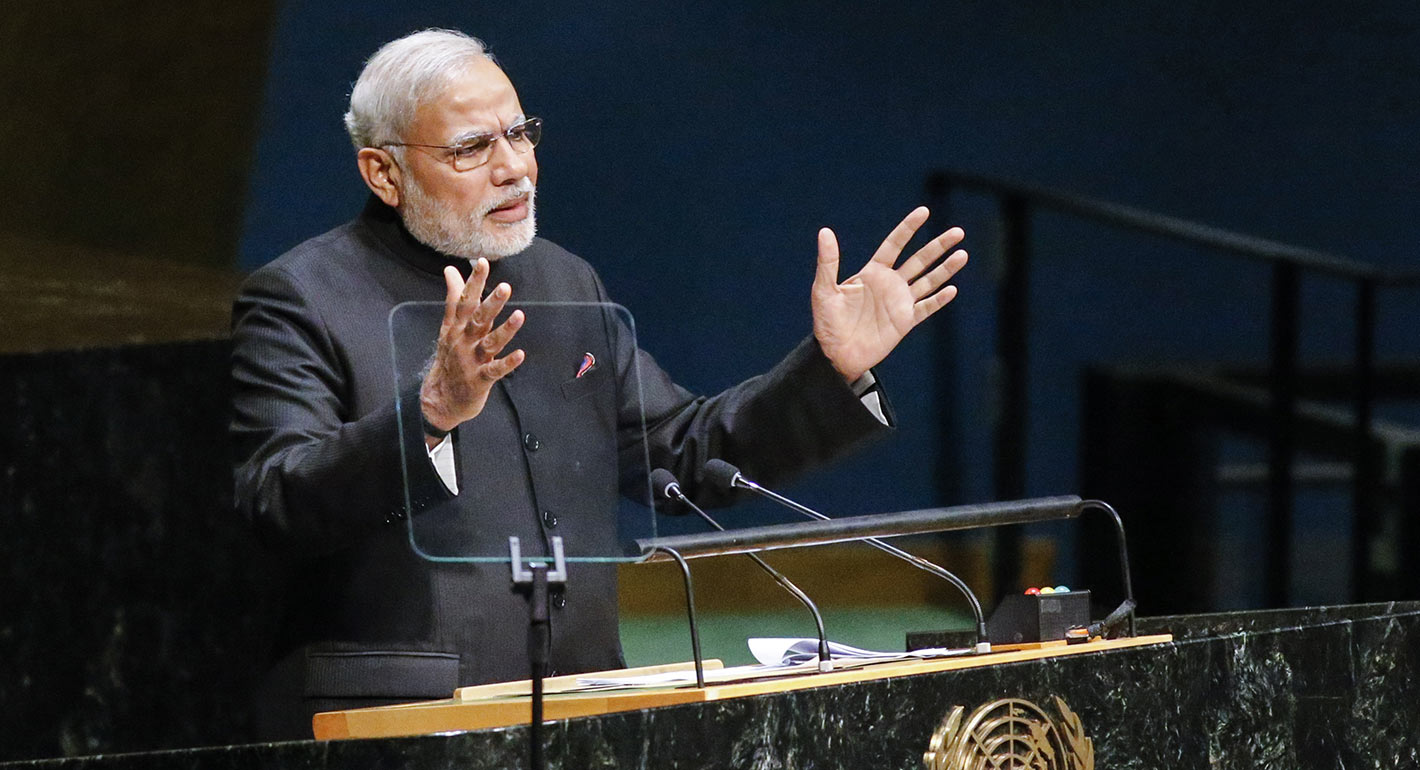
Ashley J. Tellis, Tata Chair for Strategic Affairs and a senior fellow at Carnegie Endowment for International Peace, discusses India's foreign policy under Prime Minister Narendra Modi with Business Today's Anilesh S. Mahajan.
Manmohan Singh's outreach in West Asia focussed on broadening India's engagement with all regional states. That policy was appropriate then, given that India had become disengaged from the region. In contrast, PM Modi's policy has focussed on making big bets on a few states - Israel, Saudi Arabia, and the United Arab Emirates - even as it has preserved India's traditional ties with others.
Manmohan Singh's policies towards West Asia reflected the constraints of his time. He focussed fundamentally on transforming ties with the US during his first term, but was unfortunately paralysed on many counts during the second term. Modi's policies represent a natural evolution: India is now stronger, more confident and is more capable of selectively engaging some states based on their relevance to India's national interests. Such selectivity was inevitable but the manner in which India has been able to engage all regional players despite the deep political divides that mark West Asia, is striking.
He certainly surprised many by the manner in which he engaged key Islamic states in the Persian Gulf, both Sunni Arab states and Shia Iran. This has been one of the major successes of his foreign policy and the potential benefits for India are significant. The way he has managed to enlarge India's ties to Israel, even as he has engaged the Gulf states is also remarkable-though this outcome has been undoubtedly aided by the changing attitude to Israel within the Gulf itself.
The risk of drift in the bilateral relationship is real if both sides fail to address current disagreements. There is no doubt that Trump is deeply transactional. It is a product of his worldview, which, as Robert Kagan summarised aptly, "has no sense of responsibility to anything beyond itself". Having said that, however, the Trump administration has also been schizophrenic where India is concerned: it is strongly supportive of strengthening India's military capabilities as a means of balancing China's rise, while at the same time pressing hard on New Delhi to change its economic policies on a few issues to benefit the US. If the tension over trade policy is not resolved, the gains made in the strategic arena could be at serious risk-serious because other US policies towards Russia, Iran, and Afghanistan have the effect of undermining critical Indian interests in ways that the administration's priority on India, in the Indo-Pacific context, will not be able to compensate.
The new government that will be formed in India should move quickly to address current challenges. Most, but not all, of the economic disputes are actually modest in the scheme of things and can be addressed with some creativity after the pressures of elections are over. There are some difficult issues on the horizon, however, such as the draft Indian legislation on data localisation, which will be deeply damaging to India itself. I hope New Delhi will not move further in that direction because potential US reprisals would be even more damaging than the costs inflicted by the current threatened withdrawal of General Schedule of Preferences (GSP) benefits. But Washington, too, needs to be cognizant of Indian economic interests and create some breathing space for New Delhi, where political differences in regard to Russia, Iran and Afghanistan are concerned. The Trump administration's approach so far has been one of holding India to ransom rather than seeking to achieve a diplomatic solution on these latter issues. I am therefore pessimistic that a genuine transformation in bilateral ties can be sustained during the next two years, though obviously we should not cease to try.
This is the old normal for the Trump administration. It will not change as long as Trump is in office.
I don't see any easy or happy endings here. India cannot reduce oil imports from Iran to zero for both technical and strategic reasons. Equally importantly, any US action vis-a-vis Iran that raises oil prices has severe consequences in Indian domestic politics and for India's balance of payments. The obduracy of the Trump administration, however, implies that satisfactory solutions are unlikely. Even worse, it could push India towards supporting the European, Russian and Chinese positions on the Joint Comprehensive Plan of Action, which New Delhi has refrained from doing thus far-with even more problematic consequences for the relationship with Washington.
No, the Quad will not contain the rise of Chinese power, at least not yet. For the foreseeable future, it will remain only a consultative mechanism, not an alliance against rising Chinese power. Balancing China will require other solutions: deepening US alliances and partnerships in Asia, and building up the national capabilities of key Asian states on China's periphery. The Quad is useful, but not central, in this context.
There is no alternative to a tough policy towards Pakistan. All other alternatives have been tried without success. But real change will come only when the Pakistani polity begins to believe that the costs of the policies pursued by its army far exceed the benefits accruing to Pakistan as a country. Unfortunately, we are not there yet.
Former Senior Fellow
Ashley J. Tellis was a senior fellow at the Carnegie Endowment for International Peace.
Recent Work
Ashley J. Tellis
Ashley J. Tellis
Carnegie does not take institutional positions on public policy issues; the views represented herein are those of the author(s) and do not necessarily reflect the views of Carnegie, its staff, or its trustees.

When faced with fuel shortages in the past, Central Asian governments could always count on additional supplies from Moscow. That safety net no longer exists.

Galiya Ibragimova

Two divergent trends—Putin’s hardline vision of how to prosecute the war in Ukraine, and a growing desire for change in Russia—could tear the regime apart.

Tatiana Stanovaya
Andrey Melnichenko’s essay offers no answer to the fundamental question of how, under any kind of negotiated settlement, Europe can protect itself from the Russian ressentiment that is inevitable in all scenarios except for an outright victory for Putin.

Leonid Bershidsky

Despite unhappiness on the ground, Moscow is determined to use both carrot and stick to ensure there is record support for United Russia in occupied Ukraine.

Konstantin Skorkin
The recent damage inflicted by Ukrainian drones and missiles on Russia has made Belarus aware of its own vulnerabilities—and surprisingly amenable to Kyiv’s demands.

Artyom Shraibman