

Commentary
- +11
Cornelius Adebahr, Dan Baer, Rosa Balfour, …
{
  "authors": [
    "Erik Brattberg"
  ],
  "type": "commentary",
  "centerAffiliationAll": "dc",
  "centers": [
    "Carnegie Endowment for International Peace"
  ],
  "collections": [],
  "englishNewsletterAll": "ctw",
  "nonEnglishNewsletterAll": "",
  "primaryCenter": "Carnegie Endowment for International Peace",
  "programAffiliation": "EP",
  "programs": [
    "Europe"
  ],
  "projects": [],
  "regions": [
    "Western Europe",
    "Iran"
  ],
  "topics": [
    "Political Reform"
  ]
}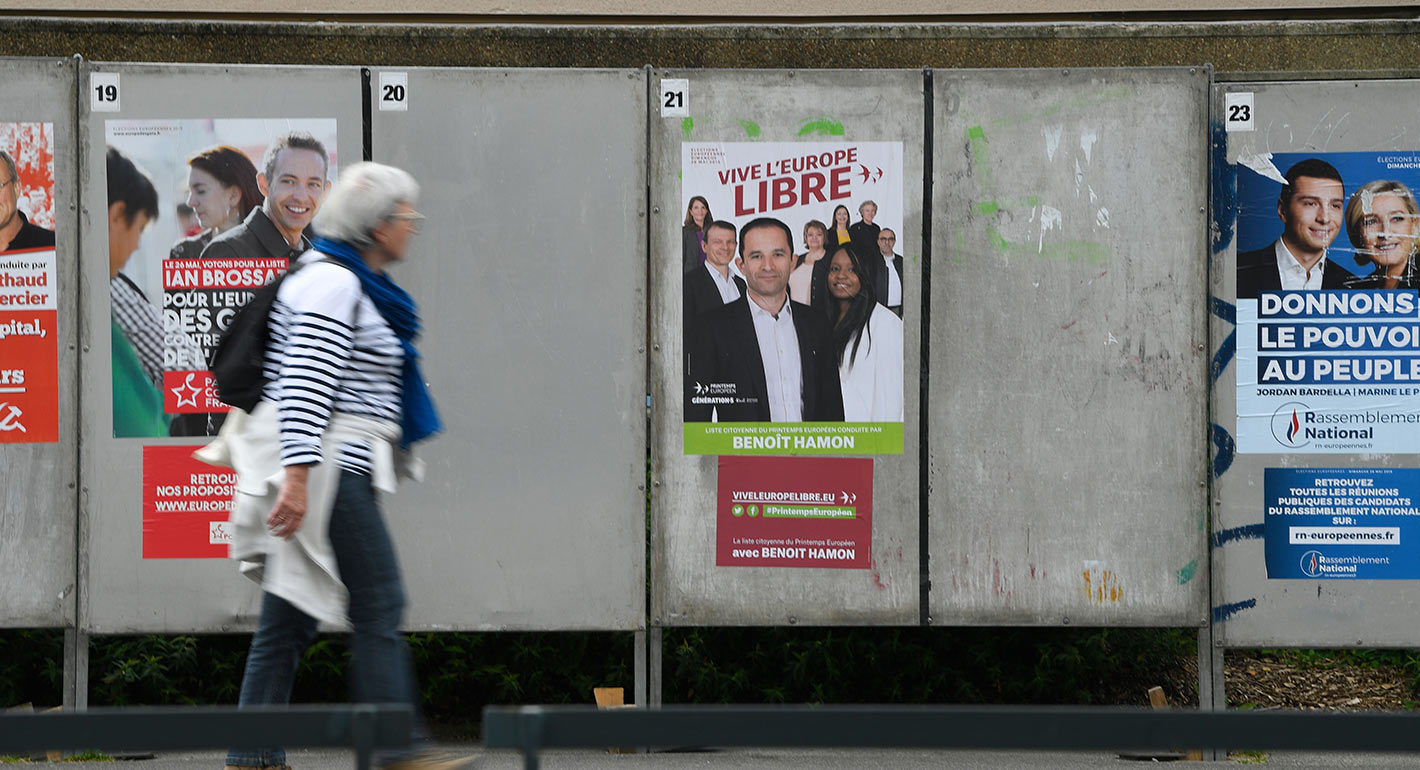
Source: Getty
Brexit has made leaving the EU seem unappetizing, so nationalists now want to change the European Union from within. To stop them, pro-European parties of different political colors will need to band together.
European Parliament elections may seem like rather dull affairs, with average voter turnout hovering around 42 percent. But the upcoming election on May 23–26, 2019, could be different. These contests come amid growing political fragmentation and as leaders must answer fundamental questions about the future direction of the European project itself.
In the last Europe-wide election five years ago, far-right parties made crucial, albeit uneven, gains. Since that “political earthquake” occurred, a series of major disruptions have shaken Europe and the wider international system, including Russia’s illegal annexation of Crimea in 2014, Europe’s 2015 migration crisis, and the UK’s 2016 Brexit vote.
Europe’s political landscape has also continued to fragment. Support for traditional center-right and center-left parties has declined, and far-right (and far-left) Euroskeptic parties have made gains in several national elections. The upcoming EU election is expected to reflect these shifts. For four decades, the two largest pan-European political groups—the center-right European People’s Party (EPP) and the center-left Progressive Alliance of Socialists and Democrats (S&D)—have enjoyed a coalition majority in the European Parliament. Opinion polls suggest that they are likely to remain the two biggest party groups but will probably lose their combined majority. At the same time, centrist political groups like the Alliance of Liberals and Democrats (ALDE) and the Greens are both expected to perform well in the election.
A crucial factor will be how well French President Emmanuel Macron’s En Marche! party fares, and where it will align itself within the European Parliament. One possibility is that Macron’s party will seek to form a brand-new centrist European Renaissance group, bringing together Green, Socialist, and Liberal parties to give itself a kingmaking role. For Macron, the election matters not only for his own standing domestically in France but also for his ambitious EU reform agenda. A win for rival Marine Le Pen’s National Rally party would mark a symbolic blow to his leadership both at home and throughout Europe.
Meanwhile, anti-European parties are expected to make notable gains and could end up controlling about a third of the seats. Rather than running on a platform of tearing up the EU, many of these groups are now campaigning to change the EU from within in a less liberal and internationalist direction, opposing further EU integration. There is even talk of a new pan-European alliance of nationalists led by Italy’s populist deputy prime minister, Matteo Salvini, together with like-minded parties from Denmark, Finland, and Germany (and possibly Poland and Hungary) with an appeal to “a Common Sense Europe!”.
The UK’s difficulties with negotiating the terms of Brexit underpin this shift in Euroskeptic parties’ approach. The wrangling has arguably dampened the desire of other countries to follow suit and also leave the EU, helping improve public sentiments about the EU across the continent to a 35-year high. Yet, although they see eye-to-eye on issues like migration, the diverse group of anti-European parties have yet to demonstrate that they can form and act as a cohesive bloc in the European Parliament over a sustained period of time.
What is more certain is that to maintain their pro-European majority, the EPP and the S&D will need to broker new coalitions with centrist political groups like ALDE and the Greens. Consequently, legislative action may become more cumbersome, and coalitions could end up being less stable and predictable.
This all matters deeply, because as the EU’s only directly elected institution, the European Parliament is at the heart of the union’s democratic legitimacy. The 2010 Lisbon Treaty gave the parliament additional powers in the EU’s decisionmaking processes. As a result, the parliament can co-decide with the European Council (composed of member state ministers) on legislative matters in many different policy areas. These areas include internal market and consumer protection, the environment, transportation, and energy. In other areas, such as international agreements, the parliament can give consent or offer nonbinding opinions.
Two immediate tests for the incoming European Parliament will be deciding on the EU’s multiannual budget and the appointment of a new European Commission, the EU’s executive branch. The parliament has a say over both who will become the president of the commission and who will serve in his or her cabinet. The European Parliament wants the political group with the most seats to appoint the European Commission president, but many EU member capitals oppose this practice.
The composition of the next European Parliament will likely more closely mirror the political fragmentation already seen in many national European parliaments. This need not be a wholly negative development, if centrist-oriented parties can find new ways to band together on common pro-European platforms. The fact that the election is viewed, at least by critics of the EU, as a referendum on Europe’s future ought to galvanize the union’s supporters. They will have to step up their efforts in order to jointly defend the EU’s original values, promote practical reforms, and address the long-term challenges facing Europe.

Former Director, Europe Program, Fellow
Erik Brattberg was director of the Europe Program and a fellow at the Carnegie Endowment for International Peace in Washington. He is an expert on European politics and security and transatlantic relations.
Recent Work



Cornelius Adebahr, Dan Baer, Rosa Balfour, …

Erik Brattberg, Philippe Le Corre, Paul Stronski, …
Carnegie does not take institutional positions on public policy issues; the views represented herein are those of the author(s) and do not necessarily reflect the views of Carnegie, its staff, or its trustees.

Sergei Kiriyenko used Russia’s parliamentary vote to further hone his strategy of corporate mobilization that is designed to maximize votes for United Russia.

Andrey Pertsev

The European far right might fail to steer EU policy in the direction Russia wants, but they will create enough chaos inside Europe to benefit the Kremlin.

Dimitar Bechev

If the Russian-speaking community in Latvia cannot articulate their interests without being seen as disloyal, they could end up embracing a pro-Kremlin agenda.

Sergejs Potapkins

Russia’s ruling party would have benefited from Putin appearing as its distant patron, but as an active frontman imposing his views on the public, he has done nothing but harm both the party’s election campaign and the ruling system overall.
Andrey Pertsev

In the tenth year of his presidency, President Mirziyoyev’s system is becoming even more personalized than that of his predecessor Karimov.

Galiya Ibragimova