

Commentary
Despite a new textbook, an influx of Russian teachers and managers, and an end to the teaching of Ukrainian, the Kremlin is unlikely to have “reprogrammed” locals.
Konstantin Skorkin
{
  "authors": [
    "Paul Stronski",
    "Aleksandar Vladicic"
  ],
  "type": "questionAnswer",
  "centerAffiliationAll": "dc",
  "centers": [
    "Carnegie Endowment for International Peace"
  ],
  "collections": [],
  "englishNewsletterAll": "ctw",
  "nonEnglishNewsletterAll": "",
  "primaryCenter": "Carnegie Endowment for International Peace",
  "programAffiliation": "russia",
  "programs": [
    "Russia and Eurasia"
  ],
  "projects": [
    "The Return of Global Russia: A Reassessment of the Kremlin’s International Agenda"
  ],
  "regions": [
    "North Africa",
    "Southern, Eastern, and Western Africa",
    "Russia"
  ],
  "topics": [
    "Security",
    "Foreign Policy",
    "Global Governance"
  ]
}
Source: Getty
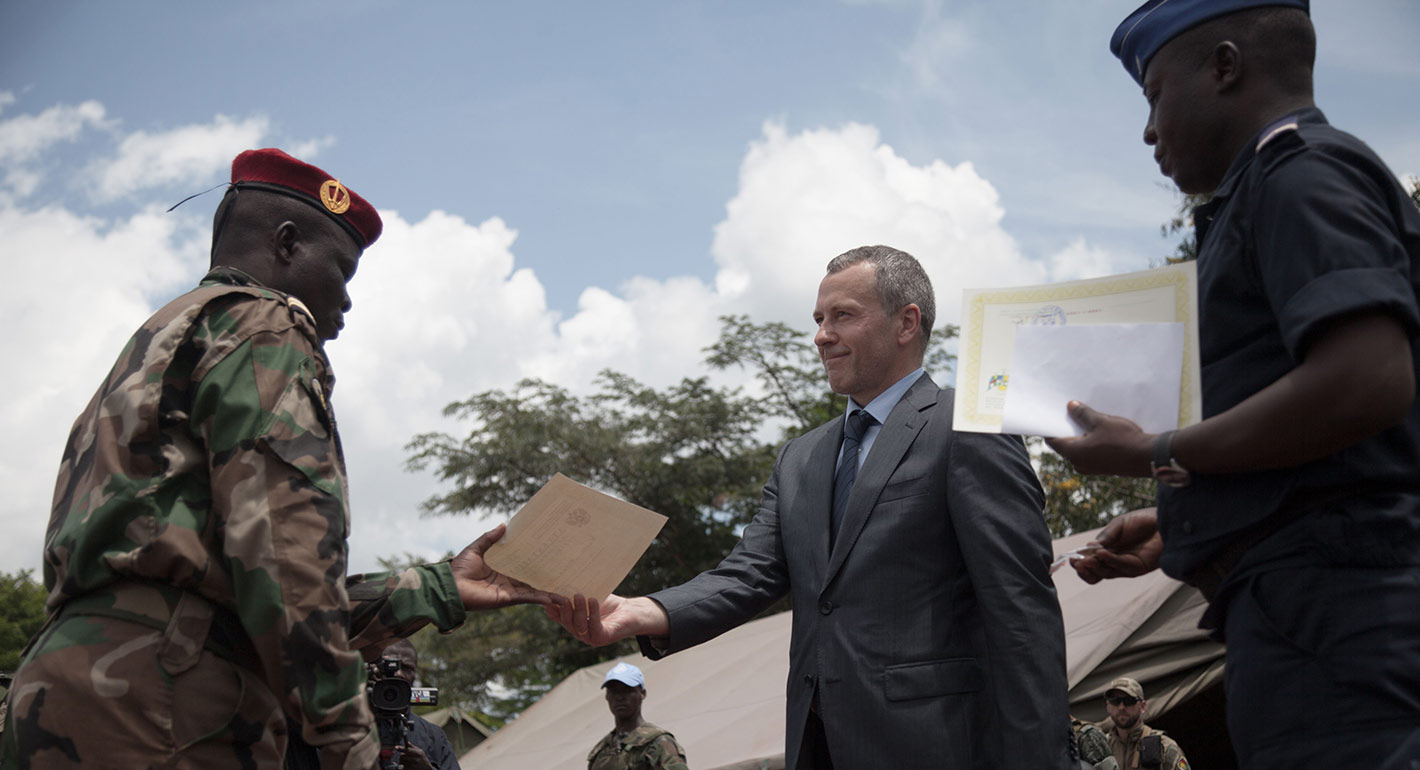
Decades after the Soviet Union wooed the leaders of Africa’s newly independent nations with weapons, scholarships, and anti-colonial rhetoric, Moscow is trying to stage a comeback on the continent. Can the Kremlin leverage its lean resources to wily effect on Africa?
Not really. The Kremlin is more than happy to play up its role in Africa for PR purposes and to seize any opportunities that come its way.
Yet Moscow is nowhere near restoring the status that the Soviet Union once enjoyed on the continent, let alone China’s current role. Russia’s clout in Africa remains tied to a handful of client states with relatively limited strategic significance, such as the Central African Republic (CAR). The Kremlin has no military footprint in Africa, nor the hefty resources needed to address the economic, development, security, and humanitarian challenges that the continent faces. When given the choice, Moscow typically opts for rattling the West, instead of doing the heavy lifting to establish itself as an influential power in Africa, beyond a few client states.
Russia lacks a robust and coordinated strategy on Africa. The Soviet legacy does not provide a terribly useful springboard for current Russian outreach efforts.
To be sure, Moscow’s no-questions-asked policy on arms sales comes in handy in various parts of Africa, as does some countries’ need for restocking Soviet-era equipment.
But on the whole, Russia’s hard power capabilities and appetite for risk on the continent are extremely limited. This helps explain why the Kremlin relies on proxies like the Wagner Group, a government-controlled “private” security company, to intervene in certain conflict zones.
Russia is not one of sub-Saharan Africa’s main trading partners, nor is it a major source of foreign investment. Russian officials claim they have offered roughly $20 billion in debt relief to Africa over the past two decades. That pales in comparison to upwards of $143 billion in commercial loans that Chinese entities have given between 2000 and 2017. Large state-owned Russian companies such as Rosatom, which handles nuclear power plant construction projects, have signed a flurry of agreements, but have a long history of overpromising and under-delivering.
Russia’s outreach, limited debt relief, and arms sales help the Kremlin court African leaders and win their support within international bodies such as the UN, where Africa accounts for about one quarter of member states. That meshes nicely with long-term Russian efforts to dilute U.S. power and create a multipolar world.
But while modern Russia is undoubtedly carving a toehold in places like CAR, Angola, Sudan or Zimbabwe, it lacks the Soviet Union’s resources, ideology, and anti-colonialist appeal to build its sway beyond a few select countries..
The Sochi meeting will reportedly be attended by approximately fifty senior African leaders. It’s a good illustration of the Kremlin’s preference for pomp and circumstance over making a major investment in its role on the continent. Russia stands to benefit from a clear decline in the level of priority that U.S. and Western policymakers have devoted to Africa in recent years. Seizing opportunities and filling vacuums are hallmarks of current Russian foreign policy behavior. Low-cost, low-risk strategies are helping Russia inflate its clout and unnerve the West in a number of regions, including North Africa, Latin America, and the Middle East.
The first order of business is to reenergize Western policy efforts and remove the sense of drift and inattentiveness that have left some African countries vulnerable to Russian inroads. That means focusing on fundamentals such as corruption, poor governance, weak rule of law, post-conflict resolution, and basic quality-of-life issues.
The United States should not overestimate Russia’s role in Africa, and needs to be clear-eyed about the enormous gap between Russia’s geopolitical ambitions and its actual capabilities. More energetic Western diplomatic efforts could disrupt the cozy alignment between Russia and African powers in international organizations. The United States and other Western governments can work with African government, media, and civil society partners to expose Russia’s malign actions, corrupt schemes, and support for oppressive regimes, including the use of security firms such as Wagner.
For an in-depth analysis of Russian influence in Africa, read Paul Stronski’s paper, Late to the Party: Russia’s Return to Africa.
This q&a is based on research supported the United States European Command, with additional support from C5 Capital. The views and conclusions contained in this document are those of the author and should not be interpreted as representing the official polices, either express or implied, of the United States Government.
Former Senior Fellow, Russia and Eurasia Program
Paul Stronski was a senior fellow in Carnegie’s Russia and Eurasia Program, where his research focuses on the relationship between Russia and neighboring countries in Central Asia and the South Caucasus.
Aleksandar Vladicic
Former Research Assistant, Russia and Eurasia Program
Aleksandar Vladicic was a research assistant with the Carnegie Russia and Eurasia Program. He was formerly a James C. Gaither Junior Fellow with the Russia and Eurasia Program.
Carnegie does not take institutional positions on public policy issues; the views represented herein are those of the author(s) and do not necessarily reflect the views of Carnegie, its staff, or its trustees.

Despite a new textbook, an influx of Russian teachers and managers, and an end to the teaching of Ukrainian, the Kremlin is unlikely to have “reprogrammed” locals.

Konstantin Skorkin

For every ruble allocated to social policy, health, and education in 2027, double that amount is earmarked for the army, the police, and the security services.

Alexandra Prokopenko

Cargo traffic through Russia’s Northern Sea Route has increased because of the disruption caused by the conflict in the Middle East, the Ukraine war, and U.S.-China tensions.

Mikhail Korostikov
An analysis of traffic accident data suggests that Ukrainian drone attacks caused a material but not disastrous fall in Russian gasoline consumption over the summer.

Sergey Vakulenko

Sergei Kiriyenko used Russia’s parliamentary vote to further hone his strategy of corporate mobilization that is designed to maximize votes for United Russia.

Andrey Pertsev