

Commentary
Alexander Gabuev
{
  "authors": [
    "Alexander Gabuev"
  ],
  "type": "legacyinthemedia",
  "centerAffiliationAll": "",
  "centers": [
    "Carnegie Endowment for International Peace",
    "Carnegie Russia Eurasia Center"
  ],
  "collections": [
    "Pax Sinica"
  ],
  "englishNewsletterAll": "",
  "nonEnglishNewsletterAll": "",
  "primaryCenter": "Carnegie Endowment for International Peace",
  "programAffiliation": "",
  "programs": [],
  "projects": [],
  "regions": [
    "East Asia",
    "China",
    "Russia"
  ],
  "topics": [
    "Foreign Policy"
  ]
}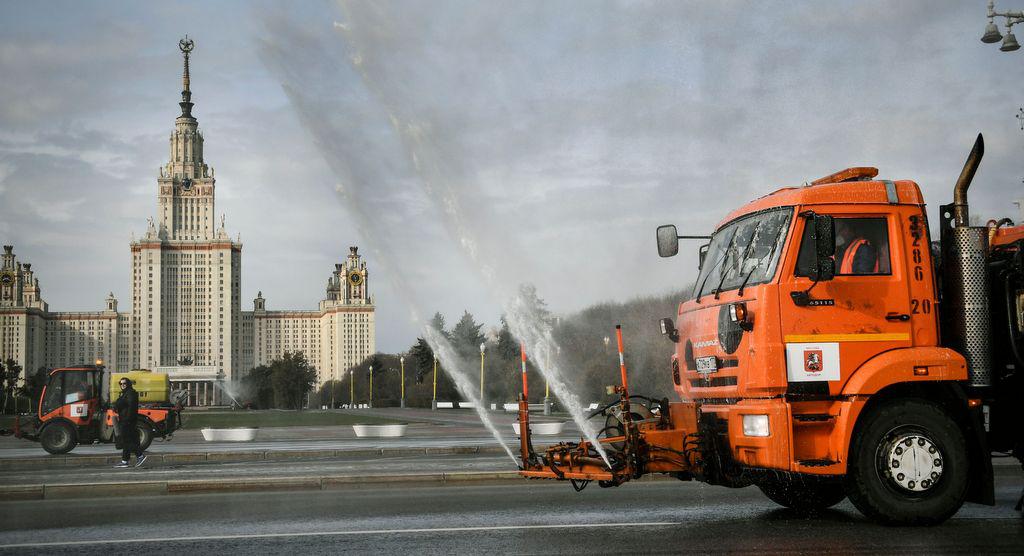
Source: Getty
Despite border closures, Russia and others may be pushed even closer to Beijing.
Source: Foreign Policy
The first phase of the coronavirus outbreak delivered a blow to Russian President Vladimir Putin’s vision of a China-Russia quasi-alliance. Following a schism in the Kremlin’s relations with the United States, Putin has touted ties to Beijing as an antidote to Western sanctions. In October 2019, the Russian president admitted that Moscow was helping Beijing to create a missile attack early warning system and characterized Sino-Russian ties as “an allied relationship in the full sense of a multifaceted strategic partnership.”
The pandemic is putting a spotlight on the lingering mistrust at both the general public and senior official levels between Moscow and Beijing that has long coexisted with the made-for-TV camaraderie between Putin and Chinese President Xi Jinping. The recent closure of the northern Chinese city of Harbin, in the wake of a fresh mini-outbreak imported from across the Russian border, has highlighted similar suspicions among Chinese leaders. But the hopes of some U.S. and European officials to hasten a new Sino-Russian split are bound to be disappointed. If anything, relations will deepen in the wake of the pandemic. Beijing’s inroads in Russia and across the vast landmass of post-Soviet Eurasia could have global ramifications as the global competition between the United States and China accelerates.
After the annexation of Crimea and the dramatic breakdown in the U.S.-China relationship under President Donald Trump, the Kremlin’s policy has been rooted in the rapid expansion of security, economic and energy ties with Beijing. Since 2014, Moscow and Beijing have regularly touted their joint military exercises, high-profile energy exploration and pipeline deals, and a good cop-bad cop routine to constrain U.S. power on issues like the Syrian civil war, the North Korea nuclear crisis, and the future of internet governance.
Then along came the new coronavirus, which exposed the deep level of suspicion that still exists between the two giant neighbors. On the Chinese side, Russia is not viewed as a real superpower that can compete with China or the United States for global leadership. Although it’s rarely pronounced officially, the most frank Chinese Russia watchers privately characterize the country as being in long-term decline amid a shrinking population, mounting corruption, and a one-sided dependency on exports of oil and gas.
Historic grievances on issues like the so-called unfair treaties forced on China by imperial Russia back in the 19th century and earlier, a narrative that still gets tacit backing from the government despite official resolution of the border issues more than a decade ago, adds to the hostility that Chinese netizens frequently express toward Russia on the internet. Over the last decade, the attitude of the Russian public toward China has dramatically improved since the early days of the 1990s, when many were worried about possible Chinese colonization of the Far East. However, lingering suspicions pop up immediately as soon as there is news about China’s possible involvement in Russian agriculture, water resources, or forestry. As the pandemic has shown, public health issues can be included in this list of sensitive issues that trigger anti-Chinese sentiments in Russia.
Russia was among the first countries that rushed to ban the entry of Chinese citizens back in February. It swiftly shut down the 2,600-mile border between the two countries. Across Russia, Chinese students were summarily deported. Chinese nationals were harassed on the streets of Russian cities, prompting official protests by Beijing. Russia has shown vocal support to Xi’s “people’s war” on the virus at a high official level and has praised Beijing’s handling of the pandemic, as exemplified in April 16 phone call between Putin and Xi. This helps explain why Beijing’s reaction to the unfair treatment of Chinese in Russia was muted compared with its vocal defense of compatriots elsewhere. However, in private, senior Kremlin officials have been frustrated by the quality and amount of information about the pandemic provided by Chinese counterparts. The reaction of the authorities and public in Central Asia was similar.
Yet just a few weeks later, things look very different. As Russia and the Central Asian states struggle to contend with the challenges posed by the pandemic, China is becoming even more central to their calculations. Russia may have nearly $600 billion in hard currency reserves, but with the number of infections and deaths from the coronavirus quickly rising and Russia’s badly underfunded national health system at risk of being overwhelmed, now is not the time for more chest-thumping and finger-pointing. The stay-at-home orders imposed in most Russian cities risk stoking social unrest not least because the government is reluctant to use all of its financial ammunition right away and roll out generous aid packages. The Kremlin’s problems have been compounded by the oil price shock. The Central Asian nations, which lack Russia’s vast reserves and with weaker state capacity, are facing even grimmer problems.
Under these challenging circumstances, China remains unquestionably the most important external partner for these embattled regimes. Firstly, the possibility that China will mount an economic recovery more quickly than Europe or the United States is perhaps the only bright spot for commodity exporters in Russia and Central Asia. While Russian oil shipments to Europe continue to fall, volumes pumped to China have remained stable so far, thanks to Beijing’s desire to fill its strategic reserve at favorable price levels.
The Kremlin and Russian elites pin their hopes on the proposition that China will roll out massive measures to support its tumbling economy and prevent growing unemployment from causing social unrest and will continue government-driven spending on construction and infrastructure, including accelerating rollout of 5G networks, giant data centers, and more. Following cuts envisaged by the OPEC deal, Russia will have to decrease shipments of oil to Europe while continuing to supply oil to China in order to meet the obligations of Rosneft, the largest state-owned oil company in the country, under its multiple long-term contracts with Chinese energy companies. With these two developments in sight, China’s current position as the dominant trade partner for Russia and Central Asia will be reinforced. The first-quarter data published by Chinese Customs supports this trend. As China’s trade volume with the outside world has plunged by 8.4 percent, trade with Russia has grown by 3.4 percent to $25.4 billion. Trade with Kazakhstan, its other important source of oil, has jumped by 17.8 percent.
Secondly, there is huge appetite among insecure leaders across Eurasia to emulate China’s model of societal control and surveillance. Chinese companies including Hikvision and Huawei have been aggressively pushing their products to authoritarian leaders in the region long before the pandemic. Moscow’s city government was an early adopter of this technology, relying on Chinese vendors like Hikvision. In Central Asia, Huawei and other Chinese companies have been building similar systems throughout the last decade. For the Kremlin, the pandemic has been the best possible justification for the rapid embrace of Chinese-style monitoring systems, such as the surveillance cameras equipped with facial recognition technology that are starting to appear on city streets. Now it is increasingly likely that other Russian cities will roll out similar systems, and the Kremlin will no doubt turn to China for technical assistance.
The growing importance of telework for the Russian economy means that the Kremlin will also accelerate its plans to upgrade Russia’s digital infrastructure, including the rollout of 5G. Given the Russian security services’ deep mistrust of Western tech companies, Huawei and ZTE will remain the overwhelming front-runners in the race to supply key hardware for the Russian 5G market. Russia’s willingness and ability to hedge its bets via trial projects with Nokia and Ericsson are now more doubtful. Thanks to pressure on the Russian state budget, Chinese vendors, which can provide cutting-edge technology at lower prices than European companies, will have clear advantage.
Before the pandemic, French President Emmanuel Macron had been trying to convince the Kremlin not to put all of its eggs in China’s basket and has publicly called for improvement of Europe’s relationship with Russia in order to prevent the emergence of a Sino-Russian axis dominated by Beijing. According to Macron’s interview with the Economist, Putin should be provided with options by the West in order not to turn him into “China’s vassal.”
Such arguments are now going to be a lot harder to make, especially as Europe finds itself mired in a painful recession. If anything, Beijing is set to boost its role across Eurasia as the major driver of economic growth, the provider of critical technologies, and the enabler of establishing new forms of political control for regimes that are feeling a whole lot wobblier. Ironically, the virus outbreak may bring China one step closer to the establishment of a Pax Sinica, a Beijing-centered regional order that covers large swaths of the Eurasian landmass.

Director, Carnegie Russia Eurasia Center
Alexander Gabuev is director of the Carnegie Russia Eurasia Center. Gabuev’s research is focused on Russian foreign policy with particular focus on the impact of the war in Ukraine and the Sino-Russia relationship. Since joining Carnegie in 2015, Gabuev has contributed commentary and analysis to a wide range of publications, including the Financial Times, the New York Times, the Wall Street Journal, and the Economist.
Recent Work
Alexander Gabuev
Alexander Gabuev
Carnegie does not take institutional positions on public policy issues; the views represented herein are those of the author(s) and do not necessarily reflect the views of Carnegie, its staff, or its trustees.
Political pressure and economic headwinds are closely intertwined problems for Russian publishers and booksellers. Together, they risk propelling Russia into a “post-literate” era.

Galina Yuzefovich

In the discussions made possible by the State Duma election campaign, one question is being asked more and more loudly. “What next?”

Andrey Pertsev

While the Nazis rushed ahead in a revolutionary fervor, Russia’s modern crusaders against enemies of the state work methodically, giving their targets time to adjust to restrictions before closing the loopholes.

Leonid Bershidsky

When faced with fuel shortages in the past, Central Asian governments could always count on additional supplies from Moscow. That safety net no longer exists.

Galiya Ibragimova

Reading the purported correspondence of celebrity Ksenia Sobchak sheds light on her role within the system, and how journalism and politics function in Putin’s Russia.

Vladislav Gorin