

Commentary
Sergey Vakulenko
{
  "authors": [
    "Sergey Vakulenko"
  ],
  "type": "commentary",
  "blog": "Carnegie Politika",
  "centerAffiliationAll": "",
  "centers": [
    "Carnegie Endowment for International Peace",
    "Carnegie Russia Eurasia Center"
  ],
  "englishNewsletterAll": "",
  "nonEnglishNewsletterAll": "",
  "primaryCenter": "Carnegie Russia Eurasia Center",
  "programAffiliation": "",
  "projects": [
    "The Future of Russian Power"
  ],
  "regions": [
    "Russia"
  ],
  "topics": [
    "Trade",
    "Domestic Politics",
    "Energy"
  ]
}
Source: Getty
If it proves impossible for the Russian authorities to avoid a gasoline deficit, the question then becomes how they will organize the distribution of a scarce resource.
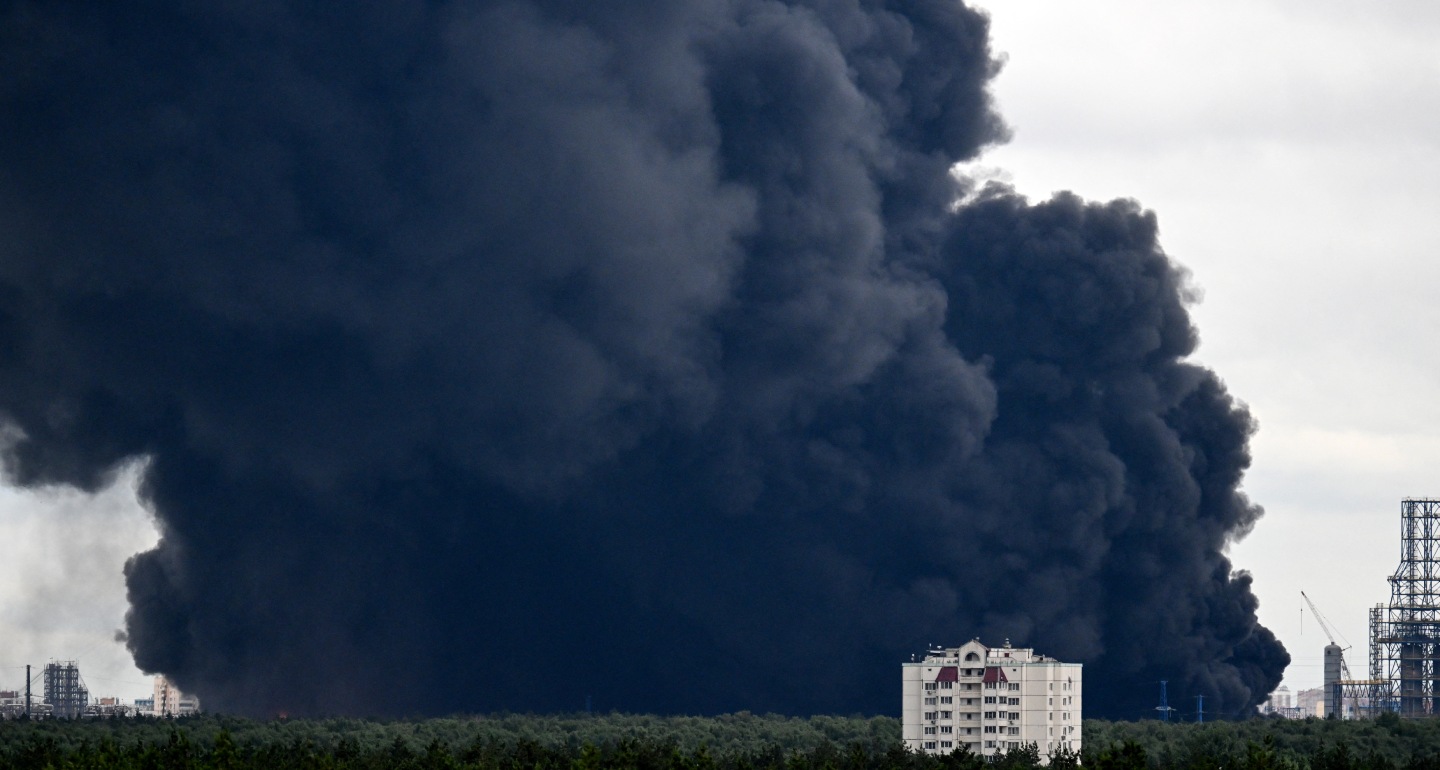
The successful Ukrainian strikes on the oil refinery in Moscow’s southeast Kapotnya district in early June 2026 signaled a new phase in Kyiv’s campaign against the Russian oil industry. Significantly, they showed that not even the heavy air defenses around Moscow can stop drones getting through. On June 12, one or more drones struck a refining unit at the Kapotnya refinery, and, on June 18, five or more drones hit the refinery’s only other such unit, as well as storage facilities for both oil and oil products.
Ironically, when the refinery was modernized in 2020, it replaced its multiple oil-processing units with two integrated installations positioned very close to each other—a decision that likely increased the impact of the attacks. In peacetime, this change made a lot of sense. Back then, it didn’t occur to anyone that it would also make the refinery vulnerable to drones.
On their own, such attacks on a mid-size refinery like the one in Kapotnya would be relatively insignificant. But they were just the latest in a string of Ukrainian air attacks that are becoming more frequent, and inflicting more and more damage. The Russian oil industry’s resilience is being stretched dangerously thin.
After a break in January, Ukraine restarted its strike campaign with renewed vigor in mid-March. Initially, Kyiv’s main target was Russia’s oil export infrastructure, with drones mostly hitting storage tanks at oil terminals. This resulted in a two-week halt to oil shipments from the Baltic port of Ust-Luga. However, the results were generally unimpressive. While they did destroy oil awaiting shipment, impose financial costs, and generate spectacular images, the damage was not long-lasting.
After two weeks of strikes on Ust-Luga, sixteen of the terminal’s fifty-four storage tanks had been hit, with five suffering severe damage. The ratios were similar following two Ukrainian attacks on the Grushovaya oil depot (servicing the Black Sea port of Novorossiysk) in which fourteen storage tanks were damaged and five destroyed.
In the most intense two weeks of attacks, the number of loaded oil tankers leaving from Russia’s Baltic and Black Sea ports dropped by half, according to Bloomberg. However, the numbers quickly bounced back—and then increased. As a result, Russia’s seaborne oil exports in the second half of April amounted to some 3.8 million barrels a day—about 500,000 barrels more than the combined average for 2023, 2024, and 2025.
Crude exports have been higher at the expense of oil products, since oil became harder to refine inside Russia when Kyiv switched its attacks from oil export infrastructure to refineries. In April and May, there were twenty-six Ukrainian attacks on refineries—exactly the same as in August and September 2025 when Russia experienced noticeable gasoline shortages. In those two months in 2025, Russia’s average daily output of refined oil fell by up to 480,000 barrels—9 percent lower than July 2025. The fall this year has been even bigger. At the end of March, Russia’s daily output of refined oil was about 5.2 million barrels, but this dropped by up to 700,000 barrels in April and May. In other words, the decline was 13 percent.
Judging from the fires at Russian refineries—which can be tracked on NASA maps—more Ukrainian drones are reaching their targets than ever before. The result is more damage. Not only to primary processing units (which are relatively easy to repair), but also complex isomerization, cracking, and hydrotreating units. The necessity of importing replacement parts means repairs take longer. And even if damaged refineries are able to maintain previous production levels, they sometimes produce lower-standard motor fuel.
Russia’s refined oil output has also been impacted by construction work to expand capacity at oil producer Tatneft’s TANECO refinery, which has a capacity of 375,000 barrels a day. Procurement documents suggest the work was originally planned for July and August, but was brought forward—possibly at the request of the Energy Ministry seeking to avoid losing production during the peak demand of the summer period.
The amount of gasoline available in Russia at the moment is determined by a race between Ukrainian drones and Russian repair teams. If the frequency of Ukrainian attacks can be maintained, and the damage from each attack increases, then the advantage swings toward Kyiv. That’s what we are currently seeing.
In April and May, there were several factors mitigating the extent of gasoline shortages, including reduced seasonal demand, increased reserves at the end of the winter, and the option of legally selling Euro-3 standard gasoline as Euro-5 standard (a measure introduced in the fall of 2025). The latter has been a significant boost to gasoline production: Previously, about a third of the light distillate fraction produced by refineries was not processed into on-spec motor fuel that could be sold at the pump. Some of it ended up at illegal gas stations, but most of it was exported as a petrochemical feedstock. As a result, Russia avoided shortages immediately after the attacks began.
Even now, the situation is not that bad—if you discount serious shortages in the annexed region of Crimea (and the areas in occupied Ukraine, and Russian regions on the border with Ukraine, where Crimean demand has been displaced). Prices on the wholesale market are still lower than during the fuel crisis of 2025. And as of June 19, there have only been reports of supply problems in twenty-five regions, compared to fifty-seven regions at the start of October. Furthermore, research from the Center for Analysis and Strategies in Europe (CASE) has shown the 2025 gasoline crisis was not as disruptive as might be assumed.
The fact that companies, officials, and drivers remember the 2025 crisis is shaping the current situation. The interests of these groups, though, do not align: While drivers seek to stockpile fuel, officials want to stop them. Measures like limits on gasoline purchases, and bans on filling up gasoline containers, are the result.
At the moment, the throughput of Russia’s oil refineries is fluctuating wildly. After another wave of attacks at the end of May, it dropped below 4 million barrels a day, but it quickly bounced back to exceed 4.5 million barrels in the week beginning June 4. It’s possible the recovery was driven by rapid repairs at several refineries. Then, in the middle of June, the dynamic shifted yet again. Ukrainian attacks on the Moscow refinery in Kapotnya and Tatneft’s TANECO refinery knocked out about 600,000 barrels a day. If previously damaged refineries can’t quickly restore their output, Russia’s loss of capacity might be 28 percent down on previous years.
The geographical distribution of the damage matters as well. Loss of production capacity has been particularly acute around Moscow, with all the refineries supplying refined oil to Moscow via pipeline—Yaroslavl, Ryazan, and Kstovo—damaged in attacks. Moscow is the nexus of Russia’s fuel consumption: About 14 percent of Russia’s 53 million passenger cars are registered in Moscow and Moscow region, and 40 percent of the country’s air passenger traffic goes through the Russian capital. So, even if the government manages to marshal the volumes of refined oil needed to keep Moscow functioning, it will run into difficulties delivering them all by railroad.
While the current situation is challenging, much remains unclear. For example, can Ukraine sustain the intensity of its strikes, or increase them? This depends on Kyiv’s drone production capacity. The drone production company Firepoint, whose FP-1 drones attacked Moscow, currently makes about 100 FP-1s a day, of which about 10 percent reach their targets. They have announced plans to expand production. Another unknown is how quickly Russia can repair its refineries. Damaged refining units are put under a lot of stress because of multiple heating and cooldown cycles—and emergency repairs lead to degradation of structural integrity and strength. We do not know how close some refineries are to breaking point (the Ryazan refinery, for example, has been attacked fifteen times).
If it proves impossible for the Russian authorities to avoid a gasoline deficit, the question then becomes how they will organize the distribution of a scarce resource. At the moment, gasoline is subsidized via so-called damper payments made by the government to oil refineries. As a result, gasoline is sold for as much as 30 rubles a liter cheaper than its real market value (thus encouraging consumption).
This subsidy only applies to fuel sold by Russian companies—so, it also reduces imports. For example, if a Russian company sends oil to Belarus for refining, and then receives refined oil back from Belarus’s Mozyr refinery or Novopolotsk refinery, then it can be sold in Russia with damper payments. But there is almost no fuel sold on the Russian market by Belneftekhim, which owns those Belarusian refineries, because it would not receive the damper payments from the Russian government.
On paper, it would be easy for Belarusian factories to buy crude from Russian companies, produce fuel, and sell it in Russia. From a logistical point of view, this would even make a lot of sense for some parts of western Russia, including the southern part of Pskov region, Bryansk region, and Smolensk region. But the way the damper payments are organized means that fuel produced in this way would simply not be competitive.
Going forward, the Russian government has three ways to deal with falling supply. Firstly, let market forces play out, and prices rise so high that drivers choose not to travel. Secondly, take measures to control prices, and introduce ration cards. Thirdly, an ad hoc approach in which people end up paying for fuel not only with money, but also with time spent in lines. The latter two options would likely lead to the emergence of a black market where prices would be even higher than they would if the market were left to its own devices.
From a market perspective, there’s a lot to be said for scrapping damper payments. This would save the government billions of rubles a month, and simplify the process of importing fuel (which might soon become much needed). Ultimately, during a period of deficit, it’s crazy to be stimulating demand by artificially depressing prices.
Admittedly, the unpopularity of more expensive gasoline would make ditching damper payments politically difficult. But the seriousness of the current situation means the Russian government has few easy options left.

Senior Fellow, Carnegie Russia Eurasia Center
Sergey Vakulenko is a senior fellow at the Carnegie Russia Eurasia Center.
Recent Work
Sergey Vakulenko
Sergey Vakulenko
Carnegie does not take institutional positions on public policy issues; the views represented herein are those of the author(s) and do not necessarily reflect the views of Carnegie, its staff, or its trustees.

Japan’s long-term security policy is driven by concerns about China, and there is little appetite for (or interest in) pursuing a confrontation with Moscow.

James D.J. Brown

The truth of the strategic situation is that Europe and Russia are extremely unlikely to be able to “turn the page” on their confrontation within the next two decades.

Arkady Moshes
Russia spent years building a “sovereign internet,” concentrating web infrastructure exclusively within Russian territory. Ukrainian drone attacks have shown how vulnerable that approach has left the Russian internet.

Maria Kolomychenko

Putin’s conservative staffing policies and search for ever greater control have cemented parliament’s transformation into a bureaucratic appendage of the executive branch.

Andrey Pertsev

Russia’s AI-driven propaganda campaigns operate in a fragmented, chaotic, and often illogical manner. That’s not necessarily a problem for the Kremlin, though: It’s much easier to mimic genuine public debate that way.

Ilya Klishin