

Article
Frederic Wehrey, Charles H. Johnson
{
  "authors": [
    "Frederic Wehrey"
  ],
  "type": "legacyinthemedia",
  "centerAffiliationAll": "dc",
  "centers": [
    "Carnegie Endowment for International Peace",
    "Malcolm H. Kerr Carnegie Middle East Center"
  ],
  "collections": [
    "Civil-Military Relations in Arab States"
  ],
  "englishNewsletterAll": "menaTransitions",
  "nonEnglishNewsletterAll": "",
  "primaryCenter": "Malcolm H. Kerr Carnegie Middle East Center",
  "programAffiliation": "MEP",
  "programs": [
    "Middle East"
  ],
  "projects": [],
  "regions": [
    "North Africa",
    "Tunisia",
    "Maghreb"
  ],
  "topics": [
    "Political Reform",
    "Security",
    "Military"
  ]
}
Source: Getty
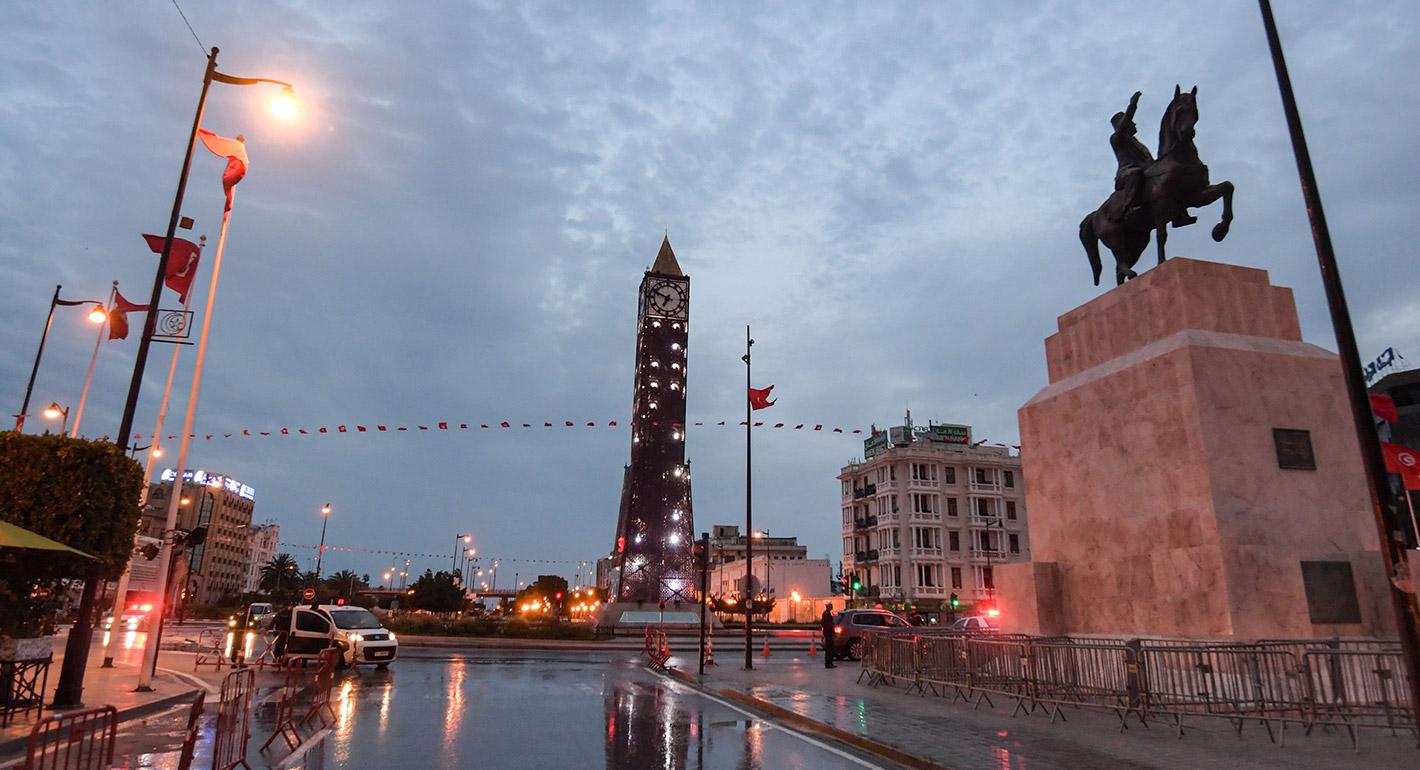
So far, the Tunisian military’s rapid response to the public health crisis in support of the elected government has been laudable. But there may be darker economic clouds on the horizon affecting the armed forces’ readiness and relations with the government.
Source: War on the Rocks
A military helicopter soars over the urban landscape, its crew scanning the city below through a cockpit video camera. They’re looking not for the enemy, but rather for their fellow citizens —crowds of them, illegally gathering in contravention of the government’s edicts on social distancing to prevent the spread of COVID-19. Sometimes they relay the coordinates of violators to ground patrols. And sometimes, as shown in one widely viewed video of a soccer match, they swoop in directly to break up the gaggle.
These flights are part of a broader mobilization of the Tunisian armed forces that, along with a range of other public health measures, have enabled this struggling Arab democracy to ride out the pandemic — so far — with relatively few cases and deaths. By the accounts of foreign observers and Tunisians alike, this military mobilization has mostly been greeted with popular support. There has been no evidence that the Tunisian military is trying to overstep its legal mandate or assert any national security prerogatives, like demanding that its members have priority in receiving protective equipment or other virus-related aid. Unlike militaries in some Arab autocracies, the Tunisian armed forces do not own commercial businesses or industries on any significant scale, for which they might be tempted to request special exemptions from government-directed restrictions...

Senior Fellow, Middle East Program
Frederic Wehrey is a senior fellow in the Middle East Program at the Carnegie Endowment for International Peace, where his research focuses on governance, conflict, and security in Libya, North Africa, and the Persian Gulf.
Recent Work
Frederic Wehrey, Charles H. Johnson
Frederic Wehrey, Charles H. Johnson
Carnegie does not take institutional positions on public policy issues; the views represented herein are those of the author(s) and do not necessarily reflect the views of Carnegie, its staff, or its trustees.

If the Russian-speaking community in Latvia cannot articulate their interests without being seen as disloyal, they could end up embracing a pro-Kremlin agenda.

Sergejs Potapkins

Russia’s ruling party would have benefited from Putin appearing as its distant patron, but as an active frontman imposing his views on the public, he has done nothing but harm both the party’s election campaign and the ruling system overall.

Andrey Pertsev

In the tenth year of his presidency, President Mirziyoyev’s system is becoming even more personalized than that of his predecessor Karimov.

Galiya Ibragimova

With the growth in points of friction between the great powers, organizations like the SCO will continue to play a role in the strategic adaptation of the smaller powers caught between them.

Temur Umarov

The greater threat to Zelensky comes not from Fedorov alone, but from the convergence between the former defense minister’s political campaign and the anti-corruption investigations moving ever closer to the presidential administration.

Balázs Jarábik