

Commentary
Japan’s long-term security policy is driven by concerns about China, and there is little appetite for (or interest in) pursuing a confrontation with Moscow.
James D.J. Brown
{
  "authors": [
    "Paul Haenle",
    "Ali Wyne"
  ],
  "type": "questionAnswer",
  "centerAffiliationAll": "",
  "centers": [
    "Carnegie Endowment for International Peace",
    "Carnegie China"
  ],
  "collections": [],
  "englishNewsletterAll": "",
  "nonEnglishNewsletterAll": "",
  "primaryCenter": "Carnegie China",
  "programAffiliation": "",
  "programs": [],
  "projects": [],
  "regions": [
    "China",
    "Russia"
  ],
  "topics": [
    "Economy",
    "Security"
  ]
}
Source: Getty
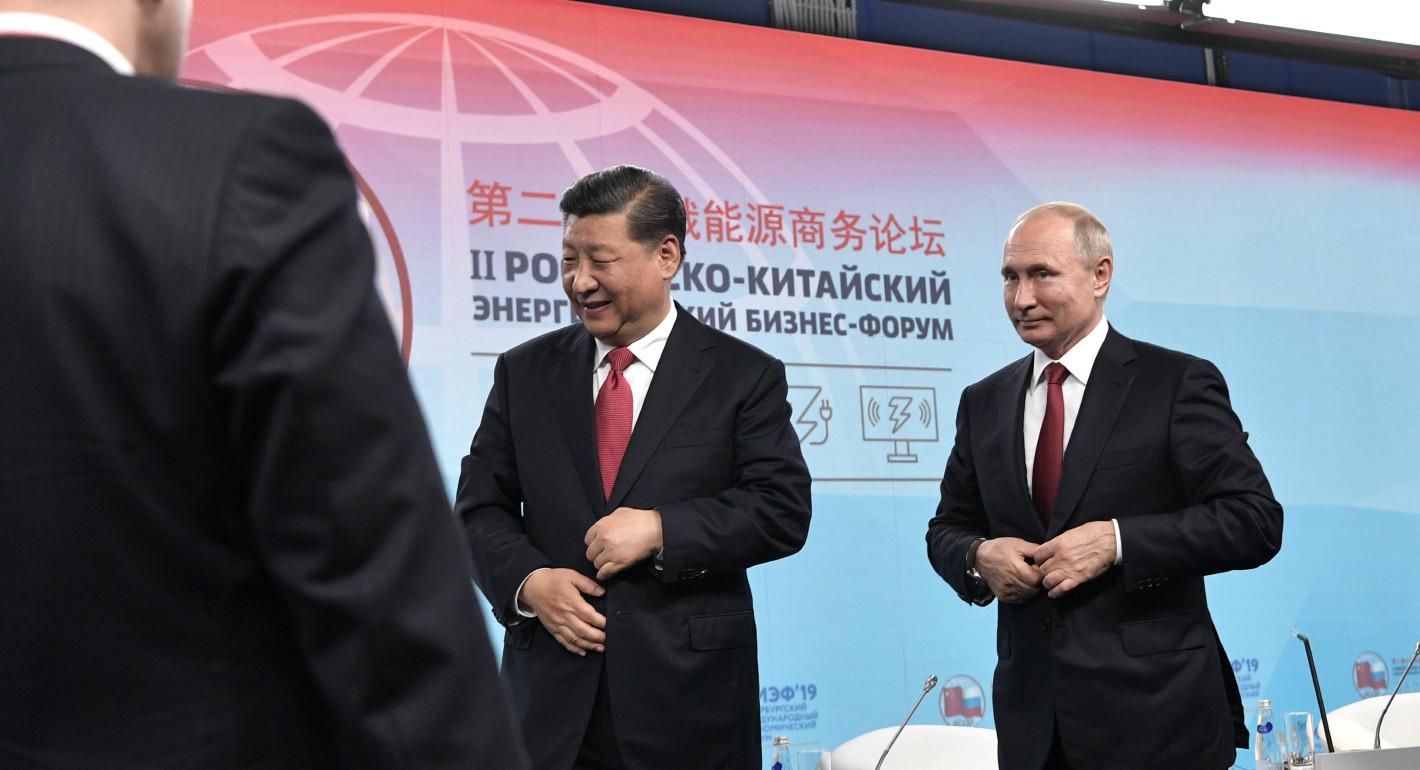
Moscow is more beholden to Beijing than it was prior to its invasion of Ukraine.
On a recent episode of the China in the World podcast, Paul Haenle spoke with Ali Wyne about how the United States should approach improving China-Russia relations. Wyne is a senior analyst at Eurasia Group. A portion of their conversation, which has been edited and condensed for clarity, is below.
Paul Haenle: Let’s talk about the China-Russia partnership. There is an ongoing debate regarding the alignment between the two powers, the potential for it to get even stronger, and how each of those two countries challenges the United States and its national interests in different ways. In your book, you refer to the China-Russia partnership as a “limited entente,” which I found to be an interesting phrase—somewhat more restrained than the way it is talked about today, with this no-limits strategic partnership after the February 4 joint statement between [Russian President Vladimir] Putin and [Chinese President] Xi [Jinping].
In your view, what makes the China-Russia partnership a limited entente?
Ali Wyne: The Sino-Russian relationship is kind of a paradox, and this paradox has grown stronger since Russia’s invasion of Ukraine in late February. It is paradoxical in that I would argue that it is simultaneously today stronger but also more strained. . . . Russia is by default more beholden to China than it was prior to the invasion.
[The relationship] is stronger by virtue of Russia’s own strategic miscalculation. Russia has driven itself further into China’s embrace. And China obviously recognizes that, given Russia’s economic difficulties right now, it can extract concessions on imports, particularly of energy. . . . Rather than condemning Russia’s aggression, China is faulting NATO and the United States and saying that NATO shouldn’t have expanded in the aftermath of the Cold War, that NATO has been insufficiently accommodating of Russia’s concerns. Publicly, Russia and China are doubling down rhetorically and having a conversation on establishing a mechanism to circumvent the U.S. dollar.
On the other side of the ledger, it is certainly more strained . . . Obviously, only Putin and Xi know what they said to each other prior to Russia’s invasion of Ukraine. But my hypothesis would be that China probably did believe that Russia was either going to conduct a so-called special military operation, one that would be limited in scope, or that if Russia did launch a full-fledged invasion, that Ukraine would capitulate so quickly that it would be over in a matter of days. It would be relatively bloodless and sufficiently short in duration that the West wouldn’t have time to mobilize a response. Obviously, the war hasn’t panned out that way, and it exhibits every sign of grinding on and becoming a protracted war of attrition—an unstable stalemate. I don’t think China anticipated that it would go that way. The longer the war drags on and the more externalities that arise, the more of a reputational albatross this entente becomes for China.
Look at Tsinghua University Professor Yan Xuetong. He wrote an essay in Foreign Affairs recently in which he argues that the externalities are having a major economic impact on China, and they are causing more reputational headaches for China in its relations to the West. These are going to have many long-term consequences for China.
Beijing shares a number of grievances with Moscow. It does not want to abandon Russia, but it recognizes—and Evan Medeiros has talked about this policy trilemma facing China, and here I am just quoting Evan’s analysis—how do you simultaneously uphold your commitment at least nominally to sovereignty and territorial integrity, strengthen your partnership with Russia, and also uphold your relationship with the West? That is a very difficult balancing act. Yes, the China-Russia relationship is stronger, but it is also more strained.
Even before Russia’s invasion of Ukraine, you saw some of those strains after the U.S. withdrawal from Afghanistan. You saw some schadenfreude in both countries. But as that schadenfreude abated somewhat, China was thinking: how do we mitigate instability coming out of Afghanistan and advance the Belt and Road initiative?
And Russia, on the other hand, is leery of China’s influence, as it regards Central Asia as part of its sphere of influence. China wants to limit India’s influence in the region while Russia wants to maintain its partnership with India. After the U.S. withdrawal from Afghanistan, you could already see some signs of misalignment. The longer the [Ukraine] war drags on, the more difficult it will become for China to avoid that policy trilemma.
For more, listen to the full episode below and subscribe to the China in the World podcast.

Former Maurice R. Greenberg Director’s Chair, Carnegie China
Paul Haenle held the Maurice R. Greenberg Director’s Chair at the Carnegie Endowment for International Peace and is a visiting senior research fellow at the East Asian Institute, National University of Singapore. He served as the White House China director on the National Security Council staffs of former presidents George W. Bush and Barack Obama.
Ali Wyne
Former Junior Fellow, China Program

Japan’s long-term security policy is driven by concerns about China, and there is little appetite for (or interest in) pursuing a confrontation with Moscow.

James D.J. Brown

The truth of the strategic situation is that Europe and Russia are extremely unlikely to be able to “turn the page” on their confrontation within the next two decades.

Arkady Moshes

Russia spent years building a “sovereign internet,” concentrating web infrastructure exclusively within Russian territory. Ukrainian drone attacks have shown how vulnerable that approach has left the Russian internet.

Maria Kolomychenko

Putin’s conservative staffing policies and search for ever greater control have cemented parliament’s transformation into a bureaucratic appendage of the executive branch.

Andrey Pertsev

Russia’s AI-driven propaganda campaigns operate in a fragmented, chaotic, and often illogical manner. That’s not necessarily a problem for the Kremlin, though: It’s much easier to mimic genuine public debate that way.

Ilya Klishin