

Commentary
Russia spent years building a “sovereign internet,” concentrating web infrastructure exclusively within Russian territory. Ukrainian drone attacks have shown how vulnerable that approach has left the Russian internet.
Maria Kolomychenko
{
  "authors": [
    "Amlan Mohanty",
    "Ashima Singh"
  ],
  "type": "other",
  "centerAffiliationAll": "",
  "centers": [
    "Carnegie Endowment for International Peace",
    "Carnegie India"
  ],
  "collections": [
    "India-U.S. Emerging Technologies Working Group"
  ],
  "englishNewsletterAll": "",
  "nonEnglishNewsletterAll": "",
  "primaryCenter": "Carnegie India",
  "programAffiliation": "",
  "programs": [],
  "projects": [
    "Technology and Society"
  ],
  "regions": [
    "South Asia",
    "India"
  ],
  "topics": [
    "Technology",
    "AI"
  ]
}
Source: Getty
Given the importance of AI under the iCET framework, this essay outlines five areas where India and the United States could collaborate to advance their partnership on AI.
This essay is part of a series that highlights the main takeaways from discussions that took place at Carnegie India’s eighth Global Technology Summit, co-hosted with the Ministry of External Affairs, Government of India.
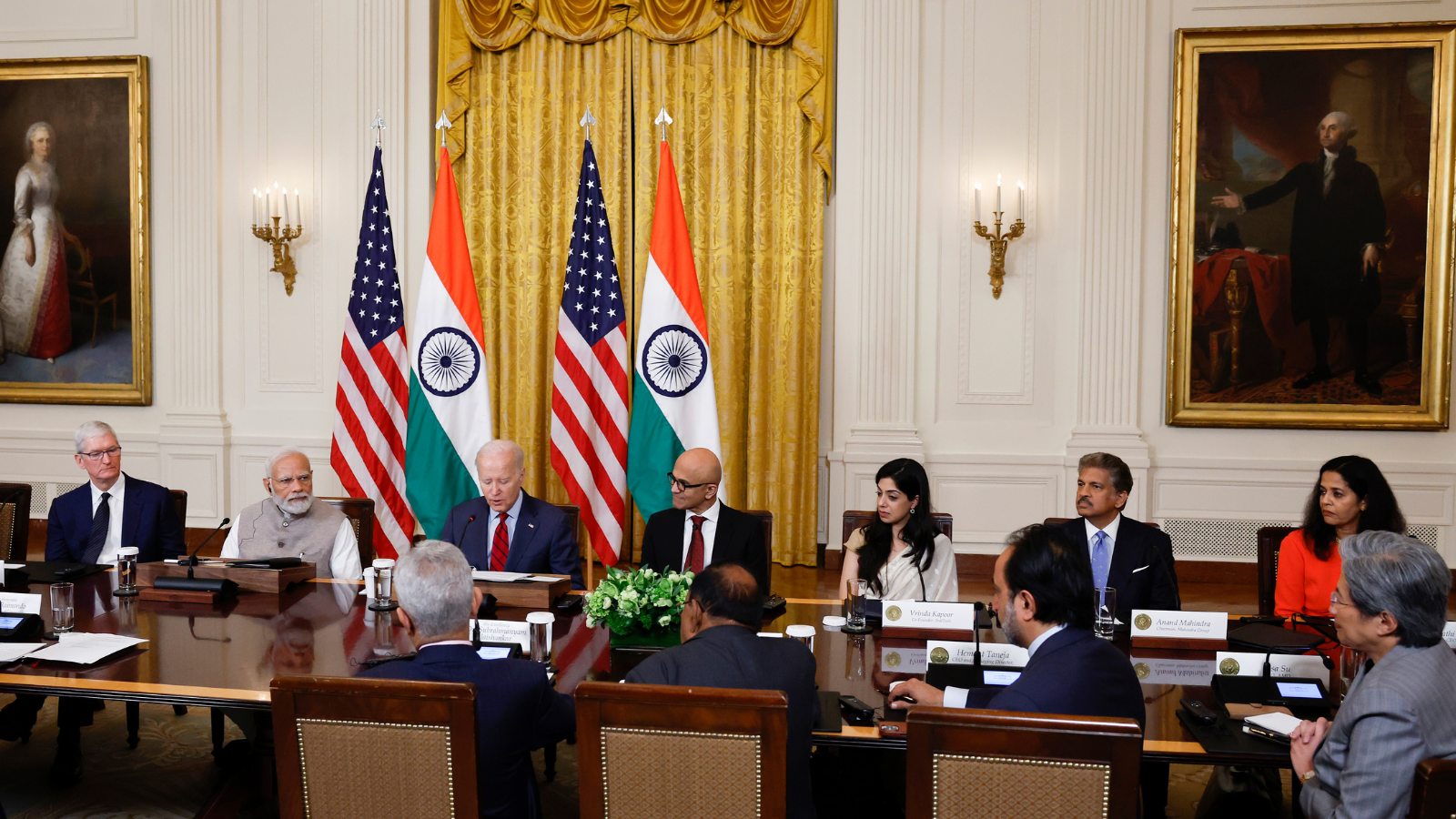
In a midterm review of the India-U.S. initiative on Critical and Emerging Technology (iCET), senior officials from both countries reiterated the importance of artificial intelligence (AI) to their strategic bilateral partnership.
Based on closed-door discussions held at the Global Technology Summit 2023 on the sidelines of the iCET review, we outline five areas where India and the United States should collaborate to advance their partnership on AI.
As founding members of the Global Partnership on Artificial Intelligence (GPAI), both India and the United States can help build scientific consensus on the nature of the risks emerging from AI systems. A shared understanding of safety risks would help establish a set of common standards to mitigate concerns around bias, privacy, security, and lack of trust.
While some efforts are already underway to develop such standards, more needs to be done. Specifically, there is a need for global benchmarks to evaluate the safety and efficacy of large language models (LLMs) before they can be made available to consumers. Another potential area of collaboration is to develop a common taxonomy for AI systems so that they can be classified and defined based on their primary function and the risk of causing harm.
Given their prior experience in developing standards for the telecom and space sectors, the expectation is that India and the United States will adopt a balanced approach that incentivizes innovation and nurtures a vibrant technology ecosystem while promoting the principles of fairness, accountability, and transparency in AI systems.
Access to computing power, more commonly referred to as “compute,” is now a critical geopolitical issue. The scarcity of resources required to run advanced AI systems and the acute concentration of such resources in a few Western countries could lead to an unequal distribution of the benefits of AI between the Global North and the Global South.
India and the United States can play an important role in bridging this new digital divide through a combination of technical innovations, market interventions, and development aid.
A good model is the U.S.-India Global Digital Development Partnership, which promotes the adoption of digital public infrastructure (DPI) in developing countries. India can also share its experience with building DPI for low-resource settings to support AI deployments in regions with limited connectivity.
Data sharing between India and the United States can help promote linguistic diversity in popular LLMs such as OpenAI’s GPT-3, which is primarily trained on English-language content.
Both countries possess complementary strengths in this domain. In India, there is a strong push to make local language content readily accessible, while the United States is leading the development of powerful LLMs, which are accessed by millions of people around the world.
An immediate priority is to develop trusted models for cross-border transfers of data, ideally as part of the India-U.S. trade and commercial dialogue and anchored around the implementation of India’s new data protection law.
The hope is that the India-U.S. partnership on data sharing will provide a blueprint for the Global South to develop demographically representative AI models. This could prove especially useful in the African Union, which faces similar challenges due to its multilingual culture.
India and the United States have a shared interest in using AI for cybersecurity, as recognized with the launch of a Defense Artificial Intelligence Dialogue at the Ministerial Dialogue in April 2022.
On the U.S. side, an executive order issued by President Biden calls on government agencies to examine how AI can be used in cyber defense. But India’s national cybersecurity policy, which is more than a decade old, fails to capture the value of AI in cyber defense and the protection of critical infrastructure.
With AI being elevated to a strategic priority, now is the right time for both countries to collaborate on using AI in intelligence gathering, military training, and counterterrorism.
Bilateral engagements on AI research and skilling are closely connected. While investment capital is necessary to support foundational breakthroughs, developing and maintaining advanced systems to facilitate such breakthroughs will also require specialized talent.
In this regard, there is an urgent need for India and the United States to share critical computing resources, research facilities, and datasets. Export barriers for high-performance computing systems must also be removed so that the United States and India can collaborate on the development of supercomputers.
To address the shortage of skilled AI professionals, the easing of H-1B visa requirements for Indians is crucial, along with facilitating deeper cross-border cultural exchanges. Further, academic universities have an important role to play in preparing the workforce for future employment opportunities through skilling programs focused on AI.
A strong partnership between India and the United States on AI research, data sharing, cybersecurity, standard setting, compute access, and skilling would go a long way in enhancing the strategic bilateral partnership.
To be sure, both countries may take different paths on some issues. For example, on AI regulation, the United States has adopted a combination of voluntary commitments and reporting requirements, whereas India prefers a light-touch hybrid model. Similarly, both countries may pursue independent efforts to build “sovereign AI infrastructure.”
While such differences may exist, there is great value in both sides committing to certain overarching principles, such as respect for democracy, equitable access, fairness, transparency, and inclusivity. A commitment to these shared values creates a strong foundation for meaningful collaboration to unlock the full potential of AI.
Fellow, Technology and Society Program
Amlan Mohanty was a fellow with Carnegie India. His areas of expertise include privacy, content policy, platform regulation, competition and AI.
Ashima Singh
Former Research Assistant and Program Coordinator
Ashima Singh is a research assistant and program coordinator in the Technology and Society program at Carnegie India.
Carnegie does not take institutional positions on public policy issues; the views represented herein are those of the author(s) and do not necessarily reflect the views of Carnegie, its staff, or its trustees.
Russia spent years building a “sovereign internet,” concentrating web infrastructure exclusively within Russian territory. Ukrainian drone attacks have shown how vulnerable that approach has left the Russian internet.

Maria Kolomychenko

Russia’s AI-driven propaganda campaigns operate in a fragmented, chaotic, and often illogical manner. That’s not necessarily a problem for the Kremlin, though: It’s much easier to mimic genuine public debate that way.

Ilya Klishin

While France and Australia are seeking to establish the legal obligations of messaging apps like Telegram, Russia wants total subordination.
Maria Kolomychenko

With the growth in points of friction between the great powers, organizations like the SCO will continue to play a role in the strategic adaptation of the smaller powers caught between them.

Temur Umarov

The war in Ukraine and a change in ownership led VK to neglect its commercial ventures in favor of implementing the Kremlin’s online agenda. Now it’s been sanctioned by the EU.
Maria Kolomychenko