

Feature
Damien Ma, Binyi Yang
{
  "authors": [
    "Damien Ma"
  ],
  "type": "commentary",
  "centerAffiliationAll": "",
  "centers": [
    "Carnegie China",
    "Carnegie Endowment for International Peace"
  ],
  "collections": [
    "Carnegie China Commentaries"
  ],
  "englishNewsletterAll": "",
  "nonEnglishNewsletterAll": "",
  "primaryCenter": "Carnegie China",
  "programAffiliation": "",
  "regions": [
    "China"
  ],
  "topics": [
    "Technology"
  ]
}
Source: Getty
China’s latest energy plan explicitly calls for integrating data centers into the electricity system, particularly connecting them to green energy. It appears Beijing wants to use compute as a source of domestic demand to absorb renewables excess capacity.
A few months after China rolled out its macro 15th Five-Year Plan (FYP) (2026–2030), it released the sectoral FYP on energy in late June. The overarching theme of the 15th FYP on energy—balancing energy security with progressing the energy transition—remains relatively unchanged from the previous plan.
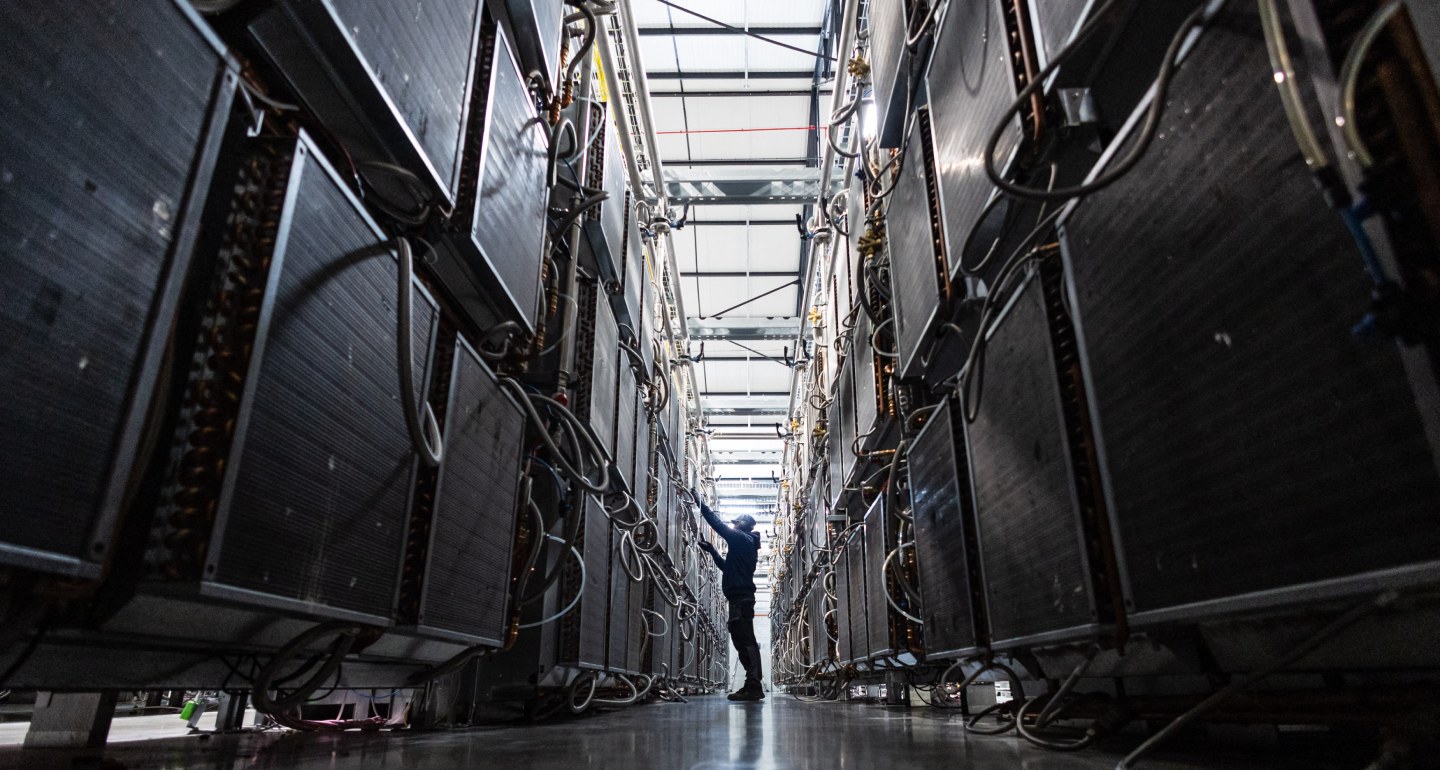
But what has notably changed is the explicit linkage between the electricity system and compute. This has implications for China’s renewables excess capacity and its relative underinvestment in data centers, especially when compared to U.S. spending.
For instance, the 14th FYP repeatedly mentioned building data centers (数据中心) efficiently, filing them under “new infrastructure.” The 15th FYP, however, has abandoned mentions of data centers and replaced it with repeated references to “computing power” (算力). This marks a significant shift in the logic—the focus is no longer just about building compute infrastructure but recasting it as an electricity load to be planned and connected to clean energy through “green direct connection” (绿电直连), a mechanism never mentioned in the 14th FYP. In other words, the 15th FYP treats compute as a new source of power demand that needs to be integrated into the electricity system.
More importantly, building on the “Eastern Data, Western Compute” (东数西算) initiative launched in early 2022, Beijing now appears to want a twofer on the energy side: 1) keep pushing data centers into Western China 2) use them to digest excess solar and wind capacity.
This is observable where China’s major compute clusters are sited—and where future data centers are likely to be built. Constructed based on public sources, map 1 shows the largest data center clusters are concentrated in Inner Mongolia and Ningxia. Reports also suggest more data centers will be built in the Western hinterlands like Qinghai and Xinjiang, where large renewable bases and curtailment problems exist.
The correlation is quite obvious: These are all regions that have the highest renewables curtailment rates, meaning there is plenty of excess capacity that needs to be absorbed. Inner Mongolia—which is China’s coal country and is rich in rare earths—has also transformed itself into the site of some of China’s largest solar and wind bases. The smaller clusters in the Yangtze River Delta and Guangdong are likely mainly to serve Chinese hyperscalers like Alibaba and Tencent, even though those big tech companies have their own data and cloud computing centers out west as well.
But “hyperscalers” may be a misnomer for Chinese entities, since thus far they have exhibited little appetite for the scale that has become a hallmark of the Chinese approach to infrastructure. This is especially so when compared to the U.S. hyperscalers, who have been responsible for the AI capital expenditure (capex) boom that has driven the U.S. economy over the last few years. For example, Goldman Sachs estimated that the top U.S. hyperscalers outspent the four largest Chinese firms on AI infrastructure by roughly eight to one. Our own estimate of capex spending is roughly in line.
What explains the chasm between Chinese and American data center capex likely requires further investigation. But one reason may be that Chinese big tech relies as much on state-backed data centers as on its own infrastructure, which means the private sector has not had to spend as much on its compute infrastructure.
That may change over the next few years, as the current energy FYP signals that China views data centers as a source of domestic demand for its renewable energy. This comes at a time when China’s rising clean energy exports are generating backlash from advanced economies. This March, for example, China exported a record 68 GW of solar panels, more than Spain’s entire installed solar fleet, and double February’s total.
The March spike likely reflects a one-off demand surge from the Middle East energy crisis, but rising solar exports is a secular trend. China’s solar module exports climbed from 154.8 GW in 2022 to around 236 GW in 2024. Whether that pace holds is another question as volume growth is showing signs of slowing, falling from approximately 34 percent in 2023 to 13 percent in 2024.
Beijing seems to recognize the furor its clean energy export surge has stirred and is calling for clean energy to be used for data centers instead of being exported. This also implies that the AI capex boom might get considerably louder in China as green data centers become a focal point of infrastructure investment over the next few years.

Director, Carnegie China; Maurice R. Greenberg Director’s Chair
Damien Ma is the director and Maurice R. Greenberg Director’s Chair of Carnegie China, an East Asia-based research center with its office in Singapore. For two decades, Damien has worked at the intersection of markets, policy, and global affairs, becoming a leading voice on China’s ascendance and U.S.-China dynamics, the most consequential bilateral relationship of the century.
Recent Work
Damien Ma, Binyi Yang
Damien Ma
Carnegie does not take institutional positions on public policy issues; the views represented herein are those of the author(s) and do not necessarily reflect the views of Carnegie, its staff, or its trustees.
Russia spent years building a “sovereign internet,” concentrating web infrastructure exclusively within Russian territory. Ukrainian drone attacks have shown how vulnerable that approach has left the Russian internet.

Maria Kolomychenko

Russia’s AI-driven propaganda campaigns operate in a fragmented, chaotic, and often illogical manner. That’s not necessarily a problem for the Kremlin, though: It’s much easier to mimic genuine public debate that way.

Ilya Klishin

While France and Australia are seeking to establish the legal obligations of messaging apps like Telegram, Russia wants total subordination.
Maria Kolomychenko

With the growth in points of friction between the great powers, organizations like the SCO will continue to play a role in the strategic adaptation of the smaller powers caught between them.

Temur Umarov

The war in Ukraine and a change in ownership led VK to neglect its commercial ventures in favor of implementing the Kremlin’s online agenda. Now it’s been sanctioned by the EU.
Maria Kolomychenko