• Research
  • Politika
  • About
Carnegie Russia Eurasia center logoCarnegie lettermark logo
  • Donate
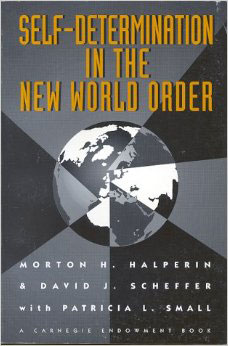
Self-Determination in the New World Order
Book

Self-Determination in the New World Order

Experts examine the dynamic self-determination movements that are erupting across the globe, analyze U.S. policy toward them, and propose criteria for decision makers who are weighing whether to support groups seeking self-determination.

Link Copied
By Morton H. Halperin, David J. Scheffer, Patricia L. Small, Scheffer David J. Small, Patricia L.
Published on Jan 1, 1992

Additional Links

Paperback - $10.95

Source: Washington

In the aftermath of the breakup of the Soviet empire, new nations are emerging rapidly, and more and more ethnic groups are pushing for independence or autonomy. But there has been relatively little public debate about how the United States should respond. To encourage such debate, Halperin and Scheffer examine the dynamic self-determination movements that are erupting across the globe and analyze U.S. policy toward them. In particular, the authors take a look at what international law says about intervention by the United States or other nations to support or oppose such movements. They also consider under what conditions such moves might be wise. They propose criteria for decision makers who are weighing whether to support groups seeking self-determination, to offer political recognition, or to intervene with force.

Advance Praise

“…[T]he book succeeds in challenging traditional thinking and the West's conservative attitudes towards self-determination.”
—Kamal S. Shehadi, International Institute for Strategic Studies

“Clear, insightful analysis underpins the new ideas in this volume, some of which are already entering international discussions but are nowhere brought together so well.”
—Andrew J. Pierre, Foreign Affairs

About the Authors

Morton H. Halperin

David J. Scheffer

Patricia L. Small

Scheffer David J. Small, Patricia L.

Authors

Morton H. Halperin
David J. Scheffer
Patricia L. Small
Scheffer David J. Small, Patricia L.
Foreign Policy

Carnegie does not take institutional positions on public policy issues; the views represented herein are those of the author(s) and do not necessarily reflect the views of Carnegie, its staff, or its trustees.

More Work from Carnegie Russia Eurasia Center

  • Commentary
    Carnegie Politika
    Lukashenko’s Bromance With Trump Has a Sell-By Date

    Lukashenko is willing to make big sacrifices for an invitation to Mar-a-Lago or the White House. He also knows that the clock is ticking: he must squeeze as much out of the Trump administration as he can before congressional elections in November leave Trump hamstrung or distracted.

      Artyom Shraibman

  • Commentary
    Carnegie Politika
    What the Russian Energy Sector Stands to Gain From War in the Middle East

    The future trajectory of the U.S.-Iran war remains uncertain, but its impact on global energy trade flows and ties will be far-reaching. Moscow is likely to become a key beneficiary of these changes; the crisis in the Gulf also strengthens Russia’s hand in its relationships with China and India, where advantages might prove more durable.

      • Sergey Vakulenko

      Sergey Vakulenko

  • Commentary
    Carnegie Politika
    Beyond Oil: Hormuz Closure Puts Russia in the Lead in the Fertilizer Market

    The Kremlin expects to not only profit from rising fertilizer prices but also exact revenge for the collapse of the 2023 grain deal.

      Alexandra Prokopenko

  • Commentary
    Carnegie Politika
    Why Has Kazakhstan Started Deporting Political Activists?

    The current U.S. indifference to human rights means Astana no longer has any incentive to refuse extradition requests from its authoritarian neighbors—including Russia.

      Temur Umarov

  • Commentary
    Carnegie Politika
    Why Are China and Russia Not Rushing to Help Iran?

    Most of Moscow’s military resources are tied up in Ukraine, while Beijing’s foreign policy prioritizes economic ties and avoids direct conflict.   

      • Alexander Gabuev

      Alexander Gabuev, Temur Umarov

Get more news and analysis from
Carnegie Russia Eurasia Center
Carnegie Russia Eurasia logo, white
  • Research
  • Politika
  • About
  • Experts
  • Events
  • Contact
  • Privacy
Get more news and analysis from
Carnegie Russia Eurasia Center
© 2026 Carnegie Endowment for International Peace. All rights reserved.