

In The Media
Lilia Shevtsova
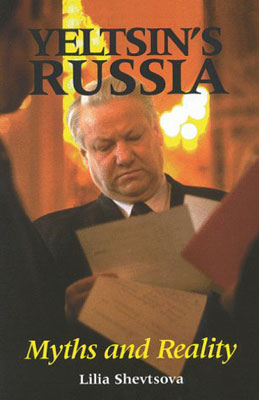
Combining keen political analysis with the unique perspective of a native observer, Lilia Shevtsova offers a valuable assessment of the forces that will shape the post-Yeltsin era.
Source: Washington

An even more telling example of the country’s paradoxical nature is Boris Yeltsin himself, president of Russia since the collapse of the Soviet Union in 1991. Regarded by many in the West as a democratic reformer who helped bring down the communist system, Yeltsin in office has often behaved like a demagogue concerned more with his political survival than with the rule of law. Written off many times as politically dead, Yeltsin has surprised domestic and foreign observers with sudden comebacks that shake up the Russian government and the political landscape—most recently in the economic crisis of the summer and fall of 1998.
Yeltsin’s Russia: Myths and Reality is the most current and comprehensive account of the achievements—and failures—of Boris Yeltsin’s Russia. Combining keen political analysis with the unique perspective of a native observer, author Lilia Shevtsova also offers a valuable assessment of the forces that will shape the post-Yeltsin era.
"One of Russia's most respected political scientists ... [Shevtsova] provides a highly illuminating insight into the state of modern Russia ... and is able to identify many of the elements of continuity in Yeltsin's political system which have eluded the gaze of western analysts."
—Financial Times of London
"In terms of intellect and political contacts, no one is more qualified to explore [Russia's] complex, unhappy evolution than Shevtsova ... a very thoughtful, intelligent account."
—Foreign Affairs

Former Senior Associate, Russian Domestic Politics and Political Institutions Program, Moscow Center
Shevtsova chaired the Russian Domestic Politics and Political Institutions Program at the Carnegie Moscow Center, dividing her time between Carnegie’s offices in Washington, DC, and Moscow. She had been with Carnegie since 1995.
Recent Work
Lilia Shevtsova
Lilia Shevtsova

Sergei Kiriyenko used Russia’s parliamentary vote to further hone his strategy of corporate mobilization that is designed to maximize votes for United Russia.

Andrey Pertsev

The European far right might fail to steer EU policy in the direction Russia wants, but they will create enough chaos inside Europe to benefit the Kremlin.

Dimitar Bechev

Russia’s ruling party would have benefited from Putin appearing as its distant patron, but as an active frontman imposing his views on the public, he has done nothing but harm both the party’s election campaign and the ruling system overall.
Andrey Pertsev

Depleted financial reserves and a shrinking tax base mean it is no longer possible to simultaneously deliver high defense spending, price stability, and economic growth.

Alexandra Prokopenko

Blurring the line between humans and animals is a long-standing tradition in social utopian prose. In his latest novel, Leonid Bershidsky reminds us that in social experiments, people are often treated no differently than animals.

Alexander Baunov