

Commentary
Russian strikes are weakening the economy sustaining Ukraine’s war effort. Closing the growing funding gap will require more European support and politically contentious reforms in Kyiv.
Balázs Jarábik
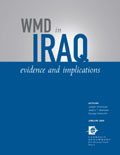
A groundbreaking report details what the U.S. and international intelligence communities understood about Iraq's weapons programs before the war and outlines policy reforms to improve threat assessments, deter transfer of WMD to terrorists, strengthen the UN weapons inspection process, and avoid politicization of the intelligence process.
Summary
This new study details what the U.S. and international intelligence communities understood about Iraq's weapons programs before the war and outlines policy reforms to improve threat assessments, deter transfer of WMD to terrorists, strengthen the UN weapons inspection process, and avoid politicization of the intelligence process.
The report distills a massive amount of data into side-by-side comparisons of pre-war intelligence, the official presentation of that intelligence, and what is now known about Iraq's programs.
Click on the link above for full text or the links to the right for specific sections of this Carnegie report.
About the Authors
Joseph Cirincione is a senior associate and director of the Non-Proliferation Project. Jessica T. Mathews is president and George Perkovich is vice president for studies of the Carnegie Endowment. Alexis Orton is a Junior Fellow with the Non-Proliferation Project.
This is a web-only publication.

Former Senior Associate, Director for NonProliferation

Distinguished Fellow
Mathews is a distinguished fellow at the Carnegie Endowment for International Peace. She served as Carnegie’s president for 18 years.

Japan Chair for a World Without Nuclear Weapons, Senior Fellow
George Perkovich is the Japan Chair for a World Without Nuclear Weapons and a senior fellow in the Carnegie Endowment for International Peace’s Nuclear Policy Program. He works primarily on nuclear deterrence, nonproliferation, and disarmament issues.
with Alexis Orton
Carnegie does not take institutional positions on public policy issues; the views represented herein are those of the author(s) and do not necessarily reflect the views of Carnegie, its staff, or its trustees.

Russian strikes are weakening the economy sustaining Ukraine’s war effort. Closing the growing funding gap will require more European support and politically contentious reforms in Kyiv.

Balázs Jarábik

The European far right might fail to steer EU policy in the direction Russia wants, but they will create enough chaos inside Europe to benefit the Kremlin.

Dimitar Bechev

With the growth in points of friction between the great powers, organizations like the SCO will continue to play a role in the strategic adaptation of the smaller powers caught between them.

Temur Umarov

Two divergent trends—Putin’s hardline vision of how to prosecute the war in Ukraine, and a growing desire for change in Russia—could tear the regime apart.

Tatiana Stanovaya
Andrey Melnichenko’s essay offers no answer to the fundamental question of how, under any kind of negotiated settlement, Europe can protect itself from the Russian ressentiment that is inevitable in all scenarios except for an outright victory for Putin.

Leonid Bershidsky