

• Research
  • Politika
  • About
Carnegie Russia Eurasia center logoCarnegie lettermark logo
  • Donate
China's Peaceful Rise?
Report

China's Peaceful Rise?

See what these leading experts have to say on such key questions as, are the United States and China on a collision course? And, what are the economic and strategic implications of China's transformation?

Link Copied
By Jonathan Spence, Zbigniew Brzezinski, John Mearsheimer, Martin Wolf, Ashley J. Tellis, Homi Kharas, Minxin Pei
Published on Jan 1, 2005

Additional Links

Full Text (PDF)

Source: Foreign Policy, January/February 2005

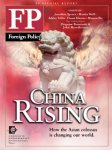
The January/February 2005 issue of Foreign Policy magazine features a special report, "China Rising: How the Asian Colossus is Changing our World," Click on links below to read individual articles and see what these leading experts have to say on such key questions as, are the United States and China on a collision course? And, what are the economic and strategic implications of China's transformation?

The report is based on the Carnegie conference, "China's Peaceful Rise?” held in the fall of 2004. Click here for speaker biographies, videos, and transcripts of that event.

The Once and Future China by Jonathan Spence

Clash of the Titans by Zbigniew Brzezinski and John Mearsheimer

Why is China Growing So Slowly by Martin Wolf

A Grand Chessboard by Ashley Tellis

Lifting All Boats by Homi Kharas

Dangerous Denials by Minxin Pei

Click on the link above for full text of this report.

About the Authors

Jonathan Spence

Zbigniew Brzezinski

Dr. Zbigniew Brzezinski served as national security adviser to President Jimmy Carter from 1977-1981. He is the author of several acclaimed books on foreign policy, most recently, Strategic Visions: America and the Crisis of Global Power.

John Mearsheimer

Martin Wolf

Ashley J. Tellis

Former Senior Fellow

Ashley J. Tellis was a senior fellow at the Carnegie Endowment for International Peace.

Homi Kharas

Minxin Pei

Former Adjunct Senior Associate, Asia Program

Pei is Tom and Margot Pritzker ‘72 Professor of Government and the director of the Keck Center for International and Strategic Studies at Claremont McKenna College.

Authors

Jonathan Spence
Zbigniew Brzezinski

Dr. Zbigniew Brzezinski served as national security adviser to President Jimmy Carter from 1977-1981. He is the author of several acclaimed books on foreign policy, most recently, Strategic Visions: America and the Crisis of Global Power.

John Mearsheimer
Martin Wolf
Ashley J. Tellis
Former Senior Fellow
Homi Kharas
Minxin Pei
Former Adjunct Senior Associate, Asia Program
Minxin Pei
ChinaEconomyTradeMilitary

Carnegie does not take institutional positions on public policy issues; the views represented herein are those of the author(s) and do not necessarily reflect the views of Carnegie, its staff, or its trustees.

More Work from Carnegie Russia Eurasia Center

  • Commentary
    Carnegie Politika
    What the Russian Energy Sector Stands to Gain From War in the Middle East

    The future trajectory of the U.S.-Iran war remains uncertain, but its impact on global energy trade flows and ties will be far-reaching. Moscow is likely to become a key beneficiary of these changes; the crisis in the Gulf also strengthens Russia’s hand in its relationships with China and India, where advantages might prove more durable.

      • Sergey Vakulenko

      Sergey Vakulenko

  • Commentary
    Carnegie Politika
    Beyond Oil: Hormuz Closure Puts Russia in the Lead in the Fertilizer Market

    The Kremlin expects to not only profit from rising fertilizer prices but also exact revenge for the collapse of the 2023 grain deal.

      Alexandra Prokopenko

  • Paper
    A Tight Spot: Challenges Facing the Russian Oil Sector Through 2035

    Russian oil production is remarkably resilient to significant price changes, but significant political headwinds may lead to a drop regardless of economics.

      • Sergey Vakulenko

      Sergey Vakulenko

  • Commentary
    Carnegie Politika
    Why Are China and Russia Not Rushing to Help Iran?

    Most of Moscow’s military resources are tied up in Ukraine, while Beijing’s foreign policy prioritizes economic ties and avoids direct conflict.   

      • Alexander Gabuev

      Alexander Gabuev, Temur Umarov

  • Commentary
    Carnegie Politika
    Georgia’s Fall From U.S. Favor Heralds South Caucasus Realignment

    With the White House only interested in economic dealmaking, Georgia finds itself eclipsed by what Armenia and Azerbaijan can offer.

      Bashir Kitachaev

Get more news and analysis from
Carnegie Russia Eurasia Center
Carnegie Russia Eurasia logo, white
  • Research
  • Politika
  • About
  • Experts
  • Events
  • Contact
  • Privacy
  • For Media
Get more news and analysis from
Carnegie Russia Eurasia Center
© 2026 Carnegie Endowment for International Peace. All rights reserved.







