

Report
Mr. Husain Haqqani, Ashley J. Tellis
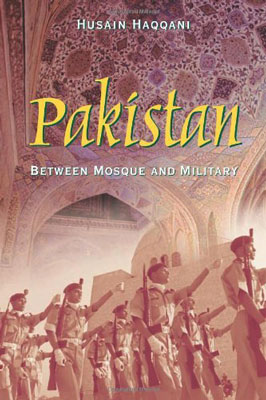
This book analyzes the origins of the relationships between Islamist groups and Pakistan’s military, and explores Pakistan’s quest for identity and security.
Source: Washington

This book analyzes the origins of the relationships between Islamist groups and Pakistan’s military, and explores Pakistan’s quest for identity and security. Tracing how the military has sought U.S. support by making itself useful for concerns-of-the-moment—while continuing to strengthen the mosque-military alliance within Pakistan—the book offers an alternative view of political developments in Pakistan since independence in 1947.
About the Author
Husain Haqqani is a former visiting scholar at the Carnegie Endowment. He is also a leading journalist and former diplomat, who served as a former adviser to three Pakistani prime ministers. He is a syndicated columnist for Indian Express, Gulf News, and The Nation (Pakistan).
"[Haqqani's] analysis will reward anyone who seeks to understand one of the most perplexing foreign policy challenges facing the U.S. today."
—Alyssa Ayres, The Wall Street Journal
"An old joke told by Pakistanis holds that three A's count in their country: Allah, army, and America. In his insightful history of his homeland, Husain Haqqani shows it is no joke."
—Kenneth Cooper, The Boston Globe
"In this cogent, well-informed and extraordinarily informative book, Husain Haqqani describes in detail the unholy alliance between Islamists and military officers that has shaped Pakistan’s past and may well determine its future. An important and disturbing tale, deftly told."
—Andrew J. Bacevich, author of The New American Militarism: How Americans Are Seduced by War
"Husain Haqqani has seen Pakistani politics close up. But his book is much more than a memoir: Haqqani has produced a provocative and controversial history revealing the depth of the links between the army and the Islamic radicals. Required reading."
—Owen Bennett-Jones, BBC, Author of Pakistan: The Eye of the Storm
"We are in Hussain Haqqani's debt for providing the authoritative account of the linkages between Pakistan's powerful Islamists and it's professional army. He conclusively demonstrates that these ties are long-standing, complex, and very troubling. This brilliantly researched and written book should be required reading for anyone who wishes to understand this increasingly important state."
—Stephen P. Cohen, Brookings Institution, Author of The Idea of Pakistan and The
—Tariq Fatemi, Dawn
—Alex Alexiev, Commentary
Former Visiting Scholar
Recent Work
Mr. Husain Haqqani, Ashley J. Tellis
Mr. Husain Haqqani
Carnegie does not take institutional positions on public policy issues; the views represented herein are those of the author(s) and do not necessarily reflect the views of Carnegie, its staff, or its trustees.

Putin’s conservative staffing policies and search for ever greater control have cemented parliament’s transformation into a bureaucratic appendage of the executive branch.

Andrey Pertsev

Without a ceasefire with Ukraine on attacking each other’s energy infrastructure—to which the Kremlin is unlikely to agree—the diesel agreement between Putin and Trump is largely for show, rather than representing a genuine increase in the volumes of Russian diesel on the global market.

Sergey Vakulenko

Russian strikes are weakening the economy sustaining Ukraine’s war effort. Closing the growing funding gap will require more European support and politically contentious reforms in Kyiv.

Balázs Jarábik

Ex-president Gurbanguly Berdimuhamedov remains interested in politics, but his son Serdar, Turkmenistan’s current president, is becoming increasingly independent and willing to break with his father’s legacy. If their covert rivalry goes too far, both risk losing power.

Galiya Ibragimova

Despite a new textbook, an influx of Russian teachers and managers, and an end to the teaching of Ukrainian, the Kremlin is unlikely to have “reprogrammed” locals.

Konstantin Skorkin