• Research
  • Politika
  • About
Carnegie Russia Eurasia center logoCarnegie lettermark logo
  • Donate
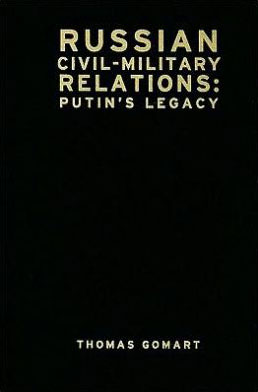
Russian Civil-Military Relations: Putin's Legacy
Book

Russian Civil-Military Relations: Putin's Legacy

Russian Civil-Military Relations provides crucial analysis of the nature and evolution of the balance between civilian and military institutions. These relations will continue to influence regime development, security policy, and societal attitudes that build from Putin’s Russia, to Medvedev’s administration, and into the future.

Link Copied
By Thomas Gomart
Published on Jun 30, 2008

Additional Links

Table of ContentsForewordIntroductionPaperback - $19.95Hardback - $49.95

Source: Washington

As Russia reasserts itself on the international stage, the relationship between its civilian and military spheres remains one of the determining factors in the organization of political power. Thomas Gomart’s Russian Civil-Military Relations: Putin’s Legacy looks beyond traditional dualism between the Kremlin and the military, introducing the role of the security services in Russian power distribution. With the support of the siloviki and justification through the fight against “international terrorism,” Putin worked throughout his administration to reestablish presidential control over the military. As Russia transitions to Dmitry Medvedev’s presidency, it is important to review the Putin presidency, which has given many of the country’s institutions their shape, but also reach back further into postcommunist and Soviet history for an understanding of the realities of today.

Russian Civil-Military Relations provides crucial analysis of the nature and evolution of the balance between civilian and military institutions. These relations will continue to influence regime development, security policy, and societal attitudes that build from Putin’s Russia, to Medvedev’s administration, and into the future.


About the Author
Thomas Gomart is director of the Russia/NIS Center at the French Institute for International Relations (IFRI) in Paris and lectures on international affairs and geopolitics at the Special Military School of Saint-Cyr Coëtquidan. He has been Lavoisier Fellow at the Moscow State Institute for International Relations, Visiting Fellow at the Institute for Security Studies, Paris, and Marie Curie Fellow at Department of War Studies, King’s College, London.

Advance Praise

“This perceptive and well-informed study highlights the continuity of the Russian (civilian and military) security community’s distrust of the outside world, fueled by NATO enlargement. Communism may be dead in Russia, but the obsession with ‘threats’ continues, rallying the population and keeping security elites in power. This makes Russia an uncomfortable world player to live with. A must read.”
—Beatrice Heuser, professor and chair of International Relations, School of Politics and International Relations, University of Reading, UK

“It is my pleasure to recommend this book by Thomas Gomart to all those who are interested in the transformation of Russia and which remains an important factor not only for Russia’s direct neighbors, but to the international system more broadly. The Russian army, which for decades opposed the West, merits sustained attention. As the old saying goes, it is never as strong as it wants to look, but is never as feeble as it at times appears.”
—From the foreword by Dmitri Trenin, deputy director of the Carnegie Moscow Center and senior associate at the Carnegie Endowment for International Peace

About the Author

Thomas Gomart

Thomas Gomart
CaucasusRussiaForeign Policy

Carnegie does not take institutional positions on public policy issues; the views represented herein are those of the author(s) and do not necessarily reflect the views of Carnegie, its staff, or its trustees.

More Work from Carnegie Russia Eurasia Center

  • Commentary
    Carnegie Politika
    Why Has Kazakhstan Started Deporting Political Activists?

    The current U.S. indifference to human rights means Astana no longer has any incentive to refuse extradition requests from its authoritarian neighbors—including Russia.

      Temur Umarov

  • Commentary
    Carnegie Politika
    Why Are China and Russia Not Rushing to Help Iran?

    Most of Moscow’s military resources are tied up in Ukraine, while Beijing’s foreign policy prioritizes economic ties and avoids direct conflict.   

      • Alexander Gabuev

      Alexander Gabuev, Temur Umarov

  • Commentary
    Carnegie Politika
    Georgia’s Fall From U.S. Favor Heralds South Caucasus Realignment

    With the White House only interested in economic dealmaking, Georgia finds itself eclipsed by what Armenia and Azerbaijan can offer.

      Bashir Kitachaev

  • Commentary
    Carnegie Politika
    What Does War in the Middle East Mean for Russia–Iran Ties?

    If the regime in Tehran survives, it could be obliged to hand Moscow significant political influence in exchange for supplies of weapons and humanitarian aid.

      Nikita Smagin

  • Commentary
    Carnegie Politika
    How Trump’s Wars Are Boosting Russian Oil Exports

    The interventions in Iran and Venezuela are in keeping with Trump’s strategy of containing China, but also strengthen Russia’s position.

      • Mikhail Korostikov

      Mikhail Korostikov

Get more news and analysis from
Carnegie Russia Eurasia Center
Carnegie Russia Eurasia logo, white
  • Research
  • Politika
  • About
  • Experts
  • Events
  • Contact
  • Privacy
Get more news and analysis from
Carnegie Russia Eurasia Center
© 2026 Carnegie Endowment for International Peace. All rights reserved.