

Commentary
Uri Dadush
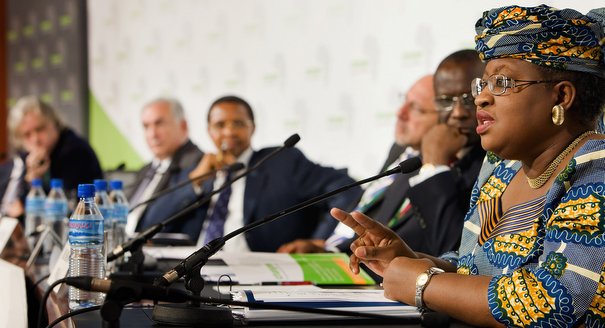
Source: Getty
Following through on promises made at the G20 meeting in London to help triple IMF resources will not only help hasten economic recovery, but also bolster U.S. leadership in a world economy on which it is increasingly reliant.
The recent meeting of the G20 in London committed to tripling the resources available to the IMF to fight the global financial crisis. As part of that agreement, the United States, the EU, and Japan each pledged to commit to the IMF $100 billion to help the most vulnerable countries cope with the financial storm. Several other G20 countries, including China and India, are considering contributions.
Now, voices are being raised in opposition to following through on the U.S.’ commitment. They are deeply wrong. Following through on this promise is not only a crucial step in recovery from the current crisis and prevention of the next; it is also imperative to continued U.S. leadership in a world economy on which it is increasingly reliant. Contributions also would not increase the U.S. budget deficit, as the transaction takes the form of what is effectively a credit line.
Despite recent excitement over “green shoots” of economic recovery, the continued decline of world trade, rising unemployment, and strained bank balance sheets remind us that recovery is not a foregone conclusion. Recovery remains a fragile hope that requires continued strong policies to come to fruition and be sustained. Rapid and strong stimulus enacted by the U.S. government has done much toward this end, pumping liquidity and fiscal support into its domestic economy.
However, focusing only on the U.S. domestic economy will not be enough. A full U.S. recovery from the current crisis requires a global recovery. Exports accounted for over half of U.S. growth in the year before the crisis, and their collapse since last summer has cost the United States at least 1.5 percent of GDP and 1.5 million jobs. As the world’s largest foreign investor, with about $18 trillion or about 120 percent of its GDP invested abroad by corporations, banks, pension funds, and individuals at end 2007, the United States can ill afford to ignore the health of economies overseas.
Support of the IMF is the best strategy available to the United States for breathing life back into global trade and protecting its own financial system from the ravages of the crisis overseas.
The IMF is uniquely poised to offer loans and technical assistance to countries most severely affected by the current crisis, mitigating shocks to enterprise and household wealth―and thereby to these entities’ links to the U.S. economy. The organization has already provided loans and lines of credit amounting to more than $100 billion to countries in crisis. Without increased IMF intervention, many other countries are at future risk. Investor confidence around the world may be improving, but it remains low and fragile. In this environment, the implications of a financial pandemic, spreading contagiously and causing country after country to go belly up, are too dire to ignore.
Providing a credit line to the IMF will be most important to ensure that the emerging market countries that have been hard-hit by the crisis will have access to the financing that will enable them to endure the shocks. In addition, the Fund needs to be able to provide its new insurance policy—known as the Flexible Credit Line—to countries that have strong economic policies but need the assurance of IMF backing in case conditions worsen. Already, Mexico and Poland have taken advantage of this financing to reassure markets, and Colombia is likely to follow soon.
As part of the deal that includes the U.S. contribution, the G20 also committed to strengthening the IMF’s resources to help address the dire situation of many of the world’s poorest countries in Africa and elsewhere. Fund concessional lending to these countries will double. Poor countries in Africa and elsewhere had no role in causing the crisis but have been severely affected by the fallout of falling commodity prices, trade, remittances, and foreign investment. As a result of the crisis, the number of people living on less than $ 1.25 a day will increase by 53 million, according to the World Bank. Among the world’s poorest countries, virtually none have the room to enact fiscal or monetary stimulus to deal with the crisis.
Support for the IMF also will reduce the likelihood that the financial and political crises in countries crucial to U.S. national security, such as nuclear-armed Pakistan, become even deeper and more intractable. IMF financing is badly needed to help finance essential imports, enable governments to protect—or even increase—social spending, and avoid a devastating collapse of government institutions.
Further, investment in the IMF will continue to provide benefits even after we have recovered from today’s crisis. By serving as a credible lender of last resort at the international level, the IMF can mitigate or even nip in the bud future financial crises—and the crisis of 2008–2009 will unfortunately not be the last. Investment in the IMF will also enhance the institution’s surveillance capabilities, which will assist in identifying the early-on imbalances that caused our current crisis (the IMF had issued repeated warnings about these imbalances, by the way).
As stressed by a recent report on IMF reform, increased monetary contributions alone will not, however, be enough to ensure that the institution delivers. The United States must also continue to promote governance reforms to make the Fund more legitimate in the eyes of developing countries, and make it politically easier to resort to IMF assistance. This means, among other steps, that the United States should continue to support the demands of developing countries to have a greater voice in decisions taken by the Fund’s governing bodies.
Establishing a merit-based system for the managing director appointment (and removing the de facto restriction that he or she be a European national) would also be an important step. Enhancing the Fund’s legitimacy will also entail sharply reducing the number of European chairs and votes and increasing those allocated to developing countries. The United States should also accept a lowered threshold of votes for important decisions, which will mean that neither the United States nor a tiny minority of advanced countries will enjoy the privilege of a veto on those decisions.
It is clear that living up to the U.S. promise to lend $100 billion to the IMF would be a significant step toward U.S. and global economic recovery. Furthermore, it is unthinkable that the United States, a country the whole world looks to for economic leadership, would renege on a promise to help countries deal with a crisis it had such a prominent role in manufacturing.

Former Senior Associate, International Economics Program
Dadush was a senior associate at the Carnegie Endowment for International Peace. He focuses on trends in the global economy and is currently tracking developments in the eurozone crisis.
Recent Work
Uri Dadush
Uri Dadush
Carnegie does not take institutional positions on public policy issues; the views represented herein are those of the author(s) and do not necessarily reflect the views of Carnegie, its staff, or its trustees.
Ongoing uncertainty in the Middle East allows Moscow to both increase its influence in Tehran and continue to enjoy the financial windfall of higher oil prices.

Nikita Smagin

A much-discussed disagreement over internet restrictions in Russia was never an existential threat for Putin: It was about elite groups protecting their interests.

Alexandra Prokopenko

The demands of the Kremlin’s war in Ukraine, demographic problems, and public hostility toward Central Asians mean Russia does not have enough workers.

Salavat Abylkalikov

Minsk’s faith in the future of its larger neighbor’s economy is fading as Belarusian firms in Russia see record losses.

Olga Loiko

The cost of air defense has become an unregistered tax on revenue for businesses. While military rents are consolidated in the federal budget, the costs of defense are being spread across the balance sheets of companies and regional governments.
Alexandra Prokopenko