• Research
  • Politika
  • About
Carnegie Russia Eurasia center logoCarnegie lettermark logo
  • Donate
Consequences of Iran’s Presidential Election Results

Source: Getty

Article

Consequences of Iran’s Presidential Election Results

Mahmoud Ahmadinejad’s election victory could pose an insurmountable challenge to the Obama administration’s engagement strategy, but Iran remains integral to critical foreign policy challenges.

Link Copied
By Karim Sadjadpour
Published on Jun 14, 2009

Additional Links

Full Text

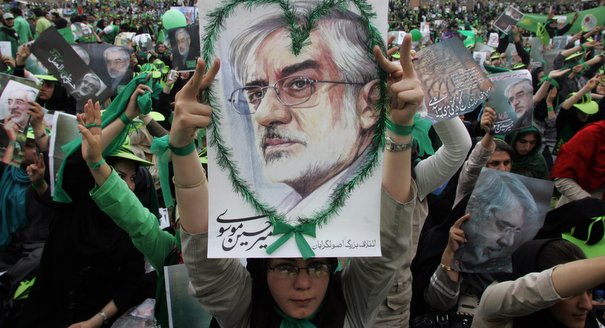
Following the surprise announcement that President Ahmadinejad had won outright the first round of Iran’s presidential election, Karim Sadjadpour explained the implications for the Obama administration’s diplomatic initiative with Iran and the domestic reaction.

Key points:

  • The United States should wait until the election has played out domestically before commenting on or reaching out to the Iranian government.
     
  • Ahmadinejad’s victory could pose an insurmountable challenge to the Obama administration’s engagement strategy, but Iran remains integral to critical challenges including Afghanistan, the Arab–Israeli conflict, terrorism, and energy security. Once the dust settles the United States will eventually have no choice but to talk to Tehran, but it will likely be a cold, hard-nosed dialogue rather than friendly greetings.
     
  • Despite being the true source of power, Supreme Leader Ayatollah Khamenei is rarely held accountable for Iran’s economic malaise or political isolation, given the high profile of the Iranian president. The United States should announce publicly they wish to talk directly with Khamenei.
     
  • In the thirty years since the Islamic revolution, Iran’s political elite have never been so divided.
     
  • While dramatic, the current protests are not yet significant enough to pose an existential threat to the regime.

Sadjadpour said:

“In retrospect, it looks like the entire campaign was a show, in the sense that Ayatollah Khamanei was never going to let Ahmadinejad lose. Assuming these results are allowed to stand, I think we should be clear about what type of regime we are dealing with in Tehran. Just as we talk about Assad’s Syria and Mubarak’s Egypt, I think we are now dealing with Khamanei’s Iran.”

About the Author

Karim Sadjadpour

Senior Fellow, Middle East Program

Karim Sadjadpour is a senior fellow at the Carnegie Endowment for International Peace, where he focuses on Iran and U.S. foreign policy toward the Middle East.

    Recent Work

  • Q&A
    What’s Keeping the Iranian Regime in Power—for Now

      Aaron David Miller, Karim Sadjadpour, Robin Wright

  • Q&A
    How Washington and Tehran Are Assessing Their Next Steps

      Aaron David Miller, David Petraeus, Karim Sadjadpour

Karim Sadjadpour
Senior Fellow, Middle East Program
Karim Sadjadpour
North AmericaUnited StatesMiddle EastIranPolitical ReformForeign Policy

Carnegie does not take institutional positions on public policy issues; the views represented herein are those of the author(s) and do not necessarily reflect the views of Carnegie, its staff, or its trustees.

More Work from Carnegie Russia Eurasia Center

  • Commentary
    Carnegie Politika
    The Kremlin Is Destroying Its Own System of Coerced Voting

    The use of technology to mobilize Russians to vote—a system tied to the relative material well-being of the electorate, its high dependence on the state, and a far-reaching system of digital control—is breaking down.

      Andrey Pertsev

  • Commentary
    Carnegie Politika
    Can the Disparate Threads of Ukraine Peace Talks Be Woven Together?

    Putin is stalling, waiting for a breakthrough on the front lines or a grand bargain in which Trump will give him something more than Ukraine in exchange for concessions on Ukraine. And if that doesn’t happen, the conflict could be expanded beyond Ukraine.

      Alexander Baunov

  • Commentary
    Carnegie Politika
    Notes From Kyiv: Is Ukraine Preparing for Elections?

    As discussions about settlement and elections move from speculation to preparation, Kyiv will have to manage not only the battlefield, but also the terms of political transition. The thaw will not resolve underlying tensions; it will only expose them more clearly.

      Balázs Jarábik

  • Commentary
    Carnegie Politika
    Once Neutral on the Ukraine War, Arab States Increasingly Favor Moscow

    Disillusioned with the West over Gaza, Arab countries are not only trading more with Russia; they are also more willing to criticize Kyiv.  

      Ruslan Suleymanov

  • Commentary
    Carnegie Politika
    Signs of an Imminent End to the Ukraine War Are Deceptive

    The main source of Russian aggression is a profound mistrust of the West and the firm belief that it intends to inflict a “strategic defeat” on Russia. As long as this fear persists, the war will not end.

      Tatiana Stanovaya

Get more news and analysis from
Carnegie Russia Eurasia Center
Carnegie Russia Eurasia logo, white
  • Research
  • Politika
  • About
  • Experts
  • Events
  • Contact
  • Privacy
Get more news and analysis from
Carnegie Russia Eurasia Center
© 2026 Carnegie Endowment for International Peace. All rights reserved.