• Research
  • Politika
  • About
Carnegie Russia Eurasia center logoCarnegie lettermark logo
  • Donate
Yemen: Avoiding a Downward Spiral

Source: Getty

Paper

Yemen: Avoiding a Downward Spiral

If the Yemeni central government cannot fully control its territory, violent extremists will have a space to regroup and launch new attacks. Yemen's problems potentially threaten the region and the international community.

Link Copied
By Christopher Boucek
Published on Sep 10, 2009

Additional Links

Full Text

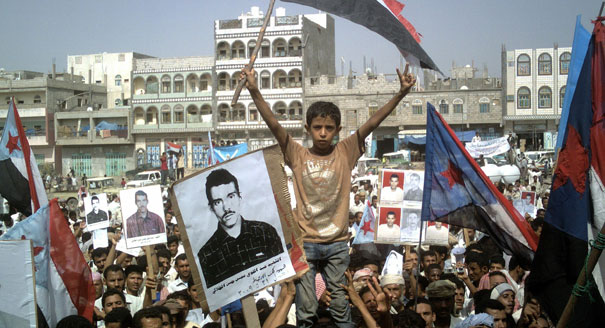
A confluence of looming challenges—economic ruin, an emerging water shortage, violent extremism, and a growing secessionist movement—threaten to overwhelm the Yemeni government, provide a breeding ground for terrorists, and destabilize the region. Yemen has survived past crises but the current risks are unprecedented in their scope and interconnectivity, warns a new paper by Christopher Boucek.

Key Conclusions:

  • There are increasing indications that al-Qaeda is regrouping in Yemen. Recent counterterrorism measures in Saudi Arabia have forced extremists to seek refuge elsewhere, with a steady flow relocating to Yemen’s under-governed areas.
     
  • The ceding of authority by the weak central government to local government has proved counterproductive by limiting control over volatile under-governed territories.
     
  • The security situation is rapidly deteriorating. Fighting with Shi’i rebels in north Yemen has strained the army, and Yemen is unable to protect its coast from the recent surge in piracy.
     
  • The poorest in the Arab world, with unemployment at 35 percent, Yemen’s economy has been severely effected by the dramatic fall in oil prices and has few sustainable post-oil, economic options.
     
  • Yemen is running out of water. Rising domestic consumption, poor water management, corruption, the absence of resource governance, and wasteful irrigation techniques are creating frequent and widespread shortages.
     
  • Yemen’s lack of food and water is complicated by the population’s dependence on qat, a quick-cash crop that requires heavy irrigation to thrive. Farmers devote so much land to qat production that Yemen is now a net food importer.

Recommendations:

  • Yemen must build local capacity in law enforcement and its legal and judicial systems by enacting counterterrorism legislation, passing terror finance laws, improving police training, and professionalizing the prison service.
     
  • The Gulf states should make Yemen’s membership of the Gulf Cooperation Council contingent on tough steps, including progress on curbing government subsidies, addressing corruption, and enacting measures to curtail security concerns.
     
  • U.S. aid to Yemen is disproportionately small given its importance to U.S. national security. Development assistance, education and technical cooperation, capacity building, institution strengthening, and direct financial assistance can better address the interconnected challenges facing Yemen than military and security aid.


Boucek concludes:


“If left unaddressed, Yemen’s problems could potentially destabilize Saudi Arabia and the other Gulf states. The inability of the Yemeni central government to fully control its territory will create space for violent extremists to regroup and launch attacks against domestic and international targets. The international community must be realistic about the limitations of intervention in Yemen. In the near term, however, inaction is not an option.”

About the Author

Christopher Boucek

Former Associate, Middle East Program

Boucek was an associate in the Carnegie Middle East Program where his research focused on security challenges in the Arabian Peninsula and Northern Africa.

    Recent Work

  • Q&A
    Yemen After Saleh’s Return and Awlaki’s Exit

      Christopher Boucek

  • Q&A
    Rivals—Iran vs. Saudi Arabia

      Christopher Boucek, Karim Sadjadpour

Christopher Boucek
Former Associate, Middle East Program
Christopher Boucek
YemenGulfSecurityPolitical ReformEconomyForeign Policy

Carnegie does not take institutional positions on public policy issues; the views represented herein are those of the author(s) and do not necessarily reflect the views of Carnegie, its staff, or its trustees.

More Work from Carnegie Russia Eurasia Center

  • Commentary
    Carnegie Politika
    Georgia’s Fall From U.S. Favor Heralds South Caucasus Realignment

    With the White House only interested in economic dealmaking, Georgia finds itself eclipsed by what Armenia and Azerbaijan can offer.

      Bashir Kitachaev

  • Commentary
    Carnegie Politika
    What Does War in the Middle East Mean for Russia–Iran Ties?

    If the regime in Tehran survives, it could be obliged to hand Moscow significant political influence in exchange for supplies of weapons and humanitarian aid.

      Nikita Smagin

  • Commentary
    Carnegie Politika
    How Trump’s Wars Are Boosting Russian Oil Exports

    The interventions in Iran and Venezuela are in keeping with Trump’s strategy of containing China, but also strengthen Russia’s position.

      • Mikhail Korostikov

      Mikhail Korostikov

  • Commentary
    Carnegie Politika
    How Far Can Russian Arms Help Iran?

    Arms supplies from Russia to Iran will not only continue, but could grow significantly if Russia gets the opportunity.

      Nikita Smagin

  • Commentary
    Carnegie Politika
    The Kremlin Is Destroying Its Own System of Coerced Voting

    The use of technology to mobilize Russians to vote—a system tied to the relative material well-being of the electorate, its high dependence on the state, and a far-reaching system of digital control—is breaking down.

      Andrey Pertsev

Get more news and analysis from
Carnegie Russia Eurasia Center
Carnegie Russia Eurasia logo, white
  • Research
  • Politika
  • About
  • Experts
  • Events
  • Contact
  • Privacy
Get more news and analysis from
Carnegie Russia Eurasia Center
© 2026 Carnegie Endowment for International Peace. All rights reserved.