

Paper
Adam Baczko, Gilles Dorronsoro, Arthur Quesnay
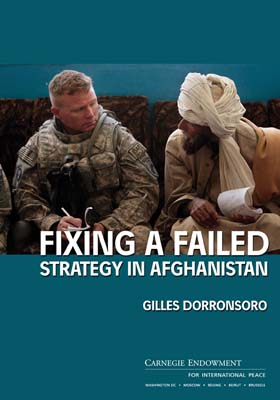
To correct a failing strategy in Afghanistan, the United States and its allies need to focus on protecting Afghan cities and reallocating more resources to the North.
As the debate on future U.S. strategy draws to a close, the war in Afghanistan is spreading to the North (an area that had previously been relatively quiet), the balance of power in Afghanistan has shifted in the Taliban’s favor, and the Afghan government continues to lose legitimacy in the eyes of the population and international community. In order to correct a failing strategy, the United States and its allies need to protect cities and reallocate more resources to the North.
Gilles Dorronsoro explains that more troops alone will not fix a flawed approach and details what a new, successful U.S. strategy should look like:
“The Coalition badly needs a success in the next few months to counter the widely held perception that defeat is the likely outcome,” concludes Dorronsoro. “The current strategy could very well fail and result in yet another demand for reinforcements next year. A vigorous debate―more about strategy than resources―is needed.”
Former Nonresident Scholar, South Asia Program
Dorronsoro’s research focuses on security and political development in Afghanistan. He was a professor of political science at the Sorbonne in Paris and the Institute of Political Studies of Rennes.
Recent Work
Adam Baczko, Gilles Dorronsoro, Arthur Quesnay
Gilles Dorronsoro
Carnegie does not take institutional positions on public policy issues; the views represented herein are those of the author(s) and do not necessarily reflect the views of Carnegie, its staff, or its trustees.

The truth of the strategic situation is that Europe and Russia are extremely unlikely to be able to “turn the page” on their confrontation within the next two decades.

Arkady Moshes

Russia’s AI-driven propaganda campaigns operate in a fragmented, chaotic, and often illogical manner. That’s not necessarily a problem for the Kremlin, though: It’s much easier to mimic genuine public debate that way.

Ilya Klishin

Without a ceasefire with Ukraine on attacking each other’s energy infrastructure—to which the Kremlin is unlikely to agree—the diesel agreement between Putin and Trump is largely for show, rather than representing a genuine increase in the volumes of Russian diesel on the global market.

Sergey Vakulenko

Russian strikes are weakening the economy sustaining Ukraine’s war effort. Closing the growing funding gap will require more European support and politically contentious reforms in Kyiv.

Balázs Jarábik

Despite a new textbook, an influx of Russian teachers and managers, and an end to the teaching of Ukrainian, the Kremlin is unlikely to have “reprogrammed” locals.

Konstantin Skorkin