

Paper
Alejandro Foxley, Fernando Sossdorf
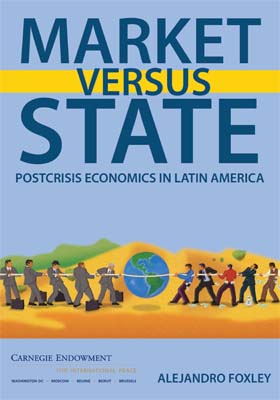
The global financial crisis was a result of failures in both the market and state—markets created financial turmoil and regulatory agencies failed to detect risks and correct imbalances. As Latin American countries emerge from the crisis, both the market and state are needed to ensure sustainable growth.
The global financial crisis was a result of failures in both the market and state—markets created financial turmoil and regulatory agencies failed to detect risks and correct imbalances. As Latin American countries emerge from the crisis, both the market and state are needed to ensure sustainable growth.
Analyzing the successes and mistakes of economic policies over the past twenty years, Foxley makes recommendations for Latin America to achieve development that creates fewer inequalities and increases the capacity for innovation.
Recommendations
“As they emerge from the most recent crisis, Latin American economies need both—more market and more state. More market will enable them to exploit new opportunities through bilateral or multilateral trade agreements, and expand public-private partnerships,” writes Foxley. “A more intelligent state, acting as a catalyst for development, could encourage creativity and foster entrepreneurship.”
Former Senior Associate, International Economics Program
Foxley was previously minister of foreign affairs, senator, and minister of finance of the Republic of Chile. While minister of finance he concurrently served as a governor of the Inter-American Development Bank and the World Bank.
Recent Work
Alejandro Foxley, Fernando Sossdorf
Alejandro Foxley
Carnegie does not take institutional positions on public policy issues; the views represented herein are those of the author(s) and do not necessarily reflect the views of Carnegie, its staff, or its trustees.

Russian strikes are weakening the economy sustaining Ukraine’s war effort. Closing the growing funding gap will require more European support and politically contentious reforms in Kyiv.

Balázs Jarábik

For every ruble allocated to social policy, health, and education in 2027, double that amount is earmarked for the army, the police, and the security services.

Alexandra Prokopenko

Depleted financial reserves and a shrinking tax base mean it is no longer possible to simultaneously deliver high defense spending, price stability, and economic growth.
Alexandra Prokopenko
A much-discussed disagreement over internet restrictions in Russia was never an existential threat for Putin: It was about elite groups protecting their interests.
Alexandra Prokopenko

The demands of the Kremlin’s war in Ukraine, demographic problems, and public hostility toward Central Asians mean Russia does not have enough workers.
Salavat Abylkalikov