

Paper
- +4
Dmitri Trenin, Alexey Arbatov, Maria Lipman, …
Source: Getty
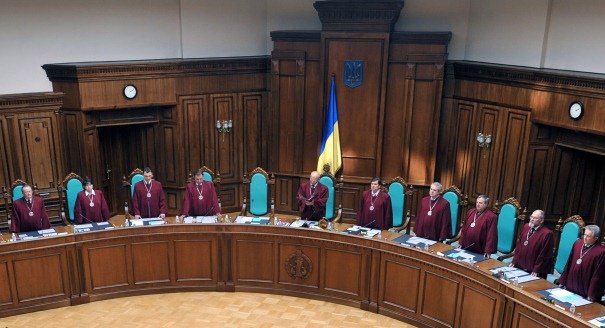
The Ukrainian Constitutional Court’s decision to overturn the political reform of 2004 acts as a relative guarantee that, should the opposition win the majority in future parliamentary elections, it will not be able to threaten the president’s agenda.
When the Ukrainian Constitutional Court recently ruled to repeal the political reform of 2004, it rejected the decision to turn the country’s presidential-parliamentary system of government into a parliamentary-presidential system. This decision – which gives the president more power than the parliament – is worth examining on several fronts.
Probably the most important thing to note about the Court’s decision is that it does not simply help President Viktor Yanukovych and his party strengthen their hold on power through the use of constitutional amendments designed to weaken the Parliament and also reduce the ministerial cabinet’s power. While the decision has that effect, Yanukovych’s team is primarily looking at the decision to prepare for possible future political developments rather than focusing on the immediate present.
The current social and economic situation in Ukraine is clearly unstable. In some respects it is worsening and broad sectors of the population are feeling the effects. Recent history has shown that the Ukrainian public is quick to change its political sympathies if it starts to sense a noticeable downturn in the economy and social conditions. At the same time, Ukrainian hopes for significant Russian aid did not bear fruit for several reasons. All these factors give the Ukrainian opposition a potential opening in future elections – despite the fact that the opposition’s leaders have been considerably weakened and discredited.
If, however, the opposition were to win the 2012 parliamentary election and form a government, Yanukovych would be in a bind. Former president Viktor Yushchenko faced a similar scenario when the constitutional reforms making Ukraine a parliamentary-presidential republic were in force. That experience showed that the president is unable to implement policies without the support of his cabinet and the parliamentary majority. The president ends up waging battle on every bill.
Realizing the potential risks inherent in the parliamentary elections, Yanukovych’s Party of Regions decided to try to avoid the problem by returning Ukraine to its previous form of government, where the president holds more power than the Parliament. This means the outcome of the 2012 parliamentary elections will not be as decisive as in the past.
One more important thing to realize is that this latest decision makes it possible to shorten the current Ukrainian Parliament’s mandate. Yanukovych and his party may have the opportunity to hold parliamentary elections in a more favorable social and economic situation than is expected in 2012. They could therefore have a greater chance of winning more seats in the new parliament.
But if Yanukovych tries to force earlier parliamentary elections, the most likely result is that the current parliamentary coalition would split, abandoned by the smaller parties. Whether this possibility will influence the political course being pursued by Yanukovych and the Party of Regions remains to be seen.
Former Scholar-in-Residence, The East East: Partnership Beyond Borders Program, Moscow Center
Ryabov was chair of the Carnegie Moscow Center’s East East: Partnership Beyond Borders Program. He is also the chief editor of the journal World Economy and International Relations and a leading researcher at the Russian Academy of Sciences’ Institute of World Economy and International Relations.
Recent Work

Dmitri Trenin, Alexey Arbatov, Maria Lipman, …
Andrei Ryabov
Carnegie does not take institutional positions on public policy issues; the views represented herein are those of the author(s) and do not necessarily reflect the views of Carnegie, its staff, or its trustees.

Despite unhappiness on the ground, Moscow is determined to use both carrot and stick to ensure there is record support for United Russia in occupied Ukraine.

Konstantin Skorkin

Whether PAS can refocus on the unfinished business of state-building may ultimately prove more consequential for Moldova’s European future than the pace of its accession negotiations.

Balázs Jarábik
Medvedev’s defeat in the battle for the position of speaker appears to signal that the long process of his marginalization in Russian politics has passed the point of no return.

Andrey Pertsev
The recent damage inflicted by Ukrainian drones and missiles on Russia has made Belarus aware of its own vulnerabilities—and surprisingly amenable to Kyiv’s demands.

Artyom Shraibman
The ruling elites in contemporary Russia are not a political class, but a community of managers who are not subject to competition or public accountability. The state is becoming an operating apparatus without any internal autonomy.

Alexandra Prokopenko