

Commentary
If the Russian-speaking community in Latvia cannot articulate their interests without being seen as disloyal, they could end up embracing a pro-Kremlin agenda.
Sergejs Potapkins
Source: Getty
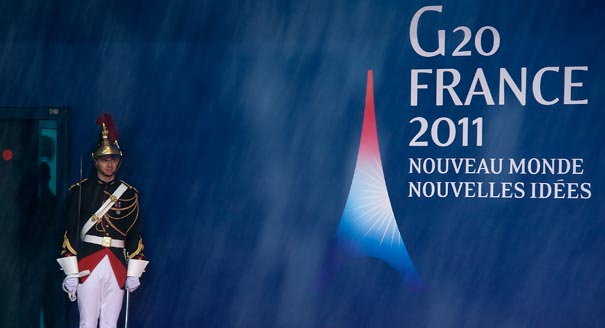
Although Cannes provided the United States and the broader G20 with an opportunity to rescue Europe from its current economic turmoil, the G20 did not make the tough decisions necessary to end the Eurozone crisis.
As expected, the G20 summit yielded little by way of concrete commitments or dramatic breakthroughs. The high hopes of just a few weeks ago had already dimmed by the time leaders gathered in Cannes, in an atmosphere beset by European divisions, Greek tragedies, and the inability of the United States—absorbed by its own domestic problems—to provide the necessary impetus. Nevertheless, leaders did make nuanced progress and also appeared to consolidate the consensus around some important issues.
In rough order of importance:
The European debt crisis, now nearing its apex, hijacked the meeting. G20 leaders did not offer new financial support, either through a direct infusion into the eurozone or through an expansion of the International Monetary Fund (IMF). However, the door was left open for IMF expansion, an issue G20 finance ministers will discuss in their upcoming meeting in February, including through the establishment of a special purpose vehicle.
Most significantly, Italy—on which the future of the eurozone now rests—agreed to call in the IMF to monitor the implementation of the budget and structural reforms it submitted to EU leaders last week. This effectively places Italy under an IMF (and EU) program. Unlike Greece, Ireland, and Portugal, however, which draw money mainly from the European Financial Stability Facility (EFSF), Italy’s program is unofficial and draws its sustenance from European Central Bank (ECB) bond purchases. Conditionality will be applied every moment of the working week, as the ECB can allow Italian yields to rise if Italy slips. This is a dangerous ploy for both the ECB and Italy, but it’s currently the only game in town.
The G20 made its strongest statement yet in favor of exchange rate flexibility—essentially a call for Chinese exchange rate reforms. In an apparent quid pro quo, the IMF will reconsider the composition of its Special Drawing Rights (SDR) currency basket to reflect the yuan’s increased importance, a technical and largely symbolic step. The call for increased exchange rate flexibility is the only concrete achievement of the much touted reform of the international monetary system prioritized by the French presidency.
As a gesture toward global rebalancing, surplus countries agreed to allow automatic stabilizers to work and provide discretionary stimulus if economic conditions worsen, while the United States committed to put its debt-to-GDP ratio on a downward path by 2015. Clearly, the decisions on these issues will require the support of domestic legislatures that may not be forthcoming in some instances, beginning with a deeply divided U.S. Congress.
Leaders made little progress in reforming G20 governance, another priority on the French agenda. Although the communiqué states that the G20 will remain an informal gathering, it also agreed to “formalize” the Troika, the current three-part management body made up of the previous, current, and upcoming chairs. This could be interpreted as a step toward establishing a permanent G20 secretariat—a stated goal of French President Nicolas Sarkozy—without saying it in name.
Underscoring the rising importance of Asia, leaders also agreed to choose G20 presidents from rotating regional groups, beginning with the Asian group after 2015. (The succession of year-long chairmanships—Mexico, Russia, Australia, and Turkey—has already been established through that date.) There was no mention of the hot button issue of changes in G20 membership.
Leaders did very little to address concerns regarding high and volatile food prices, another stated priority. They endorsed reforms to improve commodity derivative markets without providing many specifics, but avoided mentioning any redress of the underlying causes of high and volatile food prices—namely agricultural trade protection and biofuel subsidies and mandates.
The G20 reaffirmed its previous commitments regarding trade and protectionism during the crisis, agreeing to maintain standstill commitments through 2013 and calling for countries to roll back any new protectionist measures that have been implemented. Though G20 leaders also reiterated their commitment to the Doha process, they thankfully did not set another (likely-to-be-missed) deadline. Most importantly, they endorsed for the first time a more pragmatic approach to trade negotiations, calling on trade ministers to find ways to make the failed multilateral process more workable. However, alternative approaches—such as plurilateral or critical-mass agreements advocated by many experts—were not specifically mentioned.
In the end, the G20 summit missed its opportunity. During the worst days of the financial crisis in 2008 and 2009, the G20 established its credentials as an essential crisis-fighting body, led by the United States, which was at the epicenter of the crisis. With the eurozone teetering on the edge, Cannes provided the United States and the broader G20 with an opportunity to lead another dramatic rescue. But this time, it fell short.
Here, the blame is widely shared but can be placed mainly at the door of the Europeans leaders, who, in the run-up to the summit, failed to take the tough decisions needed to get ahead of the crisis, and thus to encourage the rest of the G20 to do their share. It seems that the European unwillingness to act with sufficient force will persist until the crisis gets even worse. Once it does, and perhaps very soon, the G20’s mettle will once again be tested, but the stakes will be even higher.
Former Senior Associate, International Economics Program
Dadush was a senior associate at the Carnegie Endowment for International Peace. He focuses on trends in the global economy and is currently tracking developments in the eurozone crisis.
Bennett Stancil
Former Research Assistant, International Economics Program
Zaahira Wyne
Former Managing Editor, International Economics Bulletin
Carnegie does not take institutional positions on public policy issues; the views represented herein are those of the author(s) and do not necessarily reflect the views of Carnegie, its staff, or its trustees.

If the Russian-speaking community in Latvia cannot articulate their interests without being seen as disloyal, they could end up embracing a pro-Kremlin agenda.

Sergejs Potapkins

Depleted financial reserves and a shrinking tax base mean it is no longer possible to simultaneously deliver high defense spending, price stability, and economic growth.

Alexandra Prokopenko

With the growth in points of friction between the great powers, organizations like the SCO will continue to play a role in the strategic adaptation of the smaller powers caught between them.

Temur Umarov

When faced with fuel shortages in the past, Central Asian governments could always count on additional supplies from Moscow. That safety net no longer exists.

Galiya Ibragimova
Andrey Melnichenko’s essay offers no answer to the fundamental question of how, under any kind of negotiated settlement, Europe can protect itself from the Russian ressentiment that is inevitable in all scenarios except for an outright victory for Putin.

Leonid Bershidsky