

Commentary
Olga Shumylo-Tapiola
Source: Getty
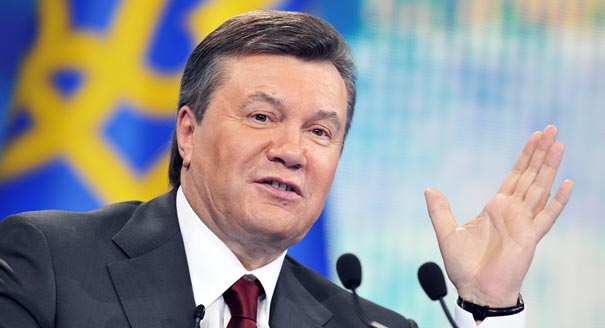
At the recent EU-Ukraine summit, Ukrainian President Viktor Yanukovych gained a tactical victory over the EU. By trying to convince him to change without holding him accountable to specific promises, the EU lost this round.
The Yanukovych administration is celebrating the end of the fifteenth EU-Ukraine summit. But I am sitting in my office somewhat confused about what just happened, and where we go from here.
The December 19 summit seemed illogical from the onset. Originally, it looked likely that the summit was going to be cancelled in response to imprisonment of former prime minister Yulia Tymoshenko. Otherwise it promised to be one of the most unremarkable summits in EU-Ukraine history. Expectations were very low on both sides, with the only deliverable expected to be a vague joint declaration. The Association Agreement, which aims at political association and economic integration between Ukraine and the EU, was not expected to be initialed or signed, despite five years of negotiations. The EU planned to deliver tough messages on Ukraine’s stalling democracy, including the lack of judicial independence and the selective prosecution of political opponents.
But President Viktor Yanukovych has expressed his satisfaction with the results of the summit to the press, and EU leaders are also calling it a relative success. What happened to change expectations so dramatically?
The official summit started with a two-hour tête-à-tête meeting between Yanukovych and EU President Herman van Rompuy and European Commission President Jose Manuel Barroso. No other officials or press were allowed to participate. Subsequently, no one knows what happened behind closed doors and what commitments both parties made. However, from the outside it appears the EU leaders walked into a trap. They were clearly not running the show. They were caught up in the rules of the post-Soviet space, where, as one high-level Ukrainian diplomat once privately explained, the parties come together at the highest level and make deals that their parliaments or people will never find out about and will never hold them accountable.
During the plenary session that followed, the presidents announced the conclusion of negotiations on the Agreement. This announcement was broadcast live on Ukraine's main television stations. This signified that Ukraine had agreed to give up its claims for an EU membership perspective in the Agreement. In return, the EU agreed to announce the talks’ completion despite serious concerns over Ukraine’s democracy and the values of its current leadership.
EU leaders, to their credit, did clearly voice their concerns over political freedom in Ukraine. But unfortunately it no longer mattered. The Ukrainian government had what it wanted. Looking at the coverage of the event in the Ukrainian media, the country’s leadership appears to have achieved a major step forward in EU-Ukraine relations. The focus was on the completion of the talks on the Agreement. The EU concerns were mentioned, but in a toned-down way.
Thus Kyiv scored a tactical victory and Yanukovych may feel that he has outwitted the Europeans. Tymoshenko and her former colleagues are still in jail, the rules of the game for the next parliamentary elections are fine-tuned for his party to win the majority of seats, the constitution is reversed to favor the current president, and the negotiations on the Agreement are concluded.
As for the EU, it was not clear why the EU leaders even agreed to have this summit in the first place. One may argue that the EU holds summits with countries that are even more problematic when it comes to democracy, such as Russia. But the timing of the summit and the pompous conclusion of the Agreement negotiations makes the EU look confused, especially against the backdrop of recent harsh statements from the same EU leadership, the European Parliament, and some EU member states.
The Association Agreement is now on the table. Initialing may still happen next year. However, the rest of the process, such as signing and ratification by the parliaments of the 27 EU member states and the European Parliament, remains a significant question. The EU still believes that President Yanukovych and his administration are more likely to change with the signing of the Agreement as an incentive.
But while the Ukrainian president gained a tactical victory with the EU, his attention span for the Union is over—at least for the time being. He is likely now to turn to Russia, where he hopes to score again. His oligarchs need cheaper gas and he is committed to delivering on his promises. Yanukovych believes that Moscow will feel threatened by the prospect of Ukraine signing the Agreement with the EU. The issue is a bit more complicated than that, however, as Russia will likely only agree to a new gas price if Ukraine joins the Customs Union or at least gives Russia control of its pipeline.
Yanukovych learned a very important lesson on December 19—he can play the EU and win. The EU should also learn its lesson—as the old saying goes, the road to hell is paved with good intentions. By coming to Kyiv in good faith to engage and try to convince Yanukovych to change without holding him accountable to specific promises, the EU is the one who lost this round.
The EU has not yet failed, however, as a strategic player vis-à-vis Ukraine. This will depend on EU’s ability to stick to its values. The Agreement with the EU will be positive for Ukraine, but it will only be effective if it is truly underpinned by the values on which it was negotiated. But when it is used for domestic electoral gains, geopolitical games, or to please a certain political ego, the process risks defeating its own purpose.

Former Nonresident Associate, Carnegie Europe
Shumylo-Tapiola is a nonresident associate at Carnegie Europe in Brussels, where her research focuses on Eastern Europe and Eurasia.
Recent Work
Olga Shumylo-Tapiola
Olga Shumylo-Tapiola
Carnegie does not take institutional positions on public policy issues; the views represented herein are those of the author(s) and do not necessarily reflect the views of Carnegie, its staff, or its trustees.
Ultimately, Zelensky sided neither with the reform camp nor with the military establishment as such, but with political control.

Balázs Jarábik
Andrey Melnichenko’s essay offers no answer to the fundamental question of how, under any kind of negotiated settlement, Europe can protect itself from the Russian ressentiment that is inevitable in all scenarios except for an outright victory for Putin.

Leonid Bershidsky

Despite unhappiness on the ground, Moscow is determined to use both carrot and stick to ensure there is record support for United Russia in occupied Ukraine.

Konstantin Skorkin

Whether PAS can refocus on the unfinished business of state-building may ultimately prove more consequential for Moldova’s European future than the pace of its accession negotiations.
Balázs Jarábik

The recent damage inflicted by Ukrainian drones and missiles on Russia has made Belarus aware of its own vulnerabilities—and surprisingly amenable to Kyiv’s demands.

Artyom Shraibman