

Commentary
Marc Pierini
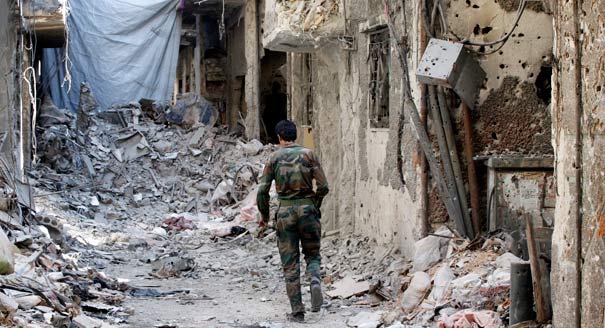
Source: Getty
The Syrian war is being played out in Moscow, Tehran, and Washington. To achieve further progress, the three capitals cannot avoid working together on a diplomatic solution.
More than ever before, the Syrian war is being played out in Moscow, Tehran, and Washington.
After a series of actions taken by Russia and the United States, the current situation is somewhat hopeful. The positions of the three major players have begun to evolve: Russia may have started looking at Syrian President Bashar al-Assad as an unpalatable ally. U.S. President Barack Obama, although criticized for inaction, is strongly influencing developments. And the return of Iran, which has long been a supporter of the Assad regime, to the regional stage might come along with mutual concessions on Syria.
If further progress is to be achieved, the three capitals cannot avoid working together on a diplomatic solution.Syria is not a classical state, which significantly complicates dealing with the regime. Since 1970, when Hafez al-Assad seized full power after a 1966 military coup, the country has been in the hands of the Assad-Makhlouf clan members: they reign over the intelligence services, the military, the effectively single party, and, more importantly, business. This makes them, by definition, allergic to political and economic reforms and willing to defend their system at all costs. They said in May 2011 that if they suffered, others would suffer too. The regime unleashed unthinkable violence against the Syrian people, including a chemical weapons attack around Damascus on August 21.
In the Assad-Makhlouf calculus, Damascus is not only Syria’s capital city. It is the city that did not fall to Israeli offensives during the 1967 Six-Day War. It is a city that Hafez al-Assad called the beating heart of the Arab world. It is the symbol of the Assads’ power and of the revenge of the Alawites, once the servants of the Sunni bourgeoisie. Maintaining control of the city matters for securing munitions and for keeping Hafez’s legacy alive. Damascus is the regime’s own redline.
It could have been the decisive progress the opposition had made toward the city center that prompted the chemical weapons attack. Or the strike could just have been a huge blunder made by the regime’s command structure. Either way, the episode made outside powers very uneasy, especially Russia.
On September 14, U.S. Secretary of State John Kerry and Russian Foreign Minister Sergei Lavrov brokered a deal in which Syria’s chemical weapons would be consolidated and destroyed. To some, the UN deal on chemical weapons is a considerable victory for Putin; to others, it is the direct result of U.S. military pressure; to many, it is hiding the fact that the conventional war rages on. But, despite fiery statements, the deal is no victory for Damascus: the Assad regime is up against a wall and has no choice but to follow Moscow’s lead.
Russia’s support to the Assad clan has been unrelenting and its deliveries of weapons seemingly unlimited. But Moscow supports Damascus not just for the Assads’ own sake. Rather, that support is a vehicle to pitch an assertive Putin as a key broker in the new world order. And Putin’s role as a world leader, as illustrated by his chairmanship of the G20, calls for a minimum of respectability. In this sense, Assad’s ruthlessness may soon become a liability for Russian President Vladimir Putin’s worldly ambitions.
Assad, while being an ally and protégé of Russia, embarrassed Moscow: in August, he crossed a Russian redline. The conventional carpet bombing that followed the August 21 attack left unmistakable traces of chemicals for the benefit of UN inspectors, including indications about the site of the missile launches. Almost immediately, Russia proposed a deal to eliminate Syria’s stocks of chemical weapons, and it was an offer the West could not refuse.
As a result of the chemical weapons discovery, and despite a verbal cover-up from Moscow, Syria had to backtrack fast. The Assad regime joined the Chemical Weapons Convention prohibiting the production, stockpiling, and use of chemical weapons. It provided a statement detailing its chemical weapons stocks, erasing once and for all the Russian-Syrian fiction that the regime did not possess them. Damascus had to accept the UN Security Council resolution that mandated the destruction of Syria’s chemical weapons arsenal by June 30, 2014; it pledged to respect the agreement and efficiently and swiftly handled the first stages of inspection and destruction.
The deal paid off in the short term—it averted a U.S. strike. But its medium-term benefits are more uncertain: if the agreement means leaving in place the unpredictable and violent Assad-Makhlouf clan, pressure from the rebellion will increase and will trigger more retaliatory violence by the regime. Sooner rather than later, this may reach a point where the Assad regime appears to be a major problem for Moscow.
The Russian leadership believes in the supremacy of the UN system, the only framework in which post–Cold War Russia can exert influence, hence its support of the chemical weapons deal and inspection process. It also believes in political stability—that is, preserving the Syrian state—and Putin fears the rise of Islamist brigades in Syria, which have developed as a result of regime violence.
Seen from this wider perspective, it may be argued that Putin’s ambitions in terms of world leadership can hardly be served by associating with thugs of a defunct era. If so, Bashar al-Assad is bound to constitute a major impediment to Russia’s policies.
While some may see the U.S. president as a reluctant warrior, the United States has so far successfully handled Syria’s Dr. Strangelove with utmost precaution.
In Washington, DC, in the aftermath of the August 21 attack, there was much discussion of America’s leadership and Obama’s reluctance to lead the fight in Syria with cruise missile strikes. The truth is that 62 percent of U.S. citizens are opposed to intervention in Syria, as compared with 72 percent of Europeans and Turks. In discussions held during my visits to Washington, London, and Paris, people seem to be of two minds—either intervene to stop the bloodshed and prevent the jihadists from coming to power, or stay out because the situation is too unpredictable. The latter is clearly the prevalent, yet uneasy, mood.
In addition, the United States, along with France and the United Kingdom, had no real choice but to entertain a plan to dismantle the arsenal of chemical weapons under the control of the rogue Syrian regime, as the weapons could well fall into jihadist hands as the regime crumbles or retreats to a smaller territory. To avoid risks of this nature, there was considerable value in a dismantlement program associated with a timetable, in a serious UN inspection process, and in thorough UN supervision in the future.
It also appears in retrospect that U.S. military preparations weighed very heavily on the calculus in Moscow and Damascus in the lead-up to the chemical weapons deal. How the agreement will work in practice is now the real question.
For Iran, a quid pro quo on Syria might help serve its own ambitions. Having successfully reinitiated a prudent relationship with Washington, Tehran has a significant interest in making progress on its nuclear program. Iran could be more conciliatory on Syria in exchange for being integrated into international discussions.
Iran’s primary objective is to regain its place in the international community and, according to recent statements, to exercise its full right to develop civilian nuclear reactors, not a nuclear weapons program. With this priority in mind and a dialogue just launched in Geneva with Western powers on Tehran’s nuclear program, a certain amount of Iranian moderation is needed on the Syrian issue.
And there is potential room for movement. Iran has said very clearly that the use of chemical weapons is off-limits. It has good reasons for that stance, having suffered seriously from Iraqi leader Saddam Hussein’s chemical arsenal. Much like Moscow, Tehran must have felt very uncomfortable with the August 21 attack and must be even more uneasy with the prospect of some of Assad’s chemical stocks falling into rebel hands.
Iran is therefore expected to exercise a moderating influence on the Syrian regime. It remains unclear whether Tehran will actually take such steps, and whether those steps would result in Iran being accepted at a future Geneva II conference aimed at finding a way to end the Syrian civil war.
A Syria-wide UN inspection program is now under way, and encouraging first results have been obtained. But the road ahead will be difficult. Inspectors will have to cover a large part of Syrian territory that is currently under regime control. In some areas at least, opposition forces will have to exercise some sort of self-restraint in order to avoid impairing the UN’s work.
The regime—which enjoys little international trust—will have to play by the rules, ensure unfettered and safe access to its chemical weapons stocks, and avoid complicating matters. Meanwhile, the Assad regime cannot be allowed to take the chemical weapons deal as a further license to kill with conventional weapons. Moscow will have to closely monitor the goings-on in its turbulent ally.
That is because Russia, along with the United States and Iran, has a crucial interest in making the chemical weapons deal work swiftly and neatly. If it does not, these actors will face a terrible accusation: that they used the movement on chemical weapons as a way to gloss over the continuation of the conventional war.
Beyond chemical weapons, ending the Syrian nightmare clearly requires a few indispensable ingredients: maintaining strong Russian pressure on Assad; including Iran in the discussions about Syria’s future, under certain conditions; safeguarding the Syrian state, though without Assad in the final stage; marginalizing jihadist forces; and holding the Geneva II conference with all concerned stakeholders.
Of course, making predictions on future progress at this stage would be foolish. Syria remains an explosive mix of issues, and its future depends on a highly hazardous series of bets. Yet, the diplomatic avenue remains the best option.

Senior Fellow, Carnegie Europe
Marc Pierini is a senior fellow at Carnegie Europe, where his research focuses on developments in the Middle East and Turkey from a European perspective.
Recent Work
Marc Pierini
Marc Pierini
Carnegie does not take institutional positions on public policy issues; the views represented herein are those of the author(s) and do not necessarily reflect the views of Carnegie, its staff, or its trustees.
Governments in Estonia, Latvia, and Lithuania want to ensure that a U.S. military withdrawal would not leave them dangerously exposed to a Russian attack.

Sergejs Potapkins
Baku’s backing for Ukraine is less about confronting Russia than about quietly broadening the mix of partners it relies on.

Zaur Shiriyev
Tokyo would have to surmount a lot of obstacles—not least Western sanctions—if it wanted to return Russian oil imports to even modest pre-2022 volumes.
Vladislav Pashchenko
Troubled by the growing salience of nuclear debates in East Asia, Moscow has responded in its usual way: with condemnation and threats. But by exacerbating insecurity, Russia is forcing South Korea and Japan to consider radical security options.

James D.J. Brown
After four years of war, there is no one who can stand up to the security establishment, and President Vladimir Putin is increasingly passive.

Tatiana Stanovaya