

Q&A
- +1
Amr Hamzawy, Andrew Leber, Eric Lob, …
Source: Getty
Amman is increasingly pursuing a policy of supporting neither the regime nor the opposition in Syria while quietly working to help resolve the conflict. It has few other options.
This piece is part of the Global Dynamics of the Syrian Conflict series, in which Carnegie experts from all over the world analyze the strategic and geopolitical interests at play in the ongoing civil war. View the full series here.
Jordan is struggling to perform a delicate balancing act as a result of the Syrian quagmire. On the one hand, the continuation of the conflict will exacerbate Jordan’s serious political, security, economic, and demographic problems. On the other, the conflict’s end could preserve or bring to power antagonistic forces in Damascus, particularly if the Assad regime survives or is replaced by radical members of the opposition hostile to Jordan. Attempting to strike the appropriate balance, Amman is increasingly pursuing a policy of supporting neither the regime nor the opposition, while quietly working to help resolve the conflict through all possible means—both political and military—that do not endanger its interests.
The government in Jordan has rarely seen eye-to-eye with Syria’s Baathist regime. During the tenure of both Hafez al-Assad (who ruled Syria from 1971 to 2000) and his son Bashar, Damascus and Amman have generally supported policies that were in direct opposition to one another. While Syria has offered long-standing support to radical forces opposed to peace with Israel, such as Hezbollah and Hamas, Jordan has worked proactively with the United States and others in an effort to peacefully resolve the Arab-Israeli conflict. During the Iran-Iraq war in the 1980s, Syria supported Iran while Jordan supported Iraq.
Jordan has long been a more influential actor in the Arab world and the international community than its size and resources warrant due to its moderate outlook and proactive, diplomacy-oriented policies—a role that Syria could never accept. Damascus viewed Amman as too independent from Syria’s self-appointed position of leader of the nationalist, anti-Western discourse in the Arab world.Yet, the fact that Syria and Jordan are neighbors with significant commercial ties means that the two countries have been careful not to upset their relationship beyond a point of no return.
During the first few months of the Syrian uprising, when it appeared that the Assad regime was in real danger of being toppled, Jordan took a daring public stand against the Syrian leader. This move was bolstered by the anti-Assad position of Saudi Arabia, a staunch political ally and financial supporter of the Jordanian government. It appeared then that the Baath regime would soon be replaced by more moderate forces that would be less friendly with Iran, Hezbollah, and Hamas and whose policies would hew closer to those of the Jordanian-Saudi axis. Syria’s reign as the spoiler of moderate policies employed by many other Arab governments appeared to finally be over.
But Amman’s lofty hopes for democratic change in Damascus vanished long ago. The resilience of the Syrian regime (which has been bolstered by heavy support from Russia, Iran, and Hezbollah) and the militarization and radicalization of the opposition have produced a brutal stalemate. The destruction of lives and property has been massive.
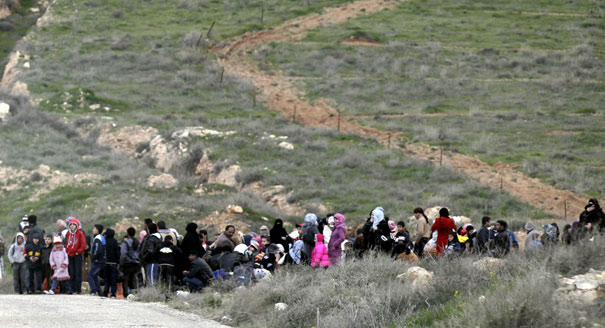
The conflict has also created a refugee problem that is of enormous concern to Syria’s neighbors, particularly Jordan and Lebanon. According to official estimates, there are as of May 2014 over 1.3 million Syrian refugees and residents in Jordan, comprising around 15 percent of the country’s total population. Only 150,000 of those refugees are in designated camps in the north of the country, while the rest are dispersed throughout Jordan with little governmental oversight. Some Jordanian cities that border Syria, such as Mafraq and Ramtha, currently have more Syrians than Jordanians.
The shift in the balance between Jordanians and refugees is exacerbating tensions between the two communities, particularly as they compete for jobs and scarce resources like water. Jordan faces dire economic conditions, including official unemployment figures hovering around 12 percent. The budget deficit, taking into account deficits due to energy subsidies, has reached 15 percent of GDP. These economic challenges are only exacerbated as the number of refugees rises.
Of course, Jordan is no stranger to refugees. And in the long run the refugee issue will pose serious demographic and political problems for the country.
Following the war in Iraq that began in 2003, a majority of the more than 200,000 Iraqis who fled to Jordan never went back to their home country, even after the conflict abated. Similarly, it appears likely that Syrian refugees will remain in Jordan for the foreseeable future, taxing the country’s resources.
What is more, the state has been struggling for decades with determining who is a Jordanian due to the influx of Palestinian refugees who were given Jordanian citizenship following the 1948 war with Israel. With the significant number of Syrians and Iraqis in Jordan—around 20 percent of the country’s total population—the issue is even more complicated.
The rise of radical Salafi forces in Syria is also of concern because a new radical Syrian regime on Jordan’s borders would pose severe threats to Jordanian security. Amman is already trying to deal with a rising Salafi movement inside its territory, and many of the country’s most radical elements are going to fight in Syria. The return of any of these fighters will pose additional challenges to the country and help further radicalize the Jordanian Salafi movement.
The growing presence in Syria of radical opposition forces aligned with al-Qaeda has also eroded what was once a solid majority of Jordanians in support of the Syrian opposition. While a strong majority of Jordanians continue to have very unfavorable views toward Assad, it’s also safe to say that a growing number of Jordanians no longer support overthrowing him, fearful of what comes next.
Though a rapid end to the conflict would help remedy these problems, Jordan can ill-afford a scenario in which Assad wins and subsequently assumes an even more antagonistic political and economic stance toward Amman. Jordan’s strategic relationship with Saudi Arabia and the West, as well as its own differences with the Syrian regime, makes reconciliation with Assad virtually impossible. Indeed, the Assad regime has publicly and repeatedly accused Jordan of training anti–Syrian regime fighters on its territory.
Jordan’s best bet appears to involve publicly stating its neutrality while quietly supporting and attempting to expedite a process that would replace the current Assad regime with moderate elements from both within the Syrian government and the opposition. That goal has so far proved elusive to countries far more powerful and influential than Jordan, but Amman has few options other than its current ambiguous policy.

Vice President for Studies
Marwan Muasher is vice president for studies at Carnegie, where he oversees research in Washington and Beirut on the Middle East. Muasher served as foreign minister (2002–2004) and deputy prime minister (2004–2005) of Jordan, and his career has spanned the areas of diplomacy, development, civil society, and communications.
Recent Work



Amr Hamzawy, Andrew Leber, Eric Lob, …
Marwan Muasher
Carnegie does not take institutional positions on public policy issues; the views represented herein are those of the author(s) and do not necessarily reflect the views of Carnegie, its staff, or its trustees.

Sergei Kiriyenko used Russia’s parliamentary vote to further hone his strategy of corporate mobilization that is designed to maximize votes for United Russia.

Andrey Pertsev

The European far right might fail to steer EU policy in the direction Russia wants, but they will create enough chaos inside Europe to benefit the Kremlin.

Dimitar Bechev

Minsk clearly expected the dialogue with Washington to yield more results, in particular the lifting of EU sanctions and permission to export potash.

Artyom Shraibman

If the Russian-speaking community in Latvia cannot articulate their interests without being seen as disloyal, they could end up embracing a pro-Kremlin agenda.

Sergejs Potapkins

Russia’s ruling party would have benefited from Putin appearing as its distant patron, but as an active frontman imposing his views on the public, he has done nothing but harm both the party’s election campaign and the ruling system overall.
Andrey Pertsev