

Commentary
Dmitri Trenin
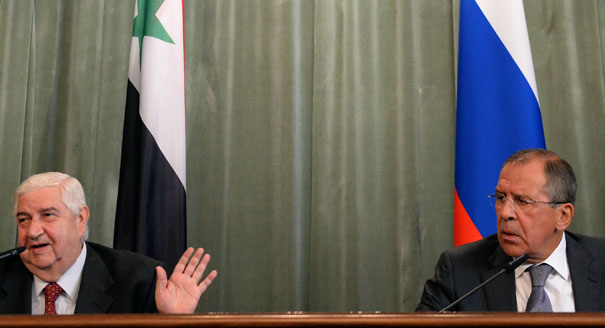
Source: Getty
Russia has two broad strategic objectives in the Syrian conflict: challenging U.S. dominance in world affairs and aiding Assad in the fight against Islamist radicals.
This piece is part of the Global Dynamics of the Syrian Conflict series, in which Carnegie experts from all over the world analyze the strategic and geopolitical interests at play in the ongoing civil war. View the full series here.
Russia’s involvement in the Syrian conflict is motivated by two broad strategic objectives: challenging U.S. dominance in world affairs and aiding the regime of Syrian President Bashar al-Assad in its fight against Islamist radicals, deemed Russia’s deadliest enemies.
The Soviet-Syrian alliance was forged during the Cold War. Since the end of that period, Syria, a client of the Russian arms industry, has remained one of Moscow’s few Soviet-era geopolitical positions in the Middle East.
From the beginning of the Syrian uprising in 2011, Russia has favored intra-Syrian dialogue and eventually power sharing, but it has been decidedly opposed to Assad’s departure as a first stage in political transition. Over time, Russia’s support for Assad has only hardened.
Keeping Assad in power serves a number of Russian interests. Syria has proved a critical case study in Russia’s efforts to prevent the use of military force by the United States. A U.S. intervention would have reversed the trend toward retrenchment initiated by the administration of U.S. President Barack Obama—a trend that Moscow considers positive. Russia has also sought to avert foreign-aided or -inspired regime change in Syria, which could have dangerous implications for countries on Russia’s post-Soviet periphery and for the Muslim parts of the Russian Federation itself. In addition, Syria has for decades been a client of the Russian defense industry. The Syrian Armed Forces use Soviet and Russian weapons, and some Syrian officers are Russian-trained—and, in many cases, married to Russian women.Syria is also central to Russia’s geopolitical aspirations. The Russian Navy keeps a small resupply and light repair facility at the Syrian port of Tartus. This strategic position, while currently modest, is important in view of Russia’s ambitions to play a bigger geopolitical role in the eastern Mediterranean and the Middle East. And because Russian foreign policy is currently acquiring an ideological dimension, with the Russian Orthodox Church becoming a key political ally and partner of the Kremlin, the protection of the dwindling Christian community in Syria, and more broadly in the Middle East, is ostensibly beginning to feature as a new geopolitical interest, at least rhetorically.
From the beginning of the domestic Syrian conflict in 2011, Russia has been seriously concerned about the stability of the Assad regime. Russian diplomats at the time advised Damascus to engage the opposition to prevent an uprising. Moscow, however, did not back its friendly advice with pressure or disincentives. And while Russia did not perceive Assad to be an indispensable ally—Russian President Vladimir Putin did not even talk to Assad by phone until 2013—Moscow continued to send weapons to and sign new contracts with Syria.
As the rebellion gradually morphed into a civil war, Russia’s main concern was a possible Western or Arab intervention in Syria that aimed to replace the Assad regime with a pro-Western government. Moscow was reeling from the 2011 Libyan rebellion, in which Russia’s decision not to veto a UN Security Council resolution approving a no-fly zone in Libya made it possible for NATO forces to intervene and eventually bring about regime change. The Libyan example served as a precedent that Russia was resolved not to see repeated in Syria, so Moscow rejected any Security Council proposal that would have condemned the Assad regime.
Given Russia’s familiarity with Syria, the Russian leadership concluded early on that absent foreign military intervention, the Assad government was in a position to survive. This assessment was in stark contrast to the calculus made by many in Washington and various European capitals who believed Assad’s collapse to be imminent. Moscow did not refuse to talk to the Syrian opposition, but it found the rebels to be weak, disunited, and unrealistic in their demands—again in contrast to the views prevailing in the West and much of the Arab world. Alongside Tehran, Moscow was generally seen as an ally of the Assad regime, its source of military hardware and supplies and its diplomatic advocate and protector.
The West and Russia, nevertheless, tried to cooperate in resolving the Syrian conflict. In mid-2012, Moscow teamed up with Washington to convene a peace conference in Geneva (now known as Geneva I), but Russia and the United States differed widely on the terms of agreement. A follow-up attempt to convene a similar conference a year later was equally unsuccessful. In September 2013, Putin offered Obama a plan to rid Syria of chemical weapons and persuaded Assad to accept the proposal. As of this writing, the process of Syrian chemical weapons disarmament, despite the ongoing conflict, is nearing completion. However, the most recent U.S.-Russian attempt to relaunch the Syrian peace process with the so-called Geneva II conference has thus far been fruitless.
From Moscow’s perspective, the continuation of the Syrian conflict poses the danger of multiplying the number of battle-ready and indoctrinated jihadis—estimated now to be in the high hundreds—who can return and have returned to their native countries, including Russia and neighboring Central Asian states. The dominance of jihadi elements among the anti-Assad forces on the ground in Syria also makes it difficult to arrange a peace settlement.
The Syrian conflict offers few opportunities to Russia, but it challenges Moscow to play a more active diplomatic role, helping organize the peace process by convening Geneva I and II and solving problems like chemical weapons disarmament. To the extent that Moscow is up to the task, its prestige in the region will grow beyond its stubborn and unwavering support for its client-turned-ally.
Contrary to the perceptions of some in Washington, Obama’s seeming failure to stick to the redlines he set in Syria—for example, his statement that any use of chemical weapons by the Syrian regime would trigger the use of U.S. military force—did not embolden Putin to annex Crimea. Putin’s intervention in Ukraine was instead a reaction to the revolutionary nationalist coup in Kiev that he suspected was engineered by Washington and would open the way to Ukraine’s membership in NATO.
That said, Moscow assesses U.S. policy toward Syria as lacking strategic goals, clear objectives, and realistic assessments. To the Russians, Washington’s Syria policy reveals both America’s global overstretch and its growing weariness.
Former Director, Carnegie Moscow Center
Trenin was director of the Carnegie Moscow Center from 2008 to early 2022.
Recent Work
Dmitri Trenin
Dmitri Trenin
Carnegie does not take institutional positions on public policy issues; the views represented herein are those of the author(s) and do not necessarily reflect the views of Carnegie, its staff, or its trustees.

Russia spent years building a “sovereign internet,” concentrating web infrastructure exclusively within Russian territory. Ukrainian drone attacks have shown how vulnerable that approach has left the Russian internet.

Maria Kolomychenko

Putin’s conservative staffing policies and search for ever greater control have cemented parliament’s transformation into a bureaucratic appendage of the executive branch.

Andrey Pertsev

Russia’s AI-driven propaganda campaigns operate in a fragmented, chaotic, and often illogical manner. That’s not necessarily a problem for the Kremlin, though: It’s much easier to mimic genuine public debate that way.

Ilya Klishin

Without a ceasefire with Ukraine on attacking each other’s energy infrastructure—to which the Kremlin is unlikely to agree—the diesel agreement between Putin and Trump is largely for show, rather than representing a genuine increase in the volumes of Russian diesel on the global market.

Sergey Vakulenko

Russian strikes are weakening the economy sustaining Ukraine’s war effort. Closing the growing funding gap will require more European support and politically contentious reforms in Kyiv.

Balázs Jarábik