

Commentary
Pashinyan’s pro-European party has been re-elected with a decisive victory. But the pro-Russian opposition could still slow Armenia’s progress toward peace with Azerbaijan and rapprochement with Europe.
Mikayel Zolyan
Source: Getty
The future looks bleak for independent media worldwide, but there is a robust infrastructure of knowledge, organizations, and people to build upon.
A free press is indispensable to democracy and accountability. Independent media delivers fact-based information to policymakers and voters alike, provides a forum to debate public policy, offers a tool to identify corruption and abuses, furnishes a means to hold political leaders to account, and creates an avenue for those out of power to peacefully express themselves. In recognition of its importance, the United States firmly supported independent journalism around the globe from the aftermath of World War II until 2025.
This assistance came to an abrupt halt in early 2025 immediately following the inauguration of Donald Trump as U.S. president. The termination of U.S. assistance to hundreds of media organizations, independent outlets, journalists, and civil society organizations came at a particularly hard time for independent media. The sector already faced an existential crisis in many parts of the world in the face of rapid technological change, declining revenues, and shrinking political space. This paper draws on 68 interviews and a global survey of 177 media outlets and media support organizations to chart the financial, sectoral, and political impacts of terminating most U.S. support for independent media. We find the following:
The sudden, ill-planned termination of U.S. governmental support caused harm and waste. Depending on the estimate and measurement, prior to the Trump administration, the United States was providing between $135 million and $248 million per year in foreign assistance support for independent media. The termination of almost all awards and payments, including payments for work already completed, was done shockingly fast. It precluded a thoughtful closedown, deprived implementing partners of payments due to them, left many without jobs, and invited costly and lengthy litigation. Unable to pay their bills, the U.S. government’s main media implementing partners fired hundreds of workers and closed offices as their staff were doxed and harassed based on false allegations.
The cuts have had wide negative effects. U.S. support not only sustained media organizations but also sought to improve the political and enabling environment for media, strengthen information integrity and resilience, protect the safety and security of journalists, improve the quality of journalism, increase the market viability of media operations, and ensure the reach of independent journalism to underserved areas and populations. The aid cuts have undermined all of these goals. For example, U.S. funds had been used to support a freedom of information act in Zambia, promote information integrity in the Philippines, provide legal support to journalists in the Republic of Georgia threatened by frivolous lawsuits, train and support journalists to conduct investigative journalism in Eastern Europe, improve media business models in Serbia, and strengthen community radio stations in Mozambique. The termination of aid stopped all of these endeavors.
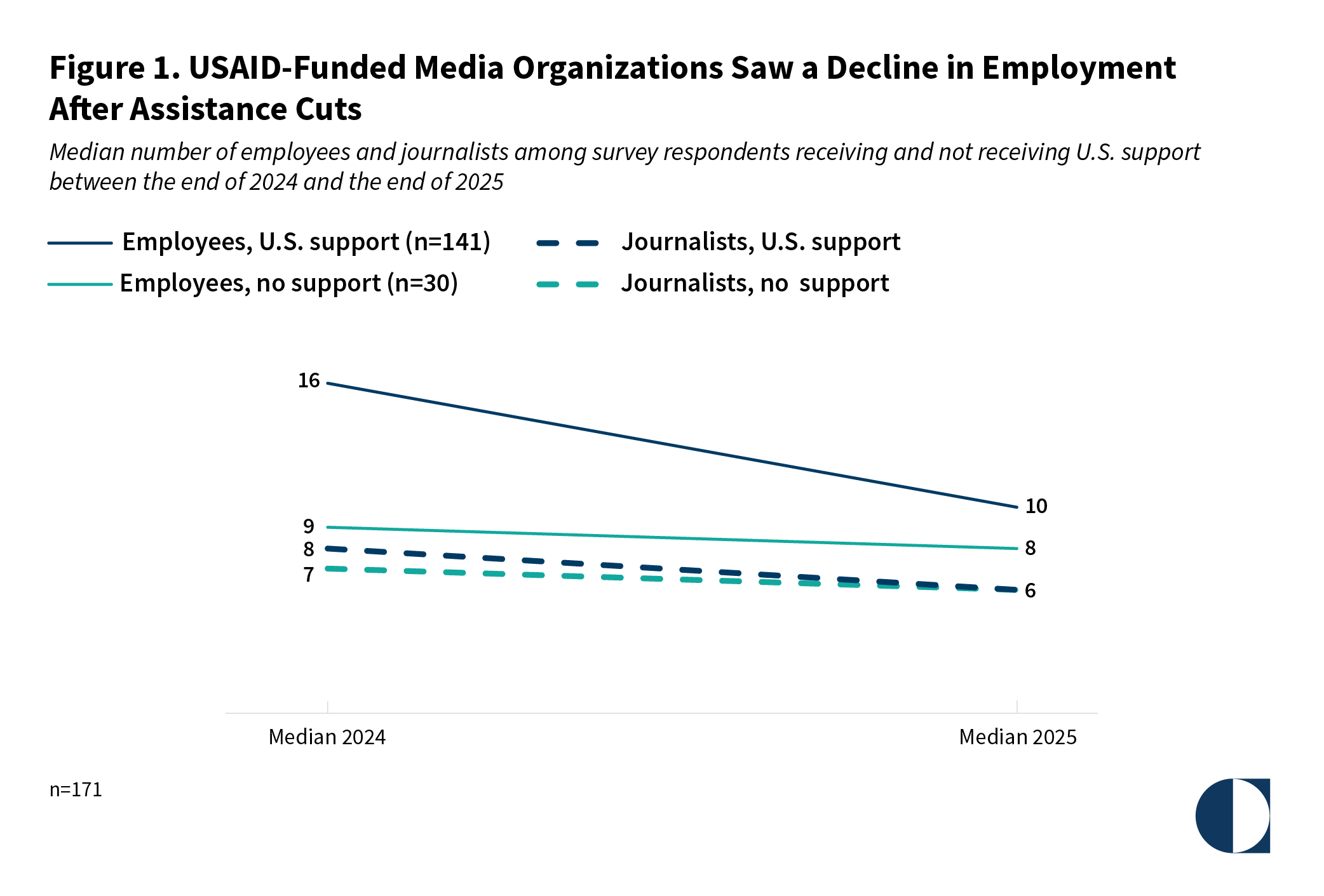
The U.S. withdrawal has had a significant financial impact on a sector that was already in trouble. Amid shrinking political space, the growth of technology platforms, and declining ad revenue, the sector depended on foreign assistance dollars. The median U.S. grantee participating in our survey lost an estimated 40 percent of their annual revenue. This large percentage had an obvious impact on staffing, content, and quality. The median grantee’s number of employees declined from sixteen to ten and journalists fell from eight to six.
In many countries, the reversal of U.S. political support for media was even more detrimental than the loss of funds. While past U.S. diplomatic pressure had protected independent media in many countries, following the arrival of the Trump administration, many governments further restricted the space for independent journalism. In El Salvador, for example, the government quickly moved to pass a foreign agents law, arrest a human rights and anti-corruption lawyer, and issue arrest warrants for several journalists. In a similar reversal, the American political right came to view efforts to promote information integrity as censorship, and these initiatives were also withdrawn. Survey respondents considered an increase in domestic- and foreign-promoted disinformation in their countries to be the biggest impact of the U.S. decision to end media assistance.
The end of support to independent media hurt the U.S. global position by removing a tool to build soft power, achieve strategic interests, and stay ahead in the great power competition. While support for independent media was primarily driven by U.S. democratic values, investments in the sector supported other U.S. interests, such as challenging Russian disinformation in Libya and Eastern Europe, undermining Al-Shabaab in Mozambique, and countering the Islamic State in the Middle East. Noting how Russian and Chinese media have taken advantage of the U.S. withdrawal from supporting independent media, one interviewee asked, “Do the people in Washington know what they have done? They have left a vacuum. You leave a vacuum and people are going to fill it.”
U.S. assistance to strengthen independent media could have entailed more direct support to local partners, but the benefits of assistance outweighed the limitations. We find that U.S. investments were generally effective, particularly from the perspective of grantees. Some investments in investigative reporting generated a financial return in the form of asset recoveries, including for the United States. However, there were legitimate critiques of how U.S. procurement rules and oversight regulations favored large U.S.-based implementing partners and limited the amount of funds that reached local media organizations.
Other donors who value a free press have not stepped up to fill the gap, either financially or politically. Even prior to the change in administration, sector advocates were raising alarm bells about the need to better fund independent media, and the sector was already damaged from the substantial decrease in funding from the Open Society Foundations, whose support had been significant. While some remaining donors increased grant flexibility and provided new stopgap funding, 48 percent of survey respondents reported that support from other international donors decreased in 2025, compared to 22 percent that reported an increase.
The future looks bleak for independent media, but there is a robust infrastructure of knowledge, organizations, and people on which to build. Although the full amount of U.S. media development funding cannot be replaced, the much smaller amount of grant money that went directly to media organizations can be. There remains a clear need for donor governments, philanthropic donors, and technology firms to support the many media organizations that are struggling to survive. There is likely no place for meaningful U.S. government media support under a transactional, America First approach, but the current institutional vacuum presents an opportunity for future administrations to strike a bargain of less bureaucracy and fewer overhead expenses from U.S. intermediaries with more aid going directly to local partners. Several bright spots remain to build on, including journalist organizations like the Organized Crime and Corruption Reporting Project, funding mechanisms like the International Fund for Public Interest Media and newer regional or country-level journalism funds, and alternative loan-based models such as the Media Development Investment Fund.
Unfortunately, independent media in many, if not most, parts of the world will likely continue to decline as technological advances eat away at their commercial opportunities and democratic backsliding reduces the space in which they can operate. This is the reality the sector confronts, and democracy and good governance will suffer because of it. To be sure, these forces exist independently from the U.S. position, but the reversal of the United States to be an exacerbating rather than constraining player in this domain has taken an extra toll. Moreover, the American public has not gained anything from this dramatic reversal in long-standing policy and expression of American values. With U.S. government expenditures rising in 2025 despite the Department of Government Efficiency cuts, the U.S. government has only ceded space to its global competitors and further eroded American standing in the world.
The sudden dismantling of U.S. foreign assistance to independent media by the second administration of Donald Trump in early 2025 marked a profound rupture in how the U.S. government sees itself in the world. Since the aftermath of World War II, the United States has treated a free press as a public good, foundational to democracy. Early U.S. interventions in postwar Germany and Japan helped lay the groundwork for durable public service broadcasting systems as a pillar of democratic reconstruction. During the 1990s, after the end of the Cold War and amid optimism about the rise of democratic governance globally, the United States dramatically expanded its assistance for independent media in scale, scope, and symbolic significance. Alongside European donors and private philanthropies, U.S. support helped seed independent news outlets, support journalist training, support media law reforms, establish regulatory institutions, and nurture media and civil society across the globe.
The logic behind this support remains true today. A free press, editorially independent from government control, political parties, or dominant private interests, continues to be indispensable to democracy. Such a press delivers fact-based information to policymakers and voters alike, provides a forum to debate public policy, offers a tool to identify corruption and abuses, furnishes a means to hold political leaders to account, and creates an avenue for those out of power to peacefully express themselves. As New York Times publisher A. G. Sulzberger succinctly said, “A free people need a free press.”1 The value of journalism appears in diverse arenas and contexts:
The existence of this valuable reporting is often taken for granted, but it is not guaranteed to continue. The post–Cold War optimism has long since faded, and globally, independent journalism faces an increasing number of existential threats.
In this politically and economically challenging environment, grants from international donors that value a free press offer a lifeline to independent media to continue to provide a needed public good. All the outlets mentioned above received U.S. financial or technical support, which prior to the cuts of early 2025 was the largest international donor supporting independent media. As the period of global democratic backsliding continues, bolstered by the efforts of illiberal governments to promote autocracy,9 the United States has dramatically swung from advocating for democracy to emboldening antidemocratic leaders and inspiring antidemocratic copycat actions.10 Following several early accounts of the U.S. government’s policy reversal,11 this analysis examines the impact on independent media more than one year later, including the financial impacts on former media grantees, the broader impacts on the media sector, the political impacts, and the effects on the United States itself.
The findings presented here are based on 68 interviews with media outlet representatives, media support organization members, and the U.S. Agency for International Development (USAID) and implementing partner staff across sixteen countries. They also draw on a survey of 177 media outlets in seven languages across forty-one countries, and a review of preexisting analysis and literature. The research includes a deeper dive into a sample of countries, including El Salvador, Libya, Moldova, the Philippines, Serbia, Ukraine, and Zambia. Many of the examples below come from these countries. More information about these samples can be found in the appendix.
The U.S. government was the largest donor supporting independent media financially, technically, and politically. Arriving at a precise figure of the total amount of financial assistance is difficult given overlap in program categories, spending spread over multiple fiscal and calendar years, and differences between budgets, obligations, and expenditures. According to data reported by the Organisation for Economic Co-operation and Development, the United States disbursed $135 million and $133 million in support to independent media in 2023 and 2024 respectively, representing approximately 35 percent of all official development assistance for media across government donors.12 The U.S. State Department’s Congressional Budget Justification, however, lists a much larger $248 million given to strengthen independent media for 2023.13 Regardless of the exact figure, the amount was substantial and far more than other donors.
The largest amount of bilateral aid to independent media went through USAID. This was followed by the U.S. Department of State’s Bureau for Democracy, Human Rights, and Labor and by direct funding from individual U.S. embassies and other State Department bureaus. U.S. support was primarily provided indirectly through implementing partners, or international nongovernmental organizations with expertise in strengthening independent media, using mechanisms set up to prevent influencing content or editorial decisions.
Two other U.S. entities have also been extremely important to the sector, but they are not the central focus of this paper. The U.S. Agency for Global Media (USAGM) provided media content directly to international markets through the Voice of America news organization and indirectly through support for Radio Free Europe/Radio Liberty, Radio Free Asia, and the Middle East Broadcasting Networks. After being targeted by the Trump administration and cut off from funding, Radio Free Asia ceased producing content, and the others reduced their content dramatically.14 This work could potentially be reinvigorated, however, as the U.S. Congress recently gave USAGM a robust budget of around $653 million in its FY 2026 appropriation.15
Second, the National Endowment for Democracy (NED) remains an important donor to independent media. The Trump administration tried to terminate NED funding; however, the NED is a private, nonprofit foundation directly funded by the Congress, and the administration’s efforts were reversed in the courts.16 As will be discussed later, it remains a lifeline to several media outlets in a constrictive funding space.
Focusing on USAID, we identified fifty-four country-level and regional projects that had the primary objective of strengthening independent media. The median project was estimated to cost $12 million over a five-year period and was typically overseen by local USAID staff. This does not include many more programs that might have provided grants to media organizations under other projects, including health, elections, climate change, and anti-corruption programming. Of these fifty-four USAID media development programs, all but a small program in Cuba were canceled. Outside of a handful of small exceptions, including the occasional small grant directly from an embassy, the U.S. government has as of this writing largely ceased to support independent media.
The case of El Kul in Libya is illustrative of the termination process. After the Arab Spring uprisings, BBC Media Action received funds from the UK development agency to hold weeks or months of intensive training and mentorship in Tunis for Libyan journalists. Over the years, the organization trained some 200 journalists from around the country. In a media landscape dominated by political and foreign interests, El Kul offered a valuable independent voice through a Facebook page that attracted over 1.3 million followers.17 For example, while other outlets covered the end of a civil conflict in Murzuk by giving credit to one or another allied military or political leader, El Kul covered the story from the perspective of ordinary grandmothers who had left and then returned. The United States took over funding for the initiative in 2024. As an independent media voice, El Kul’s reporting helped counter the enormous amount of disinformation spreading through a country with a strong presence from the Russian-backed private military company the Wagner Group (now the state-run Africa Corps).
One of the things that made El Kul unique was its inclusion of a diverse set of journalists from around the country. That word “diversity” was used in a program description written by a third party that Department of Government Efficiency (DOGE) staffers could see in their superficial review of USAID programming. As DOGE and the Trump administration tried to make the case against USAID, El Kul was cast as a purportedly wasteful diversity, equity, and inclusion program. It appeared in tweets from Senate Republicans and was a focus on conservative commentator Glenn Beck’s podcast.18 The fact that it was supported by the Department of Defense and seen as important to U.S. national security interests as a counter to Russian and Wagner Group (now Africa Corps) disinformation was irrelevant. As of this writing, El Kul is defunct, with no posts in the prior two months.
As with other areas of terminated U.S. development funding, the process seemed intended to cause harm. Following Trump’s January 20 Inauguration Day executive order requiring a ninety-day foreign assistance review, on January 24 a stop-work memo went out calling for an immediate stop to all programs and payments. It was not immediately clear just what this meant, but by February 1 USAID’s website was offline, and by February 6 almost all USAID staff had been put on leave.19 Detailed investigations of these events found that terminating projects and dismantling USAID had little to do with alleged waste, fraud, and abuse.20 Canceling the majority of existing programs was already a major shock, but the administration also decided to end all payments, even for work already completed. The effect was catastrophic to implementing partners, as some interviewed organizations had outstanding invoices unreimbursed by the government for multiple months of completed work.
In interviews, many study participants became visibly emotional when describing the weeks and months following the stop work orders, payment freezes, and program cancelations. USAID staff who had managed projects and slowly cultivated relationships over time were barred from communicating with their partners, leaving them feeling powerless and as though they had betrayed hard-earned trust. One stated in an interview, “We as USAID staff [were] instructed to stop all kind of communication with everyone—with our implementing partners, with our local partners, with everyone. . . . We could not engage with anyone. At a certain point, we were advised that if we receive a message, don’t even reply.” The interviewee could not believe these directives, adding, “These people have been our partners for years.”
With future revenue on the chopping block and reimbursements for past work not coming in, many implementing partners had no means with which to pay either their own salaries and rent or the many local media organizations they were working with. One interviewee reported that they owed their partners $5 million, but they only had $3 million in the bank. Project heads, typically known as chiefs of party, found themselves in between panicked U.S.-based offices and bewildered local organizations. One project head noted, “They left us breaking the [local] law. . . . We did not obey laws that we were required to follow in terms of contract law and payments to partners. And it was completely unnecessary. You could have terminated that project without any of that hassle. It was done to make a point.”
In the media development sector, such disruptions were particularly challenging because some people in the Make America Great Again (MAGA) movement and DOGE viewed media work as biased against conservative governments. Staff from Internews Network, one of the main media development implementing partners, were doxed and harassed, and Internews’s president became a much-maligned target on the MAGA right.21 The Organized Crime and Corruption Reporting Project (OCCRP), another target of MAGA influencers, was made to understand that it would not be reimbursed because its work was considered illegal.22 OCCRP responded by suing the U.S. government on February 10. The litigation was combined with other suits, and a federal judge issued a temporary restraining order to the government to pay its debts.23 The administration appealed and in September 2025, the Supreme Court used the emergency docket to allow the administration to reinstate the freeze.24 OCCRP reported that in the interim it received all its funds, but other media implementing partners reported that they were still owed money a year later.25
The largest burden fell on the leaders of local media, who watched organizations that they had slowly built over years become at risk of sudden collapse. They needed to make quick decisions about letting go of staff, offices, and equipment in an environment of extreme uncertainty. Because Trump’s executive order had called for a ninety-day review period, the predominant sentiment in January and early February 2025 was that it made the most sense to “wait it out”; however, the decision to eliminate programs had already been made. Many organizations thought they had diversified their funding sources, only to discover that different grants from USAID, various State Department offices, and different implementing partners, such as IREX and Internews, all had the same ultimate source, and all were canceled.
The head of a media support organization in Zambia who lost over $400,000 for the year reported that he could not comply with the labor laws in Zambia and did not have money to pay people or give severances. Furloughing was also not a legal option in Zambia. He dropped from ten staff down to four anyway while trying to keep the work going, including efforts to prevent a problematic cybersecurity bill from being approved. “It was difficult . . . apart from the stress, I would work until ten or eleven. It disconnected me from my family. I was so burned out. We had to keep the organization running, keep the other staff members alive, support them, and assure them that we are not closing shop.” We heard similar stories again and again in our interviews.
Even prior to the U.S. departure from the scene, there was a general recognition of the insufficiency of donor funds for independent media. As one prominent study noted in 2024 prior to the second Trump administration, “To secure the future of independent journalism, international aid is critical. And yet, the international assistance community is not meeting the needs of a sector in danger of extinction.”26
The financial impact of the U.S. withdrawal was therefore profound, although it varied from context to context and from media outlet to media outlet. The median grantee participating in our survey lost an estimated $50,000 in grant funding for the year 2025, representing 35 to 40 percent of annual revenue. As these figures suggest, many of the survey respondents were small operations, including news outlets in Ukraine’s regions, community radio stations in Mozambique and Liberia, and exiled media outlets from Nicaragua, El Salvador, Belarus, and Myanmar. These smaller independent media sources operating in challenging contexts were often the hardest hit. For example, one Salvadoran media organization reported reducing its staffing from seventeen to four people and cutting its content by an estimated 70 percent.
Across the survey sample, we saw a clear decline in employment because of this lost revenue. As shown in figure 1, the median grantee organization’s employees declined from sixteen to ten and the median number of journalists fell from eight to six, a decrease of 38 percent and 25 percent respectively. While we only had data for a relatively small number of organizations that did not receive U.S. support (around thirty), we observed a smaller and statistically insignificant change among this group.
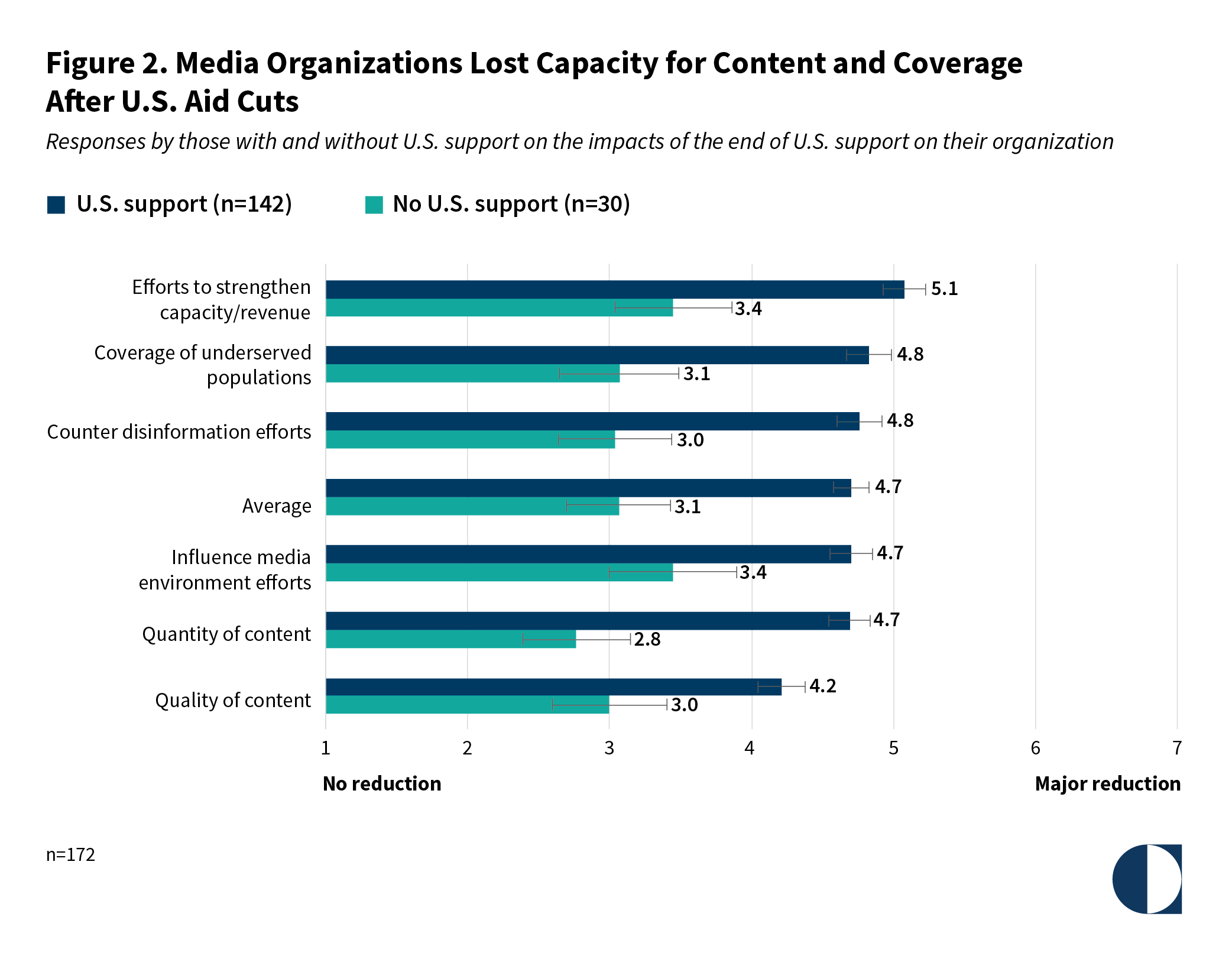
Survey respondents were asked to estimate the impact of the U.S. withdrawal on their organizations across a variety of factors on a scale from 1 to 7, where 1 is no reduction and 7 is a major reduction. As shown in figure 2, the average former U.S. beneficiary reported a reduction of 5.1 in efforts to improve administrative capacity for commercial revenue generation, followed by slightly lower values for their abilities to cover underserved areas or populations, efforts to address mis- or disinformation, and the amount of media content. Respondents reported on average a statistically significant lower reduction in the quality of their content, and many interviewees and survey respondents insisted that there was no change in quality. All these figures were considerably lower for those outlets that did not receive U.S. support; however, they were perhaps not as low as one might expect. As we discuss in detail below, other donors have not stepped in to fill the gap, and one interviewee reported a “hunger games” situation among independent media organizations competing for a shrinking pie of resources.27
These cuts reduced the ability of the press to do its job and serve the public interest. As one survey respondent noted, in the recent election period since the cuts “We could barely create one mobile journalist group to monitor hundreds of electoral districts across the region, when in the past we had four to five mobile groups.” Another stated, “We cannot work with more reporters to collaborate information,” adding, “We are unable to cover critical stories in marginalized areas.”
As bad as these results are, it could have been worse. The withdrawal of U.S. support—on top of all the other challenges—has not yet led to a feared mass extinction event. Instead, media outlets have largely hung on by letting go of staff, reducing pay, appealing to audience support, seeking stopgap funding, working long hours, and making other sacrifices to content and quality. Our interviews suggested this is largely due to the deep personal motivations of many journalists in the sector. A Ukrainian news organization owner was paying staff out of his own pocket, stating, “I continue to do this work for my relatives and friends [in the occupied territories], for the journalists that were tortured. I couldn’t leave this work.”
The financial impact was more extreme for the former implementing partner community. For FY 2023, the two major implementing partners, IREX and Internews Network, reported revenues of $147 million and $124 million, respectively.28 Internews and IREX were heavily dependent on U.S. government funds, and they were forced to fire hundreds of staff and close dozens of offices throughout the globe. At the local level, the twenty-nine survey participants that identified as local media support civil society organizations (CSOs) reported reductions from a median of 16.5 to 8 staff members between 2024 and 2025—a deeper level of cuts than media outlets reported.
While the loss of grant funding offers the most visible impact of the U.S. withdrawal of international media support, grant funds to support media organizations’ operations made up only a minority of U.S. support. As noted above, U.S. support also aimed to:
In this section, we review a sample of the actions and impacts of past USAID programming across these categories, in order to reflect on the nonfinancial losses to the media sector.
The most ambitious aspect of U.S.-funded media work, and what distinguished the United States from most other donors, was its efforts to improve the political and legal enabling environment for independent media in the countries where it operated. The United States had the unique ability to exert both diplomatic pressure and programmatic support to impact political and legal conditions. For example, USAID initiated the Zambia Open Spaces media and digital program implemented by Internews in 2021, around the time that a reformist government was voted into office. The program and its CSO implementing partners worked closely with the newly elected government to pass Zambia’s first-ever access to information law, which became operational in 2024.29 In addition to setting up a mechanism to make information public, the law criminalized obstruction of information access and designated the country’s Human Rights Commission with oversight and enforcement authority. USAID supported Zambian CSOs to enable their participation as key members of the government’s technical working group, and several Zambia-based interviewees emphasized the importance of U.S. diplomatic, financial, and programmatic support in the law’s quality, consultative process, and ultimate passage.
To offer two other examples: At the time of the U.S. funding termination, a USAID-funded program was working with the Liberian government to promote a Liberia community radio sustainability bill that would provide public funds to community radio with management by an independent media commission. In Moldova, another USAID-funded program was providing legal support to the parliament to develop a media law in line with EU accession requirements. Similarly, in more hostile contexts, programs were working to counter foreign agents laws and other legislation that would limit media independence.
Much of USAID’s programming to promote information integrity focused on news consumers and involved media literacy campaigns, including programs such as Learn to Discern.30 However, supporting independent media’s fact-based journalism was also seen as part of the countering strategy. As one Salvadoran journalist commented, “What we do is combat disinformation by writing accurate stories.” In Liberia, for example, after the 2023 election, politicians used radio stations under their influence to push disinformation about the election results, which could have led to electoral violence.31 However, this disinformation was challenged by independent stations that were providing accurate, real-time information, many of them trained by USAID programs in covering elections.
In other countries, the United States invested more directly in actively promoting information integrity. For example, U.S. support for media in the Philippines started in 2019 in response to state-sponsored disinformation campaigns and attacks on independent media by the then Rodrigo Duterte government (2016–2022) and its allies. These groups had pursued numerous legal actions against the news source Rappler, pressured the Philippine Daily Inquirer owner to sell the critical newspaper to a pro-Duterte businessman, and ensured the non-renewal of the popular television station ABS-CBN’s broadcast license.32 The Philippines was famously called “patient zero” as the earliest and clearest case where social media was used to deploy large-scale, organized disinformation campaigns to influence popular opinion.33
In response, USAID programming implemented by Internews established a Philippines Disinformation Reporting Platform that tracked and exposed more than 21,000 disinformation articles and posts. It partnered with Facebook to increase to six the number of accredited fact-checkers in the country and to financially support them.34 In addition, as foreign-promoted disinformation increased in the country, including pro-China territorial narratives in the South China Sea, the project formed a partnership to expose foreign influence operations. The partnership resulted in around eighty articles covering the topic, sections devoted to the topic in two major news sources, and a playbook explaining how foreign influence operations work.35
Similar information integrity strategies were employed across several USAID programs. For example, from 2004 until the termination of funding, the United States had been supporting Detector Media (formerly Telekritika) in its efforts to monitor the Ukrainian media sector, expose Russian and other sources of disinformation, and publish news and analysis on the country’s media industry.36
The Committee to Protect Journalists reports that 127 journalists and media workers were killed in 2025, and journalism remains a dangerous profession in many countries.37 As concerning as this figure is, physical violence is only one of the many safety and security challenges that journalists face, which also include digital threats, psychosocial challenges from the pressures of journalism, and legal attacks and lawsuits.
To address physical security, U.S. government–funded programming provided protective equipment, trained journalists to cover conflict or protests, offered support to journalists under threat, and extended resources to journalists that needed to relocate. In Myanmar, for example, after the coup in 2021, the U.S.-funded media program shifted to getting dozens of journalists to safety in exile. In response to a harsh government crackdown on protesters in the Republic of Georgia in 2024, the U.S.-funded program set up an all-night media operation center where journalists, including pro-government media, could go to escape tear gas, receive medical treatment, access Wi-Fi, warm up, and file stories.
To address digital security, which is perhaps the most common challenge journalists face, support included digital security audits, training in digital hygiene, provision of virtual private networks (VPNs), and licenses for proprietary software. For example, in Zambia, the program conducted digital security audits of media organizations and then worked with them to develop and implement a plan for digital security. The audits provided valuable information, including evidence of electronic interventions in one newsroom’s systems by a foreign embassy’s operatives following critical coverage. In another country where journalist arrests were common, trained staff worked with the spouses of detained journalists to remotely ensure the arrestees’ seized cell phones could not access files and information that could be used against them.
To address psychosocial security, U.S.-supported programming in El Salvador and the Republic of Georgia funded clinics where journalists could obtain free or subsidized social care. Such clinics could provide a lifeline to reporters facing challenges such as burnout, trauma from reporting on war or violence, or online gender-based harassment.
Legal threats have perhaps eclipsed physical violence as an existential threat to critical, independent media outlets. Strategic lawsuits against public participation (SLAPPs) are defined by the Council of Europe as “legal actions that are threatened, initiated or pursued as a means of harassing or intimidating their target, and which seek to prevent, inhibit, restrict or penalise free expression on matters of public interest and the exercise of rights associated with public participation.”38 While there are not good cross-national measures on SLAPPs, the consensus is that they are increasing exponentially and are filed by both state and nonstate actors.39 For example, KRIK, an interviewed media outlet in Serbia, reported that they had seventeen active SLAPP cases against them—more lawsuits than staff. In response, many U.S.-supported programs funded legal assistance to combat frivolous lawsuits, including the earlier-mentioned programs in El Salvador and the Republic of Georgia. Through the Joe Biden administration’s Summit for Democracy initiative, USAID also supported the creation of a membership-based mutual insurance entity, which continues to offer legal support.40
Improving the quality of journalism and the skills of journalists was another common theme in U.S.-funded programming. This included working through university programs and directly training or mentoring journalists on a range of topics, including basic journalism skills, ethical reporting and standards, political and election reporting, digital and multimedia journalism, data journalism, fact checking, collaborative reporting, and investigative journalism.
U.S. programs providing applied investigative journalism training were an increasingly common part of the media development tool kit. This work was hands-on, involving both classroom training and mentorship as program participants (typically with financial support) carried out investigations. Investigative journalism was core to several country-level programs, but much of the U.S. support for investigative journalism was regional in nature. This work was often funded through OCCRP and promoted cross-border collaboration to follow illicit financial flows. For example, the Strengthening Transparency and Accountability Through Investigative Reporting project was a $20 million program to strengthen investigative journalism networks in Europe and Eurasia set to run through 2027.
Because of funding rules regarding nonintervention in editorial decisionmaking, it is difficult to link individual stories to U.S. funding, but the U.S. support to OCCRP and investigative news outlets has been central to exposing several global corruption cases, resulting in resignations, arrests, indictments, sentences, and money recovered. For example, in El Salvador, grantee FOCOS’s reporting showed alleged corruption in the country’s prisons, including potential involvement of the head of prisons; it identified red flags in land sales involving the president and his family; and it showed how the state bank gave loans to political leaders and their family members.41 One Moldovan journalist stated, “This year, we got the European Press Prize for the best investigative story. . . . And we could never grow to this stage and inform people so well if not for foreign support.”42
In response to market challenges and to protect media independence, many programs supported the development and implementation of business plans to increase revenues. For example, the $14 million, five-year Media Innovation Activity program in Serbia implemented by IREX supported around twenty media outlets and initiatives in developing their business models. It helped a long-standing news agency modernize its administration to obtain a bank loan. It supported a female presenter who created her own platform focused on women’s issues, helping her go from an idea to a sustainable operation. It worked with app developers building a franchise model that provided users with local news and information, taking the app from a small local operation to an international one.
These efforts to increase media viability entailed several significant innovations. The implementer in Serbia coordinated with the Media Development Investment Fund, a lender, to help media organizations become creditworthy enough to receive a loan. The implementer also worked with small media outlets to join forces in creating common regional internet platforms. This allowed the outlets to better attract advertisers, who could advertise across different outlets in the same region. The program even guaranteed bank loans and monitored repayment to help clients build their credit. The project head in Serbia stated, “We want to make sure that for every dollar that we invest—that it is being multiplied,” and the project’s monitoring data supported that achievement.43
The approach varied based on the media market. In Liberia, Mozambique, and Zambia, community radio stations used USAID funds to invest in profitable side businesses to subsidize their operations. For example, some invested in a Starlink connection and solar panels to offer computers, internet access, and a meeting space to residents and local businesses. Others used funds to invest in audio equipment to provide music and audio for private events, to develop their own event spaces, to establish a café, or to create a recording studio for local musicians. In Mozambique, the program also set up a platform to link national advertisers with rural communities through community radio stations.
There were also global and regional efforts. Internews’s Media Viability Accelerator, for example, came out of the Biden administration’s Summit for Democracy and involved a partnership with Microsoft.44 It had only been fully operational for about six months prior to its termination, but engineers contracted by Microsoft successfully developed a platform for Internews that allowed user media organizations enrolled in the system to compile audience data and analytics from across different social media and internet platforms. They could then track clicks, likes, reader preferences, viewership, and market data in a consolidated way over time. Internews was working with users to design experiments to test the impact of different innovations on these now trackable indicators of business success. In the longer term there were plans to allow media organizations to compare themselves anonymously with other similar outlets, to add a marketplace where users could list out funding and in-kind needs for vendors and donors, and to provide critical insights into successful revenue-generation strategies. After an intensive recruitment effort, 300 media organizations had signed on to the platform prior to its termination.
While it perhaps attracted less attention than other areas of funding, a meaningful portion of U.S. support went toward independent media providing coverage for provincial and rural populations with low digital/internet penetration that otherwise lacked access to independent sources of news. This meant funding community radio stations throughout Africa and supporting small regional news outlets in Eastern Europe. In Libya, USAID support to El Kul was unique because it drew independent journalists from around the country.
Of the African countries we focused on in this study, at the time of the termination, USAID programs were supporting thirty-nine community radio stations in Liberia, nineteen in Zambia, and fifty-five in Mozambique. These stations provided a valuable source of national and local news, covering elections, health, nutrition, agriculture, and climate change, among other topics important to their communities.
Many of these radio stations were established decades earlier through United Nations Educational, Scientific and Cultural Organization (UNESCO) programs and remain dependent on donor support for equipment and funds. As the Mozambique program’s former head explains it, community radio stations are run by volunteer staff—typically unemployed young people. However, they leave the station once they obtain a salaried job (for example, as a teacher), resulting in high turnover and a lost opportunity to develop expertise in journalism or community issues, such as local agriculture issues or disease prevention. A donor-funded program might train these young journalists, but that investment will be lost when they move on to other work. As such, in Mozambique, the program provided around $40,000 a year to each community radio station, which allowed it to pay a minimum wage salary to staff. Then the program could invest in training and work with the station to diversify its funding streams (for example, creating multimedia centers with internet access and renting space and equipment).
This commitment to expanded coverage was not limited to Africa. For example, in Ukraine, the United States had supported regional independent media for decades, particularly in eastern and southern Ukraine.45 This was seen as particularly important to counter Russian disinformation. Earlier, we mentioned Novyny Donbasu, a media outlet displaced from the Donbas that provides independent news to Ukrainians on the front lines and in Russian-occupied areas. Realna Gazeta, another displaced media organization from Luhansk, had just completed in December 2024 a U.S.-funded documentary on what is happening to all the properties and houses of the people displaced from the occupied territories. U.S. funds also supported the Donbas Media Forum from 2015 to 2025 to convene media professionals from throughout the country to strengthen independent journalism.46
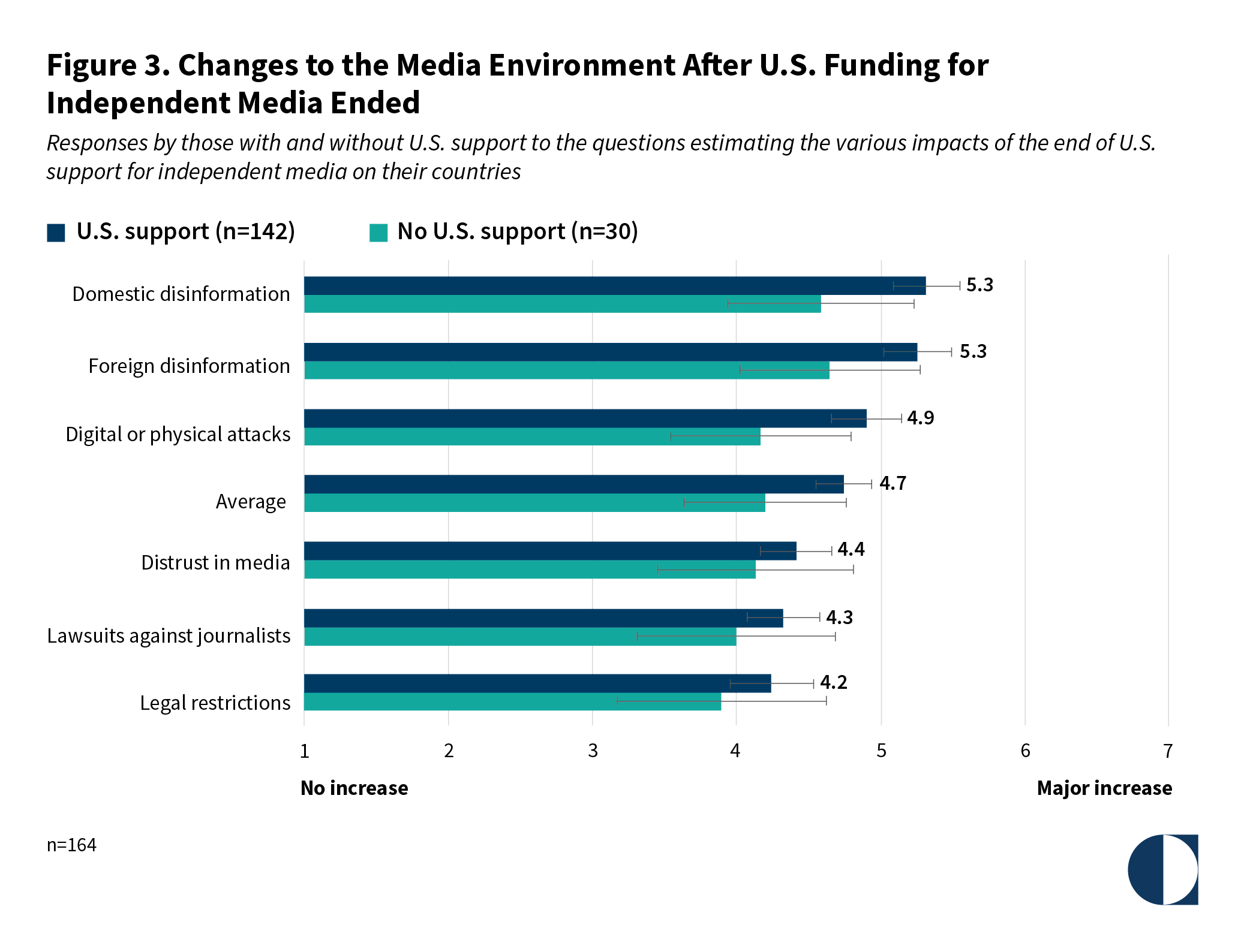
The termination of U.S. support across these programming areas cut short efforts to foster reform, promote information integrity and counter disinformation, protect journalists, improve journalistic quality, foster financially viable media outlets, and ensure independent media in underserved areas. The implications are concerning, not just for the media organizations themselves but also for their countries and people. We asked survey respondents to rate the extent to which the termination of U.S. support for independent media increased several media-related problems in their country, ranging from 1 (no increase) to 7 (major increase). Across six categories shown in figure 3, respondents reported the largest average increases in disinformation, both foreign and domestic. Those that received U.S. support on average rated the increase in domestic and foreign disinformation a 5.3 and 5.2 respectively. This was followed by digital or physical attacks on media, distrust in media, lawsuits against journalists, and legal restrictions. Non-U.S.-funded grantees tended to rate the impact lower, but they too reported an impact ranging between just under 4 and 5 on a 7-point scale. In short, the U.S. withdrawal has not only impacted organizations financially but has also had a broader impact on the media ecosystem, a topic we explore further in the next section.
In many countries, the worst impacts of the U.S. policy reversal were political rather than financial. Several interviewees noted this in their own words. One Salvadoran journalist told us,
The principal problem of USAID’s closure wasn’t the lack of funds. Many people say what happened with USAID hit the media economically. For me the most difficult part of USAID’s decision [was] knowing that the El Salvadoran journalist is no longer protected.
And a Moldovan journalist built upon this, noting that
We had always the feeling that whatever happens, American institutions are there to support us. It is not about money. It is about the feeling that they understand the role of independent journalists; they understand the role of investigative journalists; they understand the role of civil society. . . . What happened on January 25—it was that silence . . . they stopped to communicate with us. You fear that now you are left here under Russian attacks and that voice of support has vanished. . . . We feel that something important was destroyed.
While the U.S. support was not without its limitations, several interviewees noted that the United States was uniquely positioned and willing to take the political risks of supporting independent media in the face of political opposition. We find that the Trump administration not only withdrew this support but actually reversed U.S. policy, empowering autocratizing forces to roll back previously won gains, to further constrict the media environment, and to actively repress journalists.47
Zambia, where U.S. efforts had successfully supported Zambian government efforts to pass an access to information law, illustrates the effects of the political turnaround. The USAID media project in Zambia had also been supporting the President Hakainde Hichilema administration to reform cybercrime and cybersecurity laws. Hardliners within the government, however, were opposed to this collaborative approach with local CSOs and rights-protective language. In November 2024, the hardliners seemed to win out, and their version of the bill appeared in the parliament. Through the advocacy of CSOs, including USAID-supported CSOs, and diplomatic intervention by the U.S. ambassador and U.S. officials in Washington, the bill was withdrawn and the CSOs were invited back to the table.
Interviewed CSOs in Zambia felt that they were making progress in revising the bill prior to the cuts, but then U.S. diplomatic engagement ended and the local CSOs were unable to participate effectively. They had laid off staff, could no longer pay lawyers to support the process, and were distracted by the threat to their continued operations. The hardliner version of the bill was reintroduced in parliament with minor changes, moved quickly through the legislative process, and obtained presidential assent in April 2025. Although this was the same reformist administration that had just collaborated to pass a first-ever access to information law, the revised cyber laws offered a means to criminalize critical journalism through vague terminology, it concentrated enforcement in the president’s office, and it allowed for real-time surveillance without adequate checks.48
The case of El Salvador goes a step further and illustrates how the United States not only ended financial and political support for independent media but actually reversed it. El Salvador had developed a strong independent media following the civil war of the 1990s; however, as President Nayib Bukele’s government became increasingly authoritarian and consolidated state power, independent media and civil society also came under threat. From 2018 to 2024, the country dropped from 66 to 133 on Reporters Without Borders World Press Freedom Index, and documented cases of aggressions against journalists climbed.49 In response, U.S. foreign assistance to independent media became a lifeline to ensure the survival of the sector. U.S. support was not only financial but also political and diplomatic. In 2021, Bukele introduced a draft law to force independent media and CSOs receiving funds from abroad to register as foreign agents, pay a high tax on incoming funds, and subject themselves to strict oversight. At that time, however, public and international opposition, including from the Biden administration, prevented the legislation from moving forward.50
Once Trump came into office, Bukele had a clear opening to further his autocratic project. Shortly after U.S. Secretary of State Marco Rubio visited El Salvador to celebrate a new relationship and cooperation in jailing U.S. migrants in El Salvador’s Terrorism Confinement Center (CECOT), the “muzzle was off,” as one interviewee put it. This led to a series of actions, including the rushed passage of a revised foreign agents law, the arrest of human rights and anti-corruption lawyer and researcher Ruth López, and arrest warrants for journalists from El Faro, an independent outlet.51 Interviewees from the region all agreed that the shift in El Salvador was enabled by the change in Washington. They also agreed that registering as a foreign agent was not an option. As one interview noted, to stay in El Salvador and register under the foreign agents law would mean “working with a gun to your head.” As a result, an estimated fifty-three journalists went into exile in early 2025.52
Nicaragua offers a similar story of reversal. Through a series of actions between 2018 and 2022, Daniel Ortega’s government used legal changes, arrests, and seizures to exert control over the Nicaraguan news media and forced all remaining independent media into exile.53 The United States had been supporting independent media in Nicaragua since 2014, and it pivoted its efforts to keep independent journalism alive and functioning in exile. This included substantial financial support but also other investments, such as the development of a secure platform enabling in-country journalists to transmit information out of the country. An independent evaluation concluded that “USAID support was essential in helping media partners survive government repression and personal, organizational, and digital harassment. Without USAID assistance . . . many of these outlets would have gone out of business, significantly scaled back their operations, or never been founded.”54
As part of this repression, in 2021, the police raided one of USAID’s local implementing partners, the Violeta Barrios de Chamorro Foundation, and arrested and jailed two staff members on spurious money laundering charges.55 A Nicaraguan national and USAID staff member was profiled in the successful prosecution, and she was forced to leave the country.56 Despite the many challenges, up until the 2025 cuts, the U.S. government had remained steadfast in its support to independent media. Noting all the sacrifices that had been made to keep independent media organizations standing in the face of government oppression and the U.S. government’s sudden abandonment of them, one former USAID staff member stated, “The U.S. government did what the government of Nicaragua couldn’t do.”
We heard similar stories in other countries like the Republic of Georgia and Kyrgyzstan. One leader of a project in Georgia, where the government passed an even broader and more restrictive foreign agents law in April 2025,57 reported hearing from her media colleagues, “We need America. . . . We need to know that you are with us. You are the only thing stopping the government from coming after us—[the only thing] is your presence.” The interviewee added in her own words, “That is all gone. They feel completely abandoned.”
The reversal in U.S. posture offered a useful tool to autocratizing leaders. As USAID was being dismantled, Elon Musk, Trump, the administration’s press secretary, and Republican officials made unsubstantiated allegations against USAID. In various instances USAID was called a “criminal organization,” “radical-left political psy op,” “evil,” and a “ball of worms” and accused of “corruption” and “money laundering.”58 While these messages were likely targeted to a U.S. audience to justify DOGE actions, they were picked up and exploited by autocratizing leaders to push back against independent media (along with CSOs and democracy promotion efforts more generally).
Perhaps the most extreme case was in Serbia, where authorities threatened prosecutions and searched the premises of former grantee CSOs, including the Center for Research, Transparency and Accountability, which runs a fact-checking platform Istinomer, a member of the International Fact-Checking Network.59 However, the experience was widespread. For example, one Moldovan journalist from the newspaper Ziarul de Gardă referencing these allegations of corruption and criminality stated:
That message was like a gift to the Russian disinformation machine . . . They started to say that Ziarul de Gardă is a criminal organization—that we took criminal money, and we did wrong things with criminal money. . . . It was a smear campaign that we never had before and it was so painful for the team. . . . One of our young reporters went to the parliament . . . Our reporter approached [a pro-Russian politician] and the politician said to her, “Ziarul de Gardă, I don’t talk to you. You are a criminal organization.”
This was common across countries, and media reports illustrate how illiberal leaders repackaged criticisms of USAID for their own domestic audiences in a wide range of countries. This was particularly so in Europe and Eurasia, including in Hungary, Serbia, Russia, Belarus, the Republic of Georgia, Azerbaijan, and Kyrgyzstan, but it was also the case in other countries such as Sri Lanka and the aforementioned case of El Salvador in Latin America.60
The U.S. government also reversed itself in promoting information integrity. As noted in figure 3, survey respondents identified increased disinformation as their primary concern following the U.S. funding cuts. Disinformation problems were also the most frequently cited impact in open-ended survey responses.
Although U.S. information integrity initiatives expanded during Trump’s first term, domestic political opposition to such efforts intensified over time. Prominent right-wing policymakers and commentators raised concerns that federal initiatives to counter disinformation infringed on free speech and disproportionately targeted right-leaning voices. The critiques gained institutional traction in 2023, when Republicans assumed the majority in the U.S. House of Representatives. As the new chair of the House Judiciary Committee, Representative Jim Jordan launched investigations into whether federal agencies—including USAID and the State Department—had engaged in censorship of conservative speech.61 Also in 2023, the Daily Wire, the Federalist, and the State of Texas sued the State Department alleging that funding for the Global Disinformation Index through the State Department’s Global Engagement Center had indirectly pressured advertisers to withdraw support from certain right-leaning outlets under the banner of countering disinformation.62
In late 2024, Congress subsequently defunded the Global Engagement Center, which had served as the principal U.S. government entity coordinating international efforts to counter foreign disinformation, including during the first Trump administration. In January 2025, Trump issued an executive order framed as “ending federal censorship,”63 and subsequent administrative actions terminated remaining federal information integrity initiatives, including those previously housed within USAID and the State Department.
The about-face in U.S. policy spilled over into the tech industry as well. The social media platform X had already changed course on its approach to fact-checking in 2022 after Elon Musk acquired the company; however, Facebook had been developing a robust fact-checking program since 2016. For example, it funded International Fact-Checking Network fact-checkers to review flagged posts on Facebook and Instagram (which are both owned by Meta). In a surprising turnaround after Trump’s re-election, founder and CEO Mark Zuckerberg aligned himself with the view that fact checking had become “a tool to censor.”64 Fortunately, Meta has continued its support of fact-checking outside of the United States, but the public reversal further undermined information integrity efforts and created uncertainty about the future.
U.S. support for independent media has historically been motivated by a combination of normative commitments and strategic considerations. From a values-based perspective, independent media has been regarded as essential to democratic governance, accountability, and the protection of rights. For decades, assistance to strengthen journalism in other countries was viewed as a key instrument of democratic development policy, grounded in the belief that fact-based reporting can contribute to improved public policy, reduced corruption, more effective service delivery, and, in some contexts, greater political stability. At the same time, media assistance has reflected elements of strategic self-interest. Strengthening democratic institutions abroad was seen as reinforcing U.S. soft power, supporting more transparent and stable political systems, and fostering partnerships with governments more aligned with U.S. interests. In this sense, media development operated at the intersection of democratic values and foreign policy strategy.
Many of the media investments that we examined also appeared clearly aligned with U.S. interests in more concretely strategic ways. For example, investigative reporting generated information that was helpful to U.S. intelligence and diplomacy. In addition, support to groups such as El Kul in Libya stemmed from a recognized need to have independent media in a country whose press was dominated by political and foreign influences. Of particular concern to Washington was Russian and Wagner Group (now Africa Corps) influence on the media. El Kul was supported with funds from the Global Fragility Act, passed in 2019 during the first Trump administration to strengthen national security and reduce conflict, and both the State Department and the U.S. Department of Defense were involved in the funding decision.
In Ukraine and Moldova, investments aimed to counter Russian disinformation. In Mozambique, all the U.S. media investments were in the conflict-prone north of the country, which is where Al-Shabaab’s Islamist militant group was active and where conflict undermined the extraction of the country’s natural gas and rubies. In Jordan, the United States supported radio stations broadcasting to areas serving Syrian refugee camps. One respondent involved in these programs noted, “I don’t know if [the Islamic State] was looking at the list of grants that were cancelled, but if they did, they cheered, because this grant was specifically interfering with terrorists’ ability to recruit new members.” Another USAID implementing partner formerly based in the Republic of Georgia said, “I think the U.S. threw away billions and billions of dollars of investment and one of its biggest assets globally. . . . It’s a complete waste of decades of foreign diplomacy and financial investment.”
Furthermore, support for independent media was also a helpful tool in the United States’ great power competition. For example, in Zambia, U.S.-supported anti-corruption reporting and research had uncovered abusive practices by Chinese and Russian authorities and businesses, which helped influence public opinion against them. As the United States pulled its media support, interviewees in several countries, including Zambia, stated that the Russian and Chinese governments had sought to take advantage of the withdrawal, offering to pay for airing content and for training opportunities. While Russian and Chinese media outreach in the wake of the U.S. funding withdrawal appears to have been limited to specific countries, one Jordanian journalist who had been approached by RT stated, “Do the people in Washington know what they have done? They have left a vacuum. You leave a vacuum and people are going to fill it.”
Values-based investments added to its soft power while strategic investments provided more direct benefits or gave the United States a leg up in the great power competition. As such, foreign assistance to support independent media (and democracy more generally) was a win-win for the United States. In theory, the Trump administration’s 2025 National Security Strategy still recognizes this value proposition, stating “We want to maintain the United States’ unrivaled ‘soft power’ through which we exercise positive influence throughout the world that furthers our interests.”65 However, the destruction of USAID and the end of values-based assistance clearly undermined that goal.
U.S.-supported media development assistance was not without its critics. Critiques of the sector pose three primary questions that we consider in turn.
Interviews, the survey, and performance evaluations reviewed for this study surfaced some concerns on the effectiveness of U.S. support; however, these three sources were still overwhelmingly positive. Investigative reporting seems to have produced the biggest bang for taxpayer dollars, and OCCRP has perhaps done the best job of demonstrating its effectiveness and cost-effectiveness. As of this writing, the group calculates that its reporting has contributed to 803 indictments, arrests, or sentences; 140 resignations and firings; and over $12 billion in fines levied and money seized.66 In a February 2025 letter to the U.S. Congress, OCCRP stated that, “Its reporting has led to over $11 billion in criminal asset recoveries worldwide, including about $3 billion for the United States—a return of more than $100 for every dollar received from the U.S. government.”67
In our own survey, we asked respondents who received U.S. assistance if that support was effective across six potential objectives: improving the quality of journalism, countering mis- and disinformation, protecting journalists, expanding the reach of independent media to underserved communities, increasing administrative capacity or commercial revenue generation, improving the political environment, and expanding networks, coalitions, or cooperation among independent media advocates. On a scale from 1 to 7, where 1 was not effective and 7 was extremely effective, figure 4 shows that average scores were between 5.7 and 6.2. Of course, these figures should be taken with a grain of salt, as there is a natural tendency of grantees to evaluate support well, but the responses offer some indication of effectiveness.
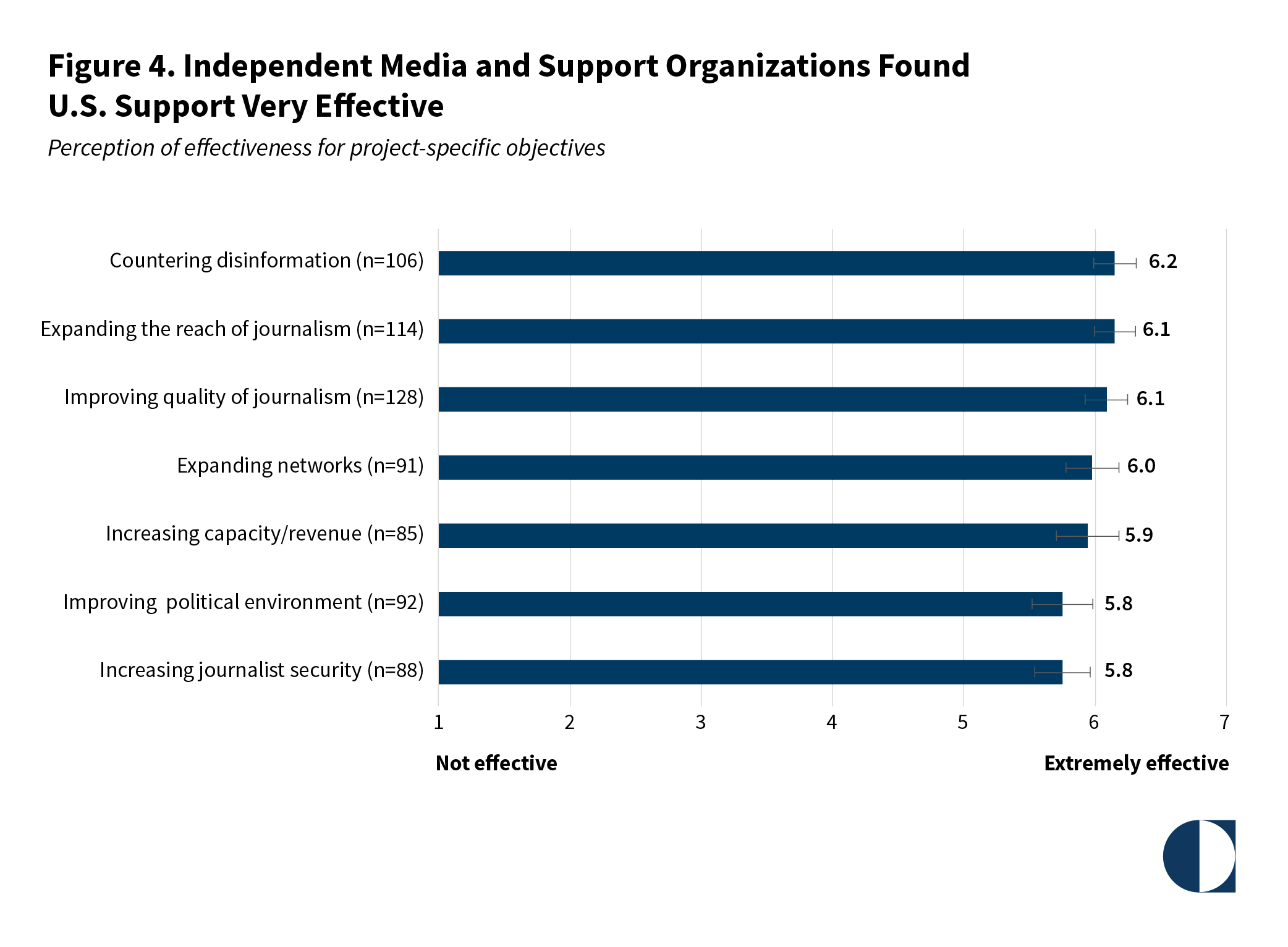
For some observers, however, the continual decline of media freedom (along with other rights and freedoms) is indication enough that the aid model was not working. The positive reporting and evaluations do not seem to match the continued deterioration in press freedom, press safety, and market viability, as well as the rise in disinformation and other threats. Defenders of media aid argue that this is an unfair standard, as these declines are driven by powerful exogenous forces. For example, one interviewee contended that an increase in disinformation is better understood to be the result of the billions of dollars in domestic and foreign influence operations than the failure of millions of dollars to combat them.
In fact, many U.S. media support initiatives were high-risk investments not guaranteed to succeed. Programs often sought to expand the enabling environment for independent media in constricting political spaces, promote information integrity where disinformation was rife, or increase market viability where the media market was not profitable. In some challenging contexts, different observers might look at the same program and fairly argue either (a) that U.S.-supported interventions were defensively holding the line and keeping a bad situation from getting worse or (b) that they were failing to make progress. Within the U.S. government and the democracy aid community, there was always disagreement about when aid should be discontinued as unlikely to work and when it should be maintained—either to hold a finger in the dike or to lay the groundwork for when the political winds shift.
What is clear is that U.S. assistance enabled and supported journalists and independent media advocates who were willing to push back against these forces in their countries. For many advocates of aid, that is justification enough, even if it does not produce a short-term, sustainable outcome. For example, in El Salvador, USAID funding and support helped transform the El Salvador Journalist Association (APES), which had been previously dependent mostly on volunteerism, into a strong voice for independent media that systematically documented abuses against independent media, provided a legal clinic and psychoemotional support services, and served the interests of its members. When APES was forced into exile, it had achieved an adequate level of institutional consolidation to maintain much of its staffing and was able to coordinate support for its members as they went into exile. To different observers, the continued decline of press freedom in El Salvador could be seen as evidence of failure, or the persistence of APES could be seen as evidence of success.
USAID media awards occurred through a competitive procurement system dominated by U.S.-based nonprofit organizations and for-profit contractors; only a minority portion of funds were grants to local media outlets. Across thirteen projects for which we were able to obtain estimates, the average media development activity provided an estimated 41 percent of the total award to local media organizations. This figure should be interpreted cautiously, as it is not representative of all funding and is based on estimates by former USAID staff who no longer have access to precise data. Other estimates are somewhat lower.68
Another portion of project funds go to pay for overhead, or indirect costs, including leadership and staff responsible for overseeing contracts, finance and billing, business development, human resources, and security as well as for office space and equipment. Overhead rates are not typically public information, but interviews suggest that the major USAID media implementing partners would use around 35 percent of the award to cover indirect costs. The remainder of the funds would go to cover programming costs by the awardee, which might include a local office, local staffing, local consultants, and a wide range of services, including training on investigative journalism, management consulting to increase commercial revenues, equipment donations for studios, or legal services.
Some observers look at estimates like these and think it is unacceptable that most funds did not go directly to the local media organizations themselves. In fact, several interviewed and surveyed local media and media support organization leaders fell into this category. Several interviewees and survey respondents expressed frustration with their role as sub-grantees. The most common recommendation among survey respondents was similar to one survey participant who wrote: “Reduce the number of intermediaries between the allocated money and the media themselves.”
However, other former USAID or implementing partner staff point out that the primary goal of USAID programming was not to fund independent media. In many cases, U.S. assistance eschewed grants for core funding as likely to create dependency. Instead, the goal was to build or strengthen local expertise and foster a safer and more financially and politically viable media environment. From this perspective, the international implementing partners, their staff, and their consultants brought expertise and experience from other countries and contexts that could be leveraged to achieve these higher-level objectives.69 There is plenty of evidence to support both perspectives: More money could have and should have gone to local partners, and yet the international implementing partners did provide important value additions that USAID was not able to find locally.
During Samantha Power’s tenure as USAID administrator (May 2021–January 2025), one of Power’s primary objectives was to increase what was termed “localization,” or putting local actors in the lead.70 This was often measured by the percent of award dollars going directly from USAID to local organizations. Similar goals were a priority for the Barack Obama administration (which it called USAID Forward), Trump’s first administration (which it called the Journey to Self-Reliance), and the Biden administration (localization), but progress was limited. By the end of Power’s tenure, only 12.6 percent of FY 2024 funds went to awards led by local partners, well short of a 25 percent target that Power had set.71
Support for independent media illustrates the challenge of increasing localization and changing the status quo. While all media programs involved local partners and local staff, only six of the fifty-four USAID media development projects identified by this research were led by local organizations (10.4 percent of the total award amount).72 The majority of media programs were implemented by two organizations, Internews and IREX—or to a consortium that the two were part of.
Their dominance was in many ways well-deserved—their work was typically well-regarded by interviewees; however, it was also driven by how USAID procured media programs. A large portion of media programming went through what is called a Leader with Associates Award (LWA). These mechanisms were procured in Washington by USAID’s Democracy, Human Rights, and Governance (DRG) Bureau (earlier the DRG Center) to carry out support to both civil society and media, and USAID missions could “buy into” the LWA mechanism without conducting their own procurements. LWAs were essential from an administrative perspective because they allowed USAID missions to more efficiently procure media and other program implementation from well-established partners quickly. By contrast, a free-and-open or other competitive mechanism would in practice take over a year to complete, entail an enormous number of staff hours, and involve considerable uncertainty (for example, the outcome could be contested).
While LWAs were a preferred procurement tool, they had two enormous downsides in media programming: First, the mechanisms were very large and global, so local partners could never be the leader and were also unlikely to run an associate award. Second, large nonprofits such as FHI 360, Freedom House, and Pact were the official leaders rather than Internews and IREX. Therefore, a large percentage of the award would cover indirect costs of both Internews or IREX and the leader, further decreasing the amount of money available to go to local media partners. The root of the problem was that USAID procurement and oversight was expensive, slow, and uncertain, but the administrative workaround ensured that a minority of program funds made it to local media partners.
Similarly, U.S. procurement and oversight regulations required a similar level of effort to procure and oversee awards regardless of size. This produced significant economies of scale in procuring and overseeing a small number of large awards rather than numerous small awards to smaller, local organizations. Moreover, there were considerable time savings in working with partners that understood the complexity of U.S. award management, and it often did not make practical sense for small, local organizations to develop such an understanding. These procurement and regulatory limitations came from diverse sources, including congressional mandates, federal acquisition requirements, USAID internal regulations, and risk-averse contracting officers and staff. Regardless of the source, however, we are confident that assistance could have been more supportive of local media organizations under a different procurement and regulatory regime.
Autocratic-leaning foreign governments long alleged that USAID, the State Department, and the NED used media support to carry out U.S. political objectives. More recently, this view has been taken up by U.S. politicians and influencers in the MAGA movement, who have gone so far as to call groups such as OCCRP “mercenary media.” One influencer argued that rather than carry out investigative journalism, OCCRP writes “hit pieces” to bring down enemies of a leftist State Department and harass conservative political enemies.73 Despite hours of podcast discussions and hundreds of X posts, these critics fail to make a case against USAID and OCCRP that holds up to scrutiny. As of this writing, OCCRP maintained a section of its webpage to respond to attacks and allegations against the organization.74
This is not to say that U.S. media funding was apolitical. It was not coincidental that the U.S. government funded exiled media in repressive countries like Belarus, Myanmar, and Nicaragua. The support was tied to the outlets’ commitment to the rights of a free press and democracy promotion in their countries, and there was no expectation to be complementary to their home countries’ governments. Moreover, these were objectives of the U.S. government over an extended period—not a particular administration or the so-called deep state.
It is of course possible or even likely that some media organizations felt they had to self-censor criticism of the United States. Nonetheless, many interviewees, including journalists skeptical of receiving grants from the U.S. government, noted that USAID and its partners did not attempt to influence story content. Implementing partners also emphasized this point on multiple occasions. We did not hear of any situations where draft reporting was submitted to USAID or even its implementers for review. In fact, this was one of the advantages of separating out a development agency from diplomatic and defense agencies.
It should be noted, however, that U.S. funding did aim to encourage reporting on certain topics, and this could be viewed as a form of influence on journalistic output. For example, media programs might have offered specific, small grants to journalists to write stories on climate, gender issues, or corruption. In these cases, USAID did incentivize the volume and quality of content on broad themes, if not specific content. While it made sense to USAID to fund topics of programmatic interest, interviewed media sector experts tended to oppose these types of “story grants” as undermining the ability of local media to determine their own priorities.
In summary, U.S. grants were political in countries where governments sought to control the media. Although USAID programming at times prioritized particular thematic areas, its support fostered institutional capacity development rather than editorial influence. While questions remain regarding the balance between intermediary and direct local support, the available evidence suggests that U.S. assistance contributed meaningfully to the resilience and development of independent media.
While there were numerous calls for the donor community to increase funding and help fill the gap left by the U.S. withdrawal, on balance, the opposite has occurred. To be sure, there have been some positive donor responses. For example, several governmental and philanthropic donors have stepped in to support Salvadoran journalists’ transition to exile.75 Several interviewed and surveyed media organizations in Europe, including in Moldova and Ukraine, reported increased funding from European donors. In addition, many interviewees reported that even if donors did not increase funding, they did allow for flexibility in how funds were used.
Another positive development is that the NED, for the time being, has been protected by the courts and as of this writing continues to provide essential grants to independent media.76 Although the push and pull with the Trump administration lowered the amount for 2025, in the past, the NED has provided up to $50 million a year to independent media with up to $35 million in direct grant funding. As one respondent who had recently received a new NED grant noted, “The NED is the single most committed funder we have ever had. Yes, thank God for the NED.”
A final, important bright spot is the International Fund for Public Interest Media (IFPIM). IFPIM was launched at the 2021 Summit for Democracy convened by the Biden administration. While IFPIM was not a U.S. or Biden administration idea, USAID became the anchor donor with a $20 million commitment (30 percent of the total), and the summit was used to leverage funds from other donors, including eight other governments as well as philanthropies and tech corporations. Hosted by France, IFPIM had already received most of its USAID commitment prior to the stop work orders, and while the grantmaking institution was hoping to receive additional USAID funds, it was nonetheless a well-functioning entity by the time that USAID contracts were canceled. As of this writing, IFPIM reports ninety-one active grants, each averaging around $195,000, across thirty-four countries.77 In Moldova, for example, substantial U.S. funding for independent media disappeared in the year of an important election, which was threatened by a substantial investment of Russian-backed disinformation.78 Along with European donors, IFPIM’s funding remained a key source of funds for Moldovan independent media providing objective coverage of the country’s 2025 elections.
Despite these bright spots, there was a consensus among interviewees that the international donor community has not and is not planning to increase its overall media support in an environment of declining official development assistance.79 In fact, most major donor countries have announced decreases in assistance for the 2025–2027 period, including France, Germany, the Netherlands, Sweden, and the United Kingdom.80
We asked survey respondents who had received international support in the past if other international donors had increased, maintained, or decreased their support. As shown in figure 5, a plurality of respondents, 48 percent, reported that support from other international donors decreased, followed by 31 percent who reported that funding stayed the same, and only 21 percent reported an increase.81 The increases were typically from European governmental donors, and European media organizations (for example, in Moldova and Ukraine) were more likely than media from other regions to report an increase. For example, the Swedish international development agency, the most important bilateral donor in the media sector after the U.S. withdrawal, recently announced it would reorient funding from African countries to Ukraine.82
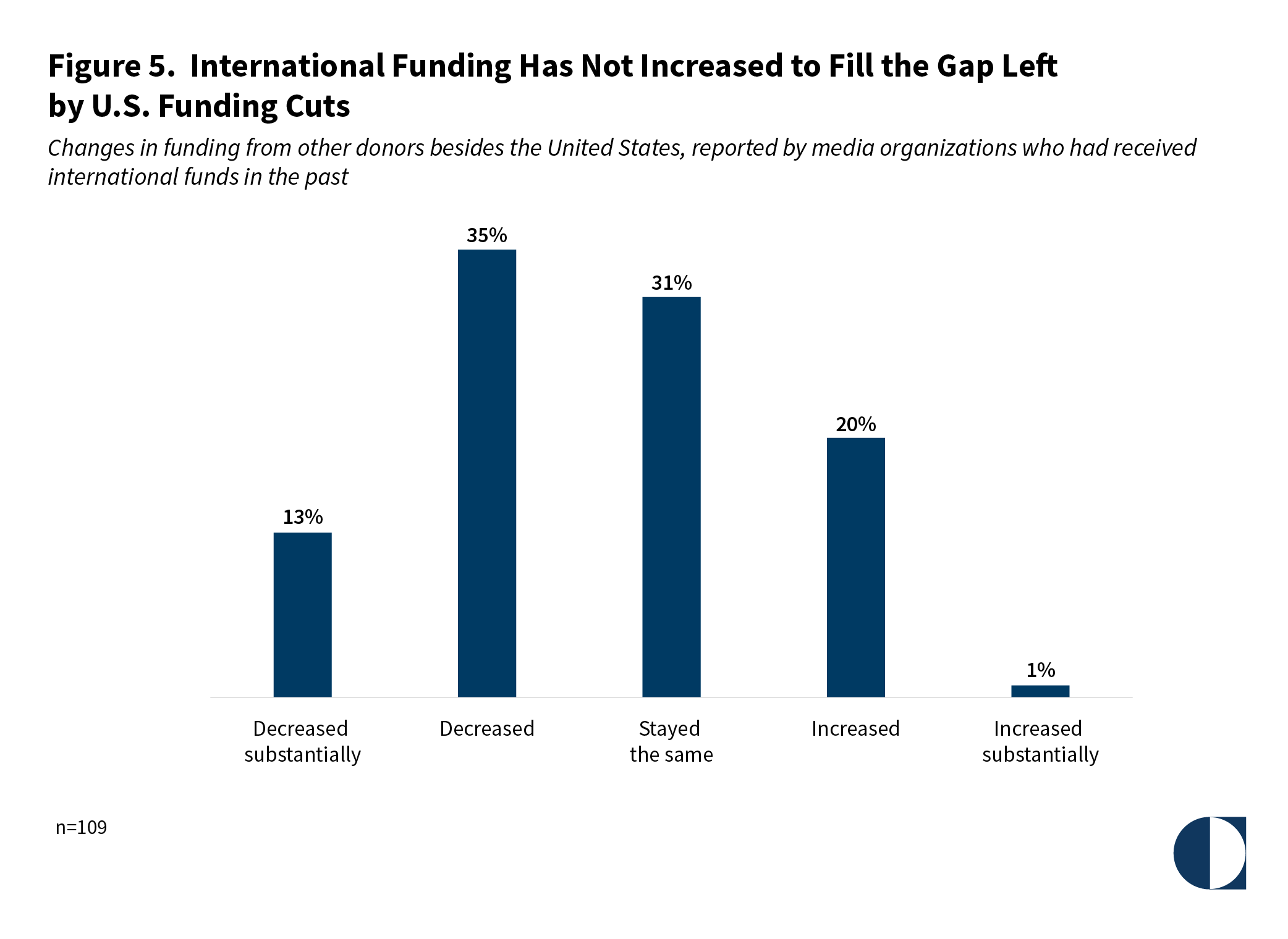
The survey and qualitative interviews suggest that philanthropy has also not increased its support, and only six respondents in the survey reported receiving an increase in funds from philanthropic sources. In fact, overall philanthropic contributions were already down because of changes at the Open Society Foundations (OSF) and a shift by donors to address the crisis in the U.S. media market. The OSF had been supporting media organizations globally for decades, but in 2023 as part of a larger restructuring process, it froze most of its grantmaking to the sector.83 In October 2024, only months before the U.S. termination of assistance, the OSF Board of Directors formally decided not to fund global journalism as a stand-alone initiative. While some journalism funding remains, several interview respondents, particularly in Latin America, argued that they were already reeling from the loss of OSF funding and now had to cope with the loss of the United States as a donor.
Through a 2023 initiative called Press Forward, several other U.S.-based philanthropies concerned about press freedom, including the John D. and Catherine T. MacArthur Foundation and the Knight Foundation, have reoriented their funding to address the crisis of media in the United States. During 2025, OCCRP became a finalist for the MacArthur Foundation Big Bet $100 million grant, raising hopes in the sector. However, the grant went to a non-media initiative instead.
Several respondents stated that they perceived a considerable degree of fear in the philanthropic community, which worried about the Trump administration attacking them and their endowments on spurious accusations. One organization reported receiving a three-year grant in one tranche of funding because the foundation wanted to be able to say that they were not actively funding the grantee.
The future looks bleak for independent media, but there is a robust infrastructure of knowledge, organizations, and people on which to build. There are no shortages of lessons learned both from the successes and failures of past U.S. government–funded programming, and there have been many well-argued and powerful calls to reinvest in strengthening democracy and independent media.84 This research suggests seven important points and areas of promise moving forward.
1. The gap can and still needs to be filled. Despite the odds, many donor-dependent, public interest media organizations have to date managed to hang on, cutting back to minimal staff, reducing content, and burning the candle at both ends to make up for the reduced staff. Nonetheless, many interviewees and survey respondents remained very worried that this was not sustainable and that more organizations will close their doors in the coming year or two. While the full amount of U.S. media development program funding cannot be replaced, it is important to highlight that the much smaller amount of grant money that went directly to media organizations can be. Based on the estimates in this study, this gap could be as low as $31 million annually. It is still vital and not too late for the donor community to step in to save these media organizations, be they exiled media from El Salvador, Myanmar, or Nicaragua; community radio stations in Liberia, Mozambique, or Zambia; small media operations serving local communities in challenging conflict countries such as Ukraine; or operations surviving in increasingly authoritarian countries like the Republic of Georgia, Kyrgyzstan, or Serbia. The need can be met, certainly at a country level, and it is worth matching the enormous investment resilient journalists continue to make every day.
2. Media support cannot be transactional. If there is a political opening for reinitiating U.S. assistance in the future, it is highly unlikely that assistance will be able to pick up where it left off. The institutional infrastructure and human capital that took decades to create cannot be easily rebuilt within the restrictive confines of the State Department. There has been an enormous loss of human capital from implementing partner organizations, and many interviewees for this study remained unemployed at the time of the interview. The United States has also lost much of its political capital in this sector. For example, a former USAID staffer in El Salvador noted that it took a long time to build a relationship with local media and demonstrate that accepting U.S. government funds would not undermine their independence. Organizations had to see and confirm from others’ experiences that USAID was not going to attempt to influence editorial decisions. Now, this interviewee feels that whatever trust was there is gone. While many media organizations are desperate for funds, a transactional America First philosophy would undermine media independence.
3. Future U.S. values-based assistance is needed, but it must overcome an old challenge. If U.S. assistance that values independent media as a means to strengthen democratic governance is rebuilt in a future administration, there is consensus that a higher percentage of funds need to go directly to media organizations.85 This requires that U.S. foreign aid procurement be more agile, quicker, bound by fewer rules, with fewer administrative hoops, and with more streamlined reporting. But as one former USAID staffer noted, he had been involved in discussions about how to do this since 1995, and in some ways nothing had changed. Congressional mandates, federal procurement requirements, USAID’s internal regulations, and risk aversion prevented these changes despite the best intentions of many staff and leaders. Paradoxically, the fear that USAID and its partners, some of whom lacked adequate administrative capacity, would misuse taxpayer dollars was the primary cause of such strict oversight, regulation, and reporting in the first place. The current institutional vacuum presents an opportunity for a grand bargain of less bureaucracy, less overhead, and fewer U.S. intermediaries with more aid going direct to local partners, but it will take creative political and administrative leadership to overcome this fear-of-waste paradox.
4. Journalist organizations remain viable partners. While Internews and IREX were hard hit by the U.S. funding cuts, the far smaller organization of OCCRP (which operated with a budget of $24 million in 2024) was able to attract new funding (replacing roughly 60 percent of what was lost) and to continue its work with far less disruption.86 OCCRP sees itself not as a development organization but as a journalism industry organization. Smaller organizations that are staffed by journalists and more closely tied to the media industry make sense as partners in future U.S. media development assistance.
5. IFPIM offers an alternative model of funding. As noted earlier, nine governments, philanthropic organizations, and corporations have made contributions to the grantmaking institution’s $70 million budget. Many governments, philanthropies, and corporations may want to support independent media abroad, but they worry about the political risks of doing so. They also lack the expertise to give funds to media organizations effectively. A multilateral fund like IFPIM is designed to address both of these issues, insulating donors from specific investments while providing the expertise to grant funds where they can be the most effective. The organization has continued to make the investment case for independent media.87
5. There are also promising country-level and regional journalism funds, including the Fundo de Apoio ao Jornalismo in Brazil. The consortium was organized by the Associação de Jornalismo Digital with initial support from several international foundations, including IFPIM. It had planned to award up to fifteen small grants under $30,000 a year to local journalism in 2025.88 Another example is the Digital News Transformation Fund in South Africa, which is managed by Tshikululu Social Investments and is distinct in that it is funded primarily by Google, in addition to South Africa’s Association of Independent Publishers. Its funds also go to support small, local, independent news publishers in South Africa. With a commitment of around $6 million, at the end of 2025 the fund announced its first round of grants worth around $650,000 to twenty-one independent publishers.89
6. Technology companies remain the elephant in the room. The South African fund is particularly interesting because of the prominent role played by Google. As noted earlier in this paper, large technology companies have come to represent an existential crisis for independent media. In early recognition of this, around 2020, Google and other technology companies expanded and initiated new programs to provide grants, in-kind support, and tools to media organizations. The flagship Google News Initiative was the company’s primary program to support media, and it reported providing over $550 million in funding to over 7,000 partners in 120 countries.90 Despite these impressive numbers, as the political tide has shifted, Google has reduced its support, and its AI tools further reduce traffic to news sites.
AI chatbots and AI overviews radically changed the game for independent media, drying up media traffic from search engines to media sites. At the same time, AI chatbots were trained on public data provided by media organizations without any compensation for what the organizations see as the stolen intellectual property that was used.91 Google, Meta, Microsoft, and OpenAI have all signed deals with large media organizations to partially address these concerns.92 For example, Google signed a deal to pay the Associated Press for news to inform its chatbot Gemini.93 However, we can find no evidence that any compensation has been directed from large technology firms to media organizations in former USAID beneficiary countries.94 Determining how technology firms can systematically compensate media organizations for taking their publications and repackaging them will remain a pending challenge for the future, but as of this writing, compensation for smaller media outlets or those in the Global South is not even on the agenda.
7. Specialized market-based mechanisms offer promise. A final innovative model that offers a continued path forward is the Media Development Investment Fund (MDIF). MDIF was started in 1995 and rather than provide grants to media organizations, it provides loans, equity financing, and business mentoring, arguing that financial independence is a guarantee of editorial independence. Because media organizations typically lack much in the way of physical assets and confront political risk, banks are traditionally unlikely to provide them loans. Through its sectoral expertise, however, MDIF can assess viable investments. MDIF has also taken in donor money, which it uses to guarantee riskier investments or to provide grants to build capacity to better implement business plans (for example, digital sales capacity building). As such, it too has been somewhat impacted by the shrinking funding environment; however, its overall model represents an option for potentially commercially viable media organizations.
The termination of U.S. governmental support to independent media has further hurt an already endangered industry. This includes a decline in the quantity and quality of independent journalism, a reduction in exiled media content and investigative journalism, a decrease in independent media in traditionally underserved areas, an increase in domestic- and foreign-produced disinformation, and the loss of political protection and legal support for media under increasingly authoritarian regimes. This will translate to possible corruption abuses that will not be discovered, officials that will not be held accountable, disinformation that will not be contested, a less informed public and policymaking community, and less fact-based political discussion.
Unfortunately, independent media in many, if not most, parts of the world will likely continue to decline as technological advances eat away at their commercial opportunities and democratic backsliding reduces the space in which they can operate. This is the reality the sector confronts, and global democracy and good governance will suffer because of it. Of course, these forces exist with or without U.S. support for them, but the U.S. government’s reversal to exacerbating rather than constraining player in this domain has taken an extra toll. Moreover, the American people have not gained anything from this dramatic reversal in long-standing policy and expression of American values. With government expenditures rising in 2025 despite the DOGE cuts, the U.S. government has only ceded space to its global competitors and further eroded U.S. standing in the world.
We would like to thank the Carnegie Endowment for International Peace for the support that helped make the research and writing of the paper possible, including the support of Tom Carothers, Haley Clasen, and McKenzie Carrier. We owe an enormous debt to many other people who contributed to this study, including Shannon Maguire, Josh Machleder, Dru Menaker, Ulvi Ismayil, Ivana Bjelic Vucini, Gillian McCormack, Katerina Tsetsura, Dariya Orlova, Jefferson Massah, Claudia Martinez, Teldah Mawarire, Charlene Bangwe, Oxana Iutes, Gerry Porta, Corina Cepoi, Adolores Guimarães, Segio Chusane, Amadou Ba, Francisco Robles Rivera, Rana Sweis, Marius Dragomir, and Jon Temin. The level of cooperation and support we received from so many people throughout this process was incredible, and we are grateful to the many people who shared their time, experiences, and challenges with us.
We conducted sixty-eight qualitative interviews between May and December 2025. Table 1 provides a breakdown of the geographic distribution of the interviews. The country represents the interviewee’s country of focus, not necessarily the country in which they were based. For example, many implementing partner former chiefs of party were no longer living in the country in which they had been working. Table 2 provides a breakdown of interviewees by role.
The survey was conducted between October and December 2025. There were 177 survey responses from forty-two different countries where the United States provided development aid. The survey was available in Arabic, English, French, Portuguese, Russian, Spanish, and Ukrainian.95 While most of these countries only attracted 1–3 respondents, there were some countries where participation was considerably stronger. These included Mozambique (21), Liberia (16), Ukraine (14), Moldova (12), and Philippines (8). Regionally, most respondents were from Africa (42 percent), followed by Europe and Eurasia (30 percent), Asia (13 percent), the Middle East and North Africa (10 percent), and Latin America (5 percent). Most respondents had received U.S. support (81 percent), compared with 19 percent who did not. A 2023 USAID fact sheet (no longer available) stated that USAID supported 700 media organizations globally. If this figure is correct, then the survey attracted 20 percent of total media partners. The survey was promoted through several global networks, including the Global Forum for Media Development, the National Endowment for Democracy, and others. Most of the respondents, however, came to the survey through the networks of implementing partner staff who were still in touch with their former media partners. This was certainly the case for the five countries that had disproportionate representation.
At least geographically, the sample did not appear to be representative of the media in countries where the U.S. provided support. There was a disproportionately low response from Latin America, some countries were overrepresented, and many countries only had a handful of participants. In other ways the sample appeared representative. For example, radio stations in Africa were the most common beneficiary type in the population and in our sample. However, without a better sense of how our sample compares to the larger population, we present unweighted data and where possible focus on the differences between groups within the survey (for example, U.S. partners vs. those that did not receive support).
Additional details about the sample include:

Daniel Sabet
Visiting Fellow, SNF Agora Institute, Johns Hopkins University
Daniel Sabet is a visiting fellow at the SNF Agora Institute at Johns Hopkins University. He was formerly employed in the Bureau for Democracy, Human Rights, and Governance at USAID.
Susan Abbott
Founder and Principal, Cross-Pollinate Consulting
Susan Abbott assisted in data collection and is founder and principal at Cross-Pollinate Consulting. She was formerly employed in the Bureau for Democracy, Human Rights, and Governance at USAID.
Carnegie does not take institutional positions on public policy issues; the views represented herein are those of the author(s) and do not necessarily reflect the views of Carnegie, its staff, or its trustees.
Pashinyan’s pro-European party has been re-elected with a decisive victory. But the pro-Russian opposition could still slow Armenia’s progress toward peace with Azerbaijan and rapprochement with Europe.
Mikayel Zolyan
How did Putin co-opt Russia’s political and economic elites, ensuring no more than fitful resistance to the regime’s war on Ukraine?

Alexandra Prokopenko
By fueling the arguments of both supporters and opponents of Armenian Prime Minister Nikol Pashinyan, Azerbaijan wants to ensure he is re-elected with a weaker mandate.

Bashir Kitachaev
Governments in Estonia, Latvia, and Lithuania want to ensure that a U.S. military withdrawal would not leave them dangerously exposed to a Russian attack.

Sergejs Potapkins
The Russian regime is now visibly motivated by fear.

Alexander Baunov