

Report
Mr. Husain Haqqani, Ashley J. Tellis
{
  "authors": [
    "Husain Haqqani"
  ],
  "type": "legacyinthemedia",
  "centerAffiliationAll": "dc",
  "centers": [
    "Carnegie Endowment for International Peace"
  ],
  "collections": [],
  "englishNewsletterAll": "ctw",
  "nonEnglishNewsletterAll": "",
  "primaryCenter": "Carnegie Endowment for International Peace",
  "programAffiliation": "russia",
  "programs": [
    "Russia and Eurasia"
  ],
  "projects": [],
  "regions": [
    "South Asia",
    "India",
    "Pakistan"
  ],
  "topics": [
    "Security",
    "Nuclear Policy",
    "Nuclear Energy"
  ]
}
REQUIRED IMAGE
Source: Carnegie
Originally appeared in the International Herald Tribune, October 26, 2002
Pakistan's status as a key ally of the United States in the war against terrorism has not protected it from allegations of secretly supplying North Korea with uranium enrichment equipment and technical expertise in exchange for ballistic missile technology.
Pakistan's military ruler, General Pervez Musharraf, described the charge as "absolutely baseless." Secretary of State Colin Powell and National Security Adviser Condoleezza Rice said they believed him, although they refused to say in absolute terms that there had never been Pakistani-North Korean cooperation.
So far, no evidence has surfaced to confirm the allegations, but reports on covert weapons programs are often based on intelligence leaks.
U.S. media reports have suggested that there may have been some exchange of technology under one of Pakistan's shaky civilian regimes that preceded Musharraf.
Most Pakistanis are outraged over the charges that their country periodically faces, ranging from allegations of covert support of terrorists to accusations about Pakistan's nuclear and missile program.
The Pakistani reaction is understandable, but so is the reason why Pakistan is vulnerable to such allegations.
Pakistan is governed in a secretive manner, with its intelligence services and military running affairs in spheres of international concern. Even when the civilians are in charge of government, security policy remains largely in the military's hands.
It is inconceivable, for example, for a civilian government in Pakistan to redefine relations with India or review policies relating to nuclear and missile programs.
The United States takes a benign view of the Pakistani military's covert operations when Pakistan's strategic cooperation is important to America, as with the anti-Soviet resistance in Afghanistan and the current war against Al Qaeda.
But nuclear proliferation and relations with India become sticking points in the U.S.-Pakistan relationship when Islamabad's strategic cooperation becomes less significant.
The reports about Pakistan exchanging nuclear know-how for ballistic missiles with North Korea have come at a time when the United States considers Pakistani support crucial for its anti-terrorism operations, which explains the cautious response by U.S. officials to such allegations.
Once the indispensability of Pakistan wanes, the accusations could become the basis for sanctions against a less compliant regime in Islamabad.
The way to break this cycle is to encourage Pakistan to become an open democracy, with a constitutionally defined power structure.
Then it would be easy to pin responsibility for actions such as training militants or buying and selling technology for weapons of mass destruction.
It is ironic that allegations of the North Korean connection have surfaced so soon after Pakistan's Oct. 10 legislative elections that resulted in a hung Parliament.
Election observers from the European Union rejected the polls as "flawed" and pointed out the many ways in which Musharraf tried to manipulate the election process.
But the United States failed to criticize Musharraf's conduct, just as it ignored the one-sided presidential referendum in April and arbitrary amendments to Pakistan's constitution in July.
As a result, Musharraf and the military will continue to wield effective power while an ineffective Parliament and a weak prime minister will be available to share the blame, though not the real responsibility, for critical decisions of war and peace.
The moral imperative for supporting democracy in Pakistan is important.
But equally important is the need to diminish the military's influence to ensure a more transparent Pakistani foreign policy.
Former Visiting Scholar
Recent Work
Mr. Husain Haqqani, Ashley J. Tellis
Mr. Husain Haqqani
Carnegie does not take institutional positions on public policy issues; the views represented herein are those of the author(s) and do not necessarily reflect the views of Carnegie, its staff, or its trustees.
The Thai-Cambodian conflict highlights the limits to China's peacemaker ambition and the significance of this role on Southeast Asia’s balance of power.

Pongphisoot (Paul) Busbarat

Beijing believes that Washington is overestimating its own leverage and its ability to handle the trade war’s impacts.


Rick Waters, Sheena Chestnut Greitens
Tapping our network of China experts in the region, Carnegie China offers this latest “China Through a Southeast Asian Lens” report to offer preliminary assessments of whether the U.S. effort to reshape the global trading order will lead countries in the region to tilt toward Beijing.



Selina Ho, Khin Khin Kyaw Kyee, Joseph Ching Velasco, …
While China will remain a significant political and economic force in the Global South, its ambition to leverage the Global South as a counterbalance to the United States and the Global North is far from assured.

Xue Gong
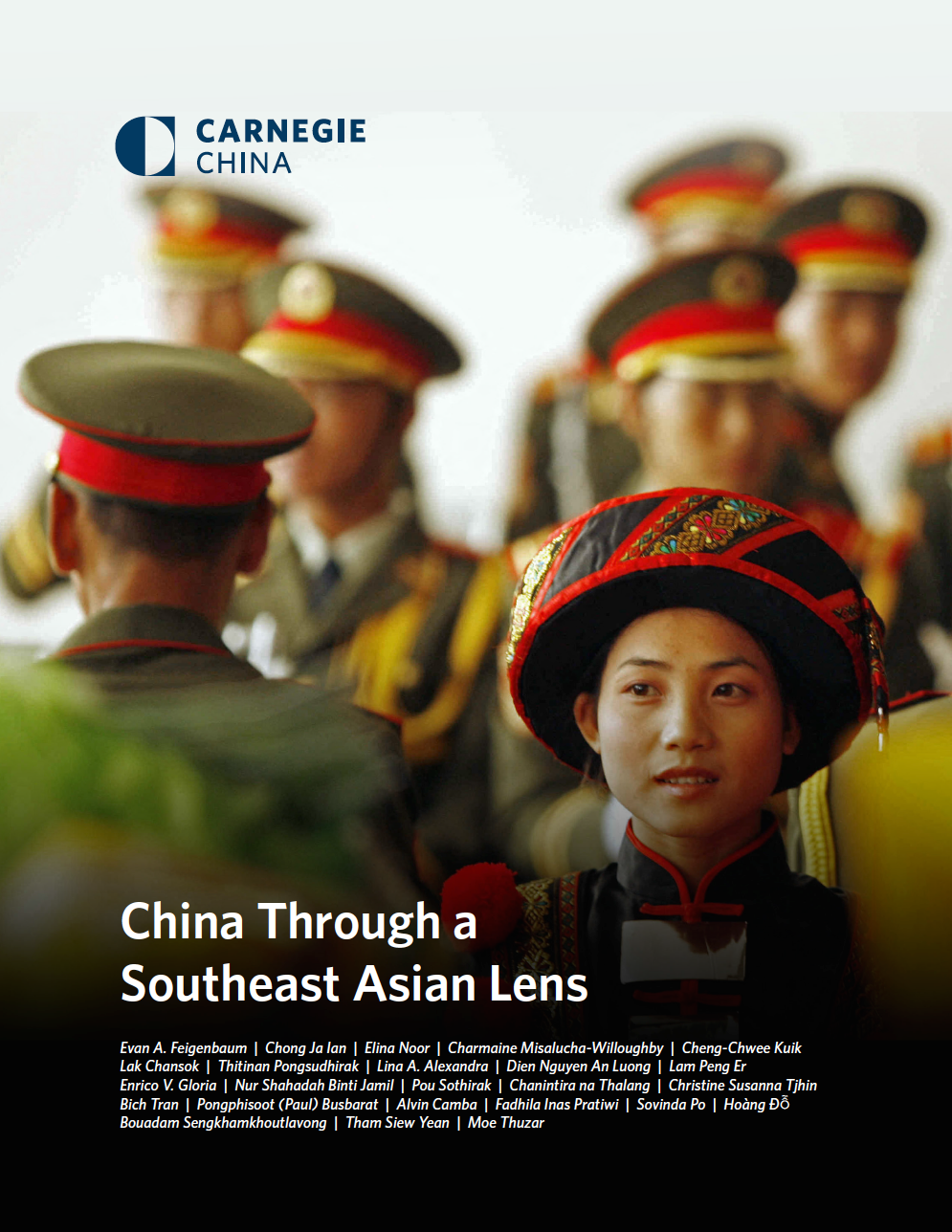
Because strategic, economic, and ideological perceptions of China contain multiple, sometimes contradictory facets in Southeast Asia, receptions of and responses to Beijing diverge across and within state lines.



Evan A. Feigenbaum, Chong Ja Ian, Elina Noor