

Article
Marina Ottaway, Omar Hossino
{
  "authors": [
    "Marina Ottaway"
  ],
  "type": "other",
  "centerAffiliationAll": "dc",
  "centers": [
    "Carnegie Endowment for International Peace",
    "Malcolm H. Kerr Carnegie Middle East Center"
  ],
  "collections": [],
  "englishNewsletterAll": "menaTransitions",
  "nonEnglishNewsletterAll": "",
  "primaryCenter": "Malcolm H. Kerr Carnegie Middle East Center",
  "programAffiliation": "MEP",
  "programs": [
    "Middle East"
  ],
  "projects": [],
  "regions": [
    "Middle East",
    "Iran",
    "Israel",
    "Türkiye",
    "Saudi Arabia",
    "Egypt",
    "Gulf",
    "Levant",
    "Maghreb"
  ],
  "topics": [
    "Political Reform",
    "Security",
    "Foreign Policy"
  ]
}
Source: Getty
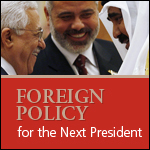
President-elect Obama emphasizes the need for greater diplomacy and a willingness to engage with hostile regimes. This commitment to “return to diplomacy” will not be enough to end the deadlock in the Middle East. Obama should break from traditional U.S. posture and support peace initiatives originating with Arab countries.
During the campaign, President-elect Obama emphasized the need for greater diplomacy and a willingness to engage with hostile regimes. This commitment to “return to diplomacy” will not be enough to break the deadlock in the Middle East. Obama should break from traditional U.S. posture and support peace initiatives originating with Arab countries, urges a new paper by the director of the Carnegie Middle East Program.
Marina Ottaway explains that the United States lacks the legitimacy and capacity to monopolize leadership in the peace process. The new administration should signal its support for three key Arab undertakings: Syrian–Israeli negotiations under Turkish leadership, Hamas–Fatah talks brokered by Egypt, and the Arab–Israeli initiative most recently proposed by Saudi Arabia.
Key Conclusions:
Ottaway concludes:
“The new administration needs to rethink the U.S. role in the politics of the Middle East, abandon the assumption that it must be at the center of every initiative, build on what the regional countries are trying to do, and, in the process, encourage them to take more responsibility. At a time when American solutions appear deadlocked and the new president will have to concentrate his attention on the economy, sharing the burden provides a way forward.”
Former Senior Associate, Middle East Program
Before joining the Endowment, Ottaway carried out research in Africa and in the Middle East for many years and taught at the University of Addis Ababa, the University of Zambia, the American University in Cairo, and the University of the Witwatersrand in South Africa.
Recent Work
Marina Ottaway, Omar Hossino
Marina Ottaway
Carnegie does not take institutional positions on public policy issues; the views represented herein are those of the author(s) and do not necessarily reflect the views of Carnegie, its staff, or its trustees.

China’s political future will be shaped between now and next October. As the Communist Party enters its intense “campaign season” to prepare for a major political transition in 2027, reading Beijing's actions and responses may become more difficult as domestic politics weigh on its behavior more than usual.

Damien Ma

But their "principal to principal" model will only be as effective as the political strength of each leader back home.
Damien Ma

U.S. unpredictability has allowed China to capitalize on its positioning as the “responsible great power”. Paradoxically, the more China wins the perception game, the more likely expectations will rise for Beijing to deliver not just words but to demonstrate with its deeds.

Chong Ja Ian

Hanoi and Beijing have long treated each other as distant cousins rather than comrades in arms. That might be changing as both sides draw closer to hedge against uncertainty and America’s erratic behavior.

Nguyễn Khắc Giang

Across Asia, China is better positioned to withstand energy shocks from the fallout of the Iran war. Its abundant coal capacity can ensure stability in the near term. Yet at the same time, the country’s energy transition away from coal will make it even less vulnerable during the next shock.
Damien Ma