

Paper
Omayma Abdel-Latif
{
  "authors": [
    "Omayma Abdel-Latif"
  ],
  "type": "legacyinthemedia",
  "centerAffiliationAll": "dc",
  "centers": [
    "Carnegie Endowment for International Peace",
    "Malcolm H. Kerr Carnegie Middle East Center"
  ],
  "collections": [],
  "englishNewsletterAll": "menaTransitions",
  "nonEnglishNewsletterAll": "",
  "primaryCenter": "Malcolm H. Kerr Carnegie Middle East Center",
  "programAffiliation": "MEP",
  "programs": [
    "Middle East"
  ],
  "projects": [],
  "regions": [
    "Egypt",
    "North Africa"
  ],
  "topics": [
    "Political Reform"
  ]
}
Source: Getty
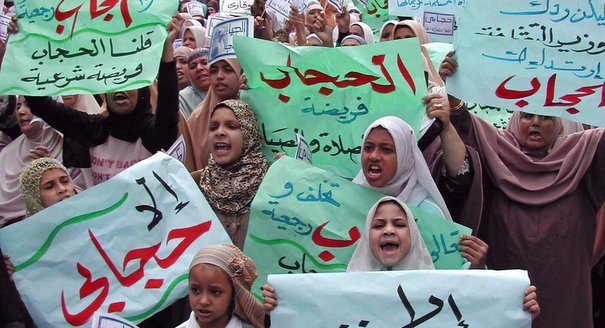
The Muslim Brotherhood’s first women’s division, the Muslim Sisters Group, was created in 1932. Since then, women activists have been at the forefront of the social and political struggle of the Muslim Brotherhood movement in Egypt.
Source: Common Ground News Service

The statement also referred to the “dominating negative social view regarding women” and the need to change it by making society fully aware of women’s rights beyond the right to education, which is widely accepted in Egyptian society.
Two years after this stated vision of gender equality, however, and 85 years after schoolteacher Hassan al Banna founded the Brotherhood in Egypt in 1924, the current status and role of women in the Muslim Brotherhood’s organisational structure remains lacking.
The Muslim Brotherhood’s first women’s division, the Muslim Sisters Group, was created in 1932. Since then, women activists have been at the forefront of the social and political struggle of the Muslim Brotherhood movement in Egypt, which seeks to establish a democratic political system in the country with an Islamic frame of reference.
Women activists advocating for an Islamic political system through the Brotherhood believe that Islam brought justice to women. Their lack of equal rights presently, they insist, has to do more with the cultural, political and social realities in which their movement functions than with the movement itself.
Still, more and more female members of the Muslim Brotherhood are becoming restless about the lack of representation and are seeking ways to increase their numbers in senior positions in the movement itself and, in time, to participate more in the country’s politics. Primarily, these women want a formal consultative position in the Muslim Brotherhood hierarchy.
Fortunately for the Sisters, some of the leading figures in this group of Brotherhood women are daughters and wives of senior Brotherhood leaders.
The daughters of higher-ranking members like Khayrat al-Shater and Essam al-Erayan, for example, are active Sisters. The first of the Brotherhood’s female political candidates, Jihan al-Halafawi, is the wife of Ibrahim al-Zaafarani, a senior member of the Alexandria chapter of the Muslim Brotherhood. Due to these connections, women are making their voices heard despite the lack of an institutionalised mechanism to consult women at the higher levels of power.
Furthermore, a growing number of men in the Brotherhood are now convinced that the current status of women inside the Muslim Brotherhood is a “weak point” that needs to be seriously addressed. The Brotherhood is routinely criticised for its position on women’s issues, especially since it presents itself as liberal with regard to politics yet is perceived as conservative when it comes to women’s issues. The majority of this pro-women group occupies mid-level positions in the movement and is calling for increased women’s leadership within the organisation, as well as a greater number of female Muslim Brotherhood candidates in national elections.
Many refer to this redefining of women’s roles within the movement as a “rebellion of the Sisters”. But members of the Brotherhood consider this call for greater women’s participation normal as the movement evolves over time to accommodate a dynamic constituency and changing political and social factors.
While these women activists have genuine grievances and demand change, they are not willing to sacrifice the movement’s unity and cohesion to obtain increased representation in the Muslim Brotherhood and among political candidates. Many of them strongly feel that it is only a matter of time before they gain these rights. Their institutional loyalties and belief that change is possible, albeit gradually, shape their call for action.
And their calls are being heard. In Egypt’s 2000 parliamentary elections, the Muslim Brotherhood nominated a female candidate, Jihan al-Halafawi, for the first time – mostly due to pressures exerted by many of the Sisters. Although the government eventually ensured her defeat (for being a Brotherhood candidate, not for gender reasons) by rigging the vote, harassing her supporters and arresting her husband and campaign manager, Al-Halafawi had a strong backing from the public. And while neither of the two women candidates (including Makarem al-Deeri in 2005) nominated by the Muslim Brotherhood have been elected thus far, their popularity and support still set an important precedent.
A conservative culture in the Brotherhood, coupled with an oppressive socio-political context – which the movement sometimes appears to mirror – is why women in the Brotherhood fail to acquire adequate representation reflective of their contribution to the movement’s political struggle.
Integrating women in the Brotherhood’s organisational structure will help alter the perception that it is as patriarchal and undemocratic as the regime it challenges. It will also give recognition to the central role played by women in the movement’s social and political struggles.
The question now is whether the emergence of a young generation of activists – men and women alike – will ultimately generate a new political force which could prove crucial to the Muslim Brotherhood as a whole, indirectly affecting the social and political culture in Egypt.
Former Research and Program Associate, Middle East Center
Abdel-Latif, formerly the assistant editor-in-chief at Al-Ahram Weekly, has done extensive work on Islamist movements with special emphasis on the Muslim Brotherhood of Egypt.
Recent Work
Omayma Abdel-Latif
Omayma Abdel-Latif
Carnegie does not take institutional positions on public policy issues; the views represented herein are those of the author(s) and do not necessarily reflect the views of Carnegie, its staff, or its trustees.
Transactional relationships are stable but can be shallow.



Paul Haenle, Maha Yahya, Benjamin Ho, …
It’s about managing oil prices, bread prices, and strategic partnerships.



Amr Hamzawy, Karim Sadjadpour, Aaron David Miller, …
The murder of George Floyd has underscored the deep inequities that have long plagued American society. In a note to the Carnegie community, Bill Burns reflects on Carnegie’s commitment to build a more just future here at home and around the world, without which peace will remain beyond our grasp.

William J. Burns

While the world hoped this pandemic might lead to more cooperation between these two great powers, American and Chinese leaders instead fell into a blame game and allowed their increasing suspicions to guide their decision-making.
Lyu Jinghua

Biological viruses and computer malware differ in important respects. They have considerable potential to spread widely, invading, disrupting and destroying their targets.

Ariel (Eli) Levite, Lyu Jinghua