

In The Media
Jessica Tuchman Mathews
{
  "authors": [
    "Jessica Tuchman Mathews"
  ],
  "type": "legacyinthemedia",
  "centerAffiliationAll": "",
  "centers": [
    "Carnegie Endowment for International Peace",
    "Malcolm H. Kerr Carnegie Middle East Center",
    "Carnegie Russia Eurasia Center"
  ],
  "collections": [],
  "englishNewsletterAll": "",
  "nonEnglishNewsletterAll": "",
  "primaryCenter": "Carnegie Endowment for International Peace",
  "programAffiliation": "",
  "programs": [],
  "projects": [],
  "regions": [
    "North America",
    "United States",
    "Egypt",
    "Gulf",
    "Levant",
    "Maghreb"
  ],
  "topics": [
    "Political Reform",
    "Economy",
    "Climate Change",
    "Security",
    "Military",
    "Foreign Policy",
    "Nuclear Policy"
  ]
}
Source: Getty
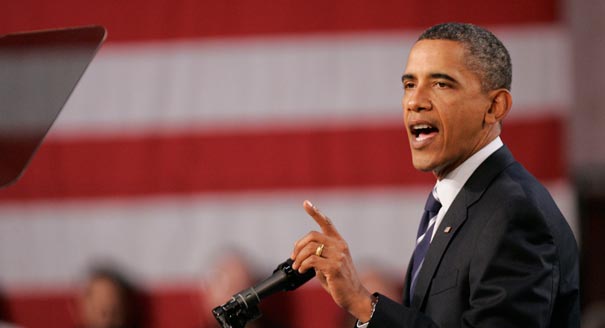
President Obama has had some major accomplishments in the past year, but serious challenges still lay ahead: strengthening the nonproliferation regime, climate change, Israeli-Palestinian conflict, Iran, and Afghanistan.
Source: The American Interest

Daunting as this list is, Obama also needed to reverse the distrust, anger or outright fear with which most of the world saw U.S. policies at the close of the Bush Administration. This was not a feel-good matter, but a hard-headed prerequisite to solving the geopolitical challenges. Iran could not be made to feel isolated because of its nuclear activities, for example, so long as the majority of countries felt, as they did last January, that Washington’s policies were a greater threat to international security than Tehran’s.
On this necessary first step, one can give the President an unequivocal “A”, and that is no small matter. Obama’s ear has been faultless, and his ability to command the world’s attention through words extraordinary. From his campaign address in Berlin to the path-breaking nuclear policy speech in Prague to the high risk venture in Cairo and the Nowruz message to Iran, the President succeeded in a remarkably short time in turning from dark to light how the world sees the United States.
It has not been just words, of course. The decision to set an aggressive deadline for closing the Guantánamo Bay prison and to unequivocally denounce and renounce torture were essential factors. One year on, people and governments across the globe (with the notable exception of Israel), see the United States as a trustworthy country, capable of understanding their problems and of acting out of more than narrow self-interest. This is true even when there is disagreement on major issues. If this were a poker game, Uncle Sam now sits with a large pile of chips in front of him that he didn’t have before. He may still lose some big hands, but the odds have shifted importantly in his favor.
On the short list of issues on which it is not too soon to reach a judgment are three other notable accomplishments: the decision to decisively end U.S. involvement in Iraq, with the deadline to remove combat brigades by August 2010; turning around the tone and direction of U.S.-Russian relations; and the achievement of urgent, internationally aligned responses to the financial crisis and establishment of the G-20 as a badly needed new instrument for such cooperation, bringing to the table economic powerhouses excluded from the G-8. Violence may yet tear Iraq apart, but the U.S. presence was and is delaying the struggle for power that always follows a government’s overthrow, whether by revolution or external force. Waiting another year and a half until leaving (by the Bush Administration’s deadline of the end of 2011) would merely delay the inevitable at greater cost to the U.S. treasury and its heavily stressed military forces, and run a greater risk of trouble from Iraqi impatience for a return to full sovereignty.
It remains to be seen how the U.S.-Russia relationship will evolve—especially whether Moscow will do what it must do vis-à-vis Iran to retain credibility as a responsible international actor. But there is a working relationship now, whereas a year ago there was a broken shell exuding mistrust. Obama’s wise decision to reverse the Bush policy on missile defense in Poland and the Czech Republic cemented earlier steps to re-establish constructive relations. Strategic arms control negotiations have resumed, Russia has agreed to allow thousands of annual U.S. overflights for delivering materiel to Afghanistan, and the Russian co-presidency has suggested that it might support sanctions if Iran continues its march toward nuclear weapons. Unfortunately, Moscow has also said the opposite, so that Tehran is unsure whether it can or can’t continue to rely on Russian support. If Moscow ever makes a clear choice, we will know it not from public statements, but from Tehran’s behavior.
All this is a solid record of achievement for a year marked by economic crisis and an escalating war, but it pales in comparison to the challenges that remain. The U.S. down payment for badly needed agreements to strengthen the nonproliferation regime is ratification of the Comprehensive Test Ban Treaty. Though the President promised to act “aggressively” on the treaty, his Administration seems to have decided to wait until after the Senate deals with the strategic arms treaty. That choice risks failure at the NPT Review Conference in May and the possibility that Senate action will have to wait until after the midterm elections, when it will likely be even harder to round up 67 votes.
Lack of Senate action also threatens failure at the Copenhagen meeting on climate change. While Mr. Obama made cutting carbon emissions a priority, he knows that to agree to specifics before Congress acts is to risk rejection of whatever he agrees to. Yet to be unable to talk specifics on emission cuts and dollars in Copenhagen raises the likelihood that the talks will fail and that the United States will be blamed for it. One could argue that the President took on more than the Senate could bear (even without counting health care reform), but on these two issues he could not have done less.
That leaves the Israeli-Palestinian conflict, Iran and Afghanistan—the war that could gobble up the Obama presidency. Mr. Obama rightly laid down the gauntlet on continuing Israeli settlement activity. Months later, he has nothing to show for that politically costly but necessary and courageous step. If he backs down on this, any chance of progress on this conflict, and on much else in the Middle East during his Administration, is likely gone. On Iran, Obama has also gone a long way toward reversing the world’s view of whether Washington or Tehran has the better argument in its favor on the crucial nuclear issue. But, by drastically undermining Tehran’s narrative of the United States as Great Satan, Obama threatens the mullahs who, after last June’s elections, need America as an adversary more than ever. They will do all they can to keep us in that box. The odds are long, but if Obama can continue to extend a rational, open hand, succeed in making Iran’s prevarication and delay clear to all, and bring Russia to work with the West, then he still stands some chance of success.
The gravest mistake of the year may actually have been made in 2008, when candidate Obama committed himself so deeply to the war in Afghanistan. President Obama then lost precious months by failing to ask fundamental questions about the war during his early policy review and then staying with a strategy that was demonstrably not working. All of those questions were posed during the fall’s far more serious review. How they are answered—which should be known when this article appears—will likely determine how history will treat this presidency.
This article was originally published in The American Interest.

Distinguished Fellow
Mathews is a distinguished fellow at the Carnegie Endowment for International Peace. She served as Carnegie’s president for 18 years.
Recent Work
Jessica Tuchman Mathews
Jessica Tuchman Mathews
Carnegie does not take institutional positions on public policy issues; the views represented herein are those of the author(s) and do not necessarily reflect the views of Carnegie, its staff, or its trustees.

The nuclear relationship between China and the United States is increasingly shaped by widening perception gaps rather than deliberate strategic design.

Tong Zhao

China’s banking crisis in the 2000s was resolved by transferring the costs to households through financial repression—a decision that recapitalized the banks while exacerbating the structural imbalances that continue to shape the Chinese economy today.

Michael Pettis

But their "principal to principal" model will only be as effective as the political strength of each leader back home.

Damien Ma

U.S. unpredictability has allowed China to capitalize on its positioning as the “responsible great power”. Paradoxically, the more China wins the perception game, the more likely expectations will rise for Beijing to deliver not just words but to demonstrate with its deeds.

Chong Ja Ian

Hanoi and Beijing have long treated each other as distant cousins rather than comrades in arms. That might be changing as both sides draw closer to hedge against uncertainty and America’s erratic behavior.

Nguyễn Khắc Giang