

Paper
Ashley J. Tellis
{
  "authors": [
    "Ashley J. Tellis"
  ],
  "type": "legacyinthemedia",
  "centerAffiliationAll": "dc",
  "centers": [
    "Carnegie Endowment for International Peace"
  ],
  "collections": [],
  "englishNewsletterAll": "ctw",
  "nonEnglishNewsletterAll": "",
  "primaryCenter": "Carnegie Endowment for International Peace",
  "programAffiliation": "SAP",
  "programs": [
    "South Asia"
  ],
  "projects": [],
  "regions": [
    "North America",
    "United States",
    "South Asia",
    "Afghanistan",
    "Pakistan"
  ],
  "topics": [
    "Security",
    "Foreign Policy"
  ]
}
Source: Getty
The United States should expand its military supply network for Afghanistan beyond Pakistan, so that it has the option of making further military aid contingent on Islamabad ceasing support for militant groups in Afghanistan.
Source: Foreign Policy

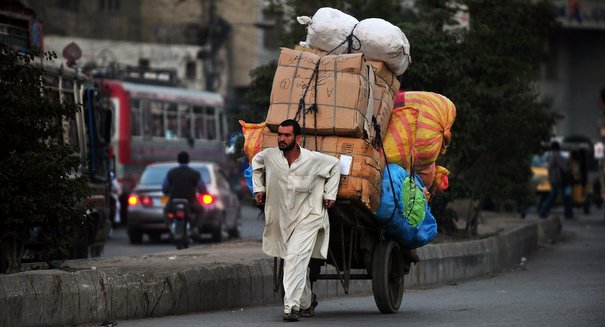
Yet both the Bush and Obama administrations have tolerated Pakistan's duplicity with regard to counterterrorism, primarily because the country remains the principal artery for transporting U.S. cargo -- food, water, vehicles -- and fuel delivered to Afghanistan. And, as the recent border closings by Pakistani forces have shown, the Obama administration must implement a Plan B that denies Pakistan the ability to hold the coalition at ransom: It must begin by planning to move larger quantities of supplies through the northern distribution network that runs from Georgia through Azerbaijan, to Kazakhstan, and then Uzbekistan to Afghanistan. Although U.S. forces now receive more supplies through this route than they did before, the dependence on Pakistan is still substantial -- and so consequently is Islamabad's capacity for blackmail.
As a complement to increasing reliance on the northern route, U.S. assistance to Pakistan (totaling roughly $18 billion in civilian and military aid since 9/11) should be tacitly conditioned on Islamabad's meeting certain counterterrorism benchmarks. For starters, all transfers of major military equipment to Islamabad should be contingent on Pakistan ceasing support for militant groups that threaten coalition and national forces in Afghanistan. More extreme (and hopefully unnecessary) options would include expanded drone and air-power operations inside Pakistani airspace. Or -- and this is certain to catch Islamabad's attention -- more open support for Indian contributions to Afghan stability.
The most important problem is that suddenly challenging Pakistan after a decade of acquiescence to its mendacity is tantamount to abruptly changing the rules of a game that Washington and Islamabad have gotten used to: It could result in even greater Pakistani obduracy and further support for its jihadi proxies. Although that is certainly an unpalatable possibility, the bitter truth is that the current state of affairs -- in which Washington indefinitely subsidizes Islamabad's sustenance of U.S. enemies -- poses far greater dangers to the United States. The Obama administration must make the difficult choice now and show Islamabad that the rules of the game have changed.
Former Senior Fellow
Ashley J. Tellis was a senior fellow at the Carnegie Endowment for International Peace.
Recent Work
Ashley J. Tellis
Ashley J. Tellis
Carnegie does not take institutional positions on public policy issues; the views represented herein are those of the author(s) and do not necessarily reflect the views of Carnegie, its staff, or its trustees.

But their "principal to principal" model will only be as effective as the political strength of each leader back home.

Damien Ma

U.S. unpredictability has allowed China to capitalize on its positioning as the “responsible great power”. Paradoxically, the more China wins the perception game, the more likely expectations will rise for Beijing to deliver not just words but to demonstrate with its deeds.

Chong Ja Ian

Hanoi and Beijing have long treated each other as distant cousins rather than comrades in arms. That might be changing as both sides draw closer to hedge against uncertainty and America’s erratic behavior.

Nguyễn Khắc Giang

Across Asia, China is better positioned to withstand energy shocks from the fallout of the Iran war. Its abundant coal capacity can ensure stability in the near term. Yet at the same time, the country’s energy transition away from coal will make it even less vulnerable during the next shock.
Damien Ma

Malaysia’s chairmanship sought to fend off short-term challenges while laying the groundwork for minimizing ASEAN’s longer-term exposure to external stresses.

Elina Noor