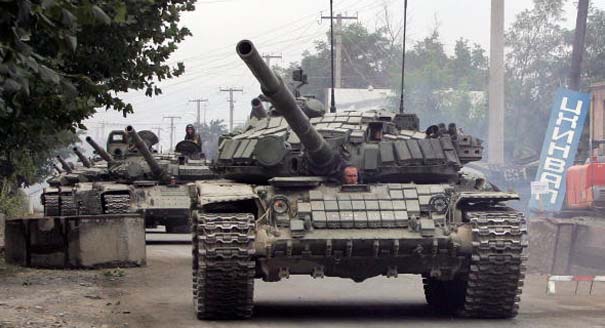
Popular depictions of the 2008 Georgian-Russian conflict over South Ossetia have served primarily to obscure what really happened and undermine any potential opportunity for the two sides to come to a rapprochement.
Distorting the Russian-Georgian WarThe Georgian-Russian conflict over South Ossetia occurred only three years ago, but already it is becoming as mythologized as the Trojan War. Mythical retelling is obscuring what really happened—and that will make it harder for the two sides to make up when the wheel of history turns again and gives them a chance for rapprochement.
Every month that goes by adds more obfuscation. I was not expecting balance in Dick Cheney’s account of the conflict in his memoir In My Time. You get the drift when he writes about imposing a freedom agenda on the Russians: “In the end, we need to make clear to the Russians and our friends and allies that we will be aggressive in expanding the borders of the free world and that the Russian government has to make a choice.” But I would have expected that the former vice president had decent fact-checkers. Cheney writes that Abkhazia and South Ossetia had “large Russian populations.” Not so; it was merely Abkhaz and Ossetians who took Russian passports. He also states that “In August [2008] South Ossetian forces under the command of Russian commanders, fired on Georgian villages in South Ossetia.” Again this is wrong: there were skirmishes between Georgian and Ossetian villages, but Russian peacekeeping forces did not take part in the fighting before the Georgian offensive began on August 8.
On the Russian side the latest salvo in the post-war reckoning comes from the state film fund, which has just announced that it is spending 250 million rubles (about nine million dollars) on a new blockbuster entitled August ’08.
This is an obvious riposte to Hollywood’s version of the conflict, 5 Days of War, directed by Renny Harlin, more famous for having made Die Hard 2, which aired to tiny audiences in Washington, DC last month. Having gone to see it (for professional reasons), I can confirm that it’s as bad as you heard. The movie combines lots of bombs and exploding cars with beautiful Georgian landscapes, dodgy accents (though Andy Garcia puts in a credible impersonation of Mikheil Saakashvili) and outrageous distortions of reality. The scene of Russian jets deliberately turning a Georgian wedding from celebration into bloody carnage crudely combines folkloric Georgian footage with action-movie gore.
The premise of the Georgian-financed Harlin film is that Russia invaded Georgia but nobody in the West noticed. The brave journalist and his beautiful Georgian companion spend the entire movie trying to dodge wicked Russian killers in order to get a precious memory card showing the wedding massacre out to the world. The cheekiest notion is that the Western media was apparently only interested in the Russian version of events. We see only five Western journalists covering the war, and when our embattled hero rings in, his producer says there is no interest (while an interview with Vladimir Putin on CNN plays in the background). No glimmer here of John McCain’s “We are all Georgians” and the massive pro-Georgian response of large parts of the Western media. Human Rights Watch has not surprisingly objected to the way it is cited as a source for a heavily biased version of reality.
After seeing Hollywood-meets-Georgia I took a look online at Russia’s first cinematic attempt at depicting the war, Olimypius Inferno. Strangely enough, it has precisely the same plot as 5 Days of War, but in mirror image. An American entomologist (a slightly more original touch at least) goes to South Ossetia to film a rare butterfly but instead catches the start of the Georgian offensive on Tskhinvali, carried out with U.S. support, on his night camera. But the whole world believes that it was Russia who started the war! He and his Russian girlfriend, a journalist, want to get the truth out to the world. They run through scenes of carnage as wicked Georgian soldiers wantonly kill Ossetian civilians and try to seize their memory card.
The similarities are striking, down to the personification of evil in a sadistic Russian/Georgian soldier on each side. It’s a fascinating that the Russian movie also casts an American as the legitimator of truth for the world, even as it portrays the Americans as plotting the war against Russia.
Naturally, neither movie conveys anything of the real complexity of the conflict in which, as we know now, the Georgian side attacked first and then Russia responded with great brutality. The competing Russian-Georgian cinematic versions of reality will doubtless be fruitful material for a PhD student in cultural studies. But we are still waiting for a version of August 2008 that does justice to the political realities of what happened and honors the victims on both sides of the conflict.
Carnegie does not take institutional positions on public policy issues; the views represented herein are those of the author(s) and do not necessarily reflect the views of Carnegie, its staff, or its trustees.
U.S. unpredictability has allowed China to capitalize on its positioning as the “responsible great power”. Paradoxically, the more China wins the perception game, the more likely expectations will rise for Beijing to deliver not just words but to demonstrate with its deeds.
Hanoi and Beijing have long treated each other as distant cousins rather than comrades in arms. That might be changing as both sides draw closer to hedge against uncertainty and America’s erratic behavior.
Across Asia, China is better positioned to withstand energy shocks from the fallout of the Iran war. Its abundant coal capacity can ensure stability in the near term. Yet at the same time, the country’s energy transition away from coal will make it even less vulnerable during the next shock.
Malaysia’s chairmanship sought to fend off short-term challenges while laying the groundwork for minimizing ASEAN’s longer-term exposure to external stresses.