Source: NPR's All Things Considered
ROBERT SIEGEL, HOST:
This is ALL THINGS CONSIDERED from NPR News. I'm Robert Siegel. The U.S. and Iran are on a collision course. Washington says it intends to prevent Iran from developing nuclear weapons. Iran denies it's doing that. But the International Atomic Energy Agency reported last month that it has serious concerns that Iran's nuclear program has a military side, and that Iran is not cooperating enough with the agency's inspectors. With the U.S. and Europe both on the verge of tighter sanctions against Iran, the Iranians this week conducted naval exercises in the Persian Gulf and warned that in response to more sanctions Iran would close off the Strait of Hormuz, the gateway to the Gulf, through which 20 percent of the world's oil passes. Here's Iranian Navy chief Habibollah Sayari, as translated by Reuters.
REAR ADMIRAL HABIBOLLAH SAYYARI: (Through Translator) Today, closing the Strait of Hormuz for Iran's armed forces is really easy, or as the Iranians say, it will be easier than drinking a glass of water.
SIEGEL: In Washington, State Department spokeswoman Victoria Nuland was asked about that.
VICTORIA NULAND: Well, I can't get inside Iranian heads. I wouldn't want to even if it were appropriate from this podium. But, you know, we've seen quite a bit of irrational behavior from Iran recently. One could only guess that the international sanctions are beginning to feel the pinch, and that the ratcheting up of pressure, particularly on their oil sector, is pinching in a way that is causing them to lash out.
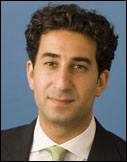
SIEGEL: Meanwhile, Washington yesterday announced a $30 billion arms sale to Saudi Arabia, and the State Department acknowledged, under questioning, that one of Saudi Arabia's security concerns is Iran. Joining us now is Karim Sadjadpour, Iran analyst at the Carnegie Endowment for International Peace. Welcome back.
KARIM SADJADPOUR: Thank you, Robert.
SIEGEL: The Obama administration says it still hopes for a diplomatic outcome to this conflict, but it's warned Iran not to underestimate U.S. military resolve. How might an attack on Iran or a war with Iran be averted?
SADJADPOUR: It's a difficult question, Robert, because over the last several months, we've been going more and more in the direction of some type of a conflict, if not a hot conflict, certainly a cold conflict. I think the strategy of the Obama administration is to exact enough pressure on Iran to get it to make meaningful nuclear compromises. I think the logic from the Iranian end, however, is that the more they actually push on the nuclear issue and if they were to in fact acquire a nuclear capability or a nuclear weapon, the more protection it would offer them from outside pressure.
SIEGEL: Well, in that case, your reading of what Iran's response to all this would be is quite different from what State Department spokeswoman Nuland was suggesting, that Iranian behavior might be responsive to sanctions. You're saying the response would be push ahead, finish those weapons fast.
SADJADPOUR: Historically, the modus operandi of Iran's supreme leader, Ayatollah Ali Khamenei, is that when you're being pressured never compromise, because compromise will project weakness and invite even more pressure. That said, the country is arguably more isolated than it's ever been. If the sanctions against Iran's central bank are implemented, which they stand to be in the coming weeks, it's going to be extremely difficult for Iran to continue to get its oil out to the global markets.
All that said, I think there's a couple of things which are important to recognize. One is that when oil prices are over 80, 90, $100 a barrel, Iran can continue to muddle through. The second point is that Iranian officials since the 1979 revolution have long been willing to subject their population to pretty severe economic hardship rather than compromise on their own political and ideological aims.
SIEGEL: There have been explosions near an Iranian missile site, attacks on Iranian scientists. A U.S. drone was lost over Iran. Some people say the U.S., Britain, Israel are currently waging a quiet covert war against Iran. Is that true?
SADJADPOUR: I think we're certainly doing everything in our power covertly to try to either prevent Iran's acquisition of a nuclear weapons capability or delay their acquisition of a nuclear weapons capability as much as possible. And I think from the vantage point of the Obama administration what they certainly don't want to do is to embark on a military attack on Iran without existing all other possibilities.
SIEGEL: Well, a new year is about to begin. You, Karim, in your view, what do you think the likelihood is that in 2012 there will be an all-out attack on Iran?
SADJADPOUR: If we were having this conversation two months ago, I would have said it's closer to zero. It's - the likelihood is not high. I would say 10, 15 percent. I now believe the likelihood is closer to 50 percent than it is to zero percent. I think that there's even a sense among U.S. officials asking themselves the question whether Iran is actually trying to provoke a military attack on itself in order to repair its internal fissures, both amongst political elites and between the population and the regime.
But I have to say that in an election year, I'm not sure if a military attack on Iran would be at all beneficial to the Obama administration because certainly a result of it would be skyrocketing oil prices. And these days, in 2012, I think overwhelmingly this election is going to be about the domestic American economy, not foreign policy.
SIEGEL: Karim Sadjadpour of the Carnegie Endowment, thanks a lot for talking with us.
SADJADPOUR: Thank you, Robert.
This transcript was originally published on NPR.